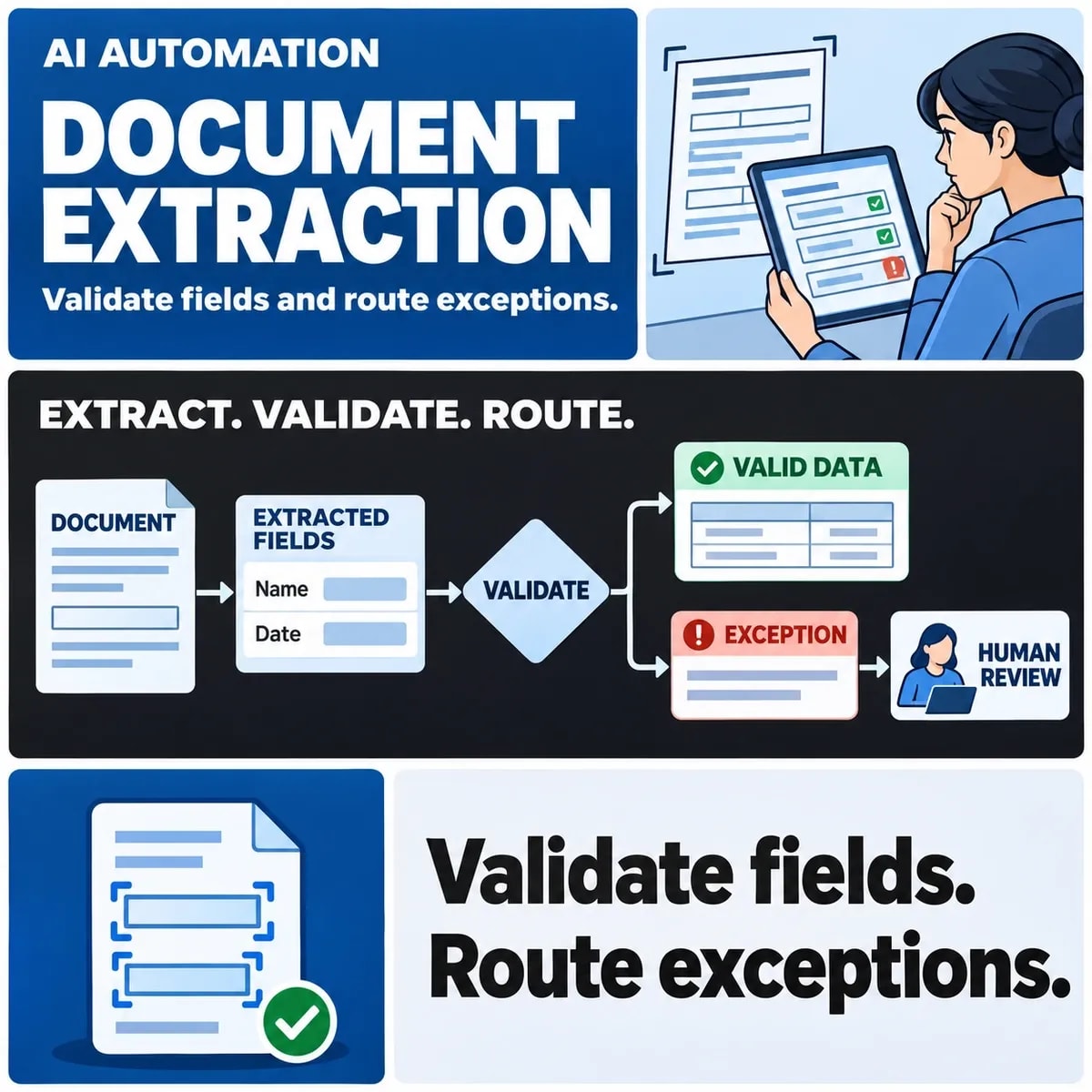

AI document extraction should produce candidate values that are checked before they enter a business system. Define the required fields, acceptable formats, relationships between values and the exceptions a person must review. A confidence score is one signal; it is not a substitute for deciding whether the value is suitable for the intended operation.
The useful scope is the whole route from source document to accepted record. It includes unreadable files, missing information, uncertain matches and the time people spend resolving them. An extraction demonstration that shows only clean documents leaves much of that workload undefined.
Define which fields may enter the business system
Start with the receiving process. List the values it needs, what each means and which owner can approve its use. A document reference, an account identifier and a date can all be recognisable text while still being wrong for the destination field.
Compare this bounded workflow with other business automation opportunities rather than treating every document as equally suitable.
Distinguish required information from information that is merely convenient to collect. If a field is absent from the source, decide whether the record must wait, whether another authorised source can supply it or whether the business process permits an explicit missing value.
Identify the document population too. Different layouts, scans, languages and revisions may need different treatment. A successful example from one layout does not establish performance across every file the organisation receives.
Microsoft's Document Intelligence transparency guidance describes limitations relevant to extraction and responsible use. Use that context to plan validation and human review, rather than claiming that any extraction service will achieve a universal accuracy level.
For each field, record where the reviewer can find the original evidence. A cropped value alone may hide a heading or note that changes its meaning. The review process should provide enough context to make the decision without unnecessarily exposing the entire document to every operator.
Separate extraction from validation
Extraction asks what text or value a system identified. Validation asks whether that candidate meets the requirements of the receiving process. Normalisation, such as converting a date into a standard representation, is another step and can introduce its own ambiguity.
A date may look valid while referring to the wrong event. An account code may have the right format while belonging to a different organisation. Keep these failures separate so the team can correct the appropriate rule rather than simply changing a confidence threshold.
If the extractor provides confidence, understand its documented meaning and scope. Do not assume that scores from different fields, models or document types are directly comparable. Agree how any threshold will be assessed against representative examples and the consequences of an incorrect value.
A low-confidence value is not automatically wrong, and a high-confidence value is not automatically appropriate. Human review and business rules should be designed around the field's purpose, including the cost of allowing a wrong value into a downstream action.
Use field and cross-field checks deliberately
Field checks can examine presence, accepted format, allowed values and reference matching. Specify the response to each failure. “Invalid” is less useful than “required date absent: route to the document review queue”.
Cross-field checks examine relationships. In a fictional order document, line quantities and unit values may need to support the stated total under the organisation's agreed rules. A discrepancy should be explained or reviewed rather than silently corrected to make the record balance.
Sensible's validation documentation illustrates using rules to flag extracted values and results. The particular checks still need to come from the buyer's process; a vendor feature does not decide which business exceptions are acceptable.
Be careful with apparently obvious transformations. A decimal separator, date order or unit label may change the value materially. Preserve the original representation and record the transformation so a reviewer can trace the accepted result.
Define how rules interact. If a required identifier is missing, a later reference lookup may be impossible rather than independently failed. A clear reason hierarchy helps avoid creating several confusing review tasks for one underlying problem.
Route exceptions with useful evidence
An exception record should identify the source, affected field, extracted value, rule that failed and required decision. Give it a status and owner. A queue with no accountable team is simply a slower way of losing work.
Include exception evidence and correction records in the AI software requirements before implementation.
Separate technical problems from business questions. An unreadable file may require a new copy; an unknown supplier reference may require a data-owner decision. Re-running extraction repeatedly will not resolve every missing business relationship.
Decide what reviewers may change and what needs additional approval. Retain the correction and its evidence rather than overwriting the candidate value without explanation. The accepted record should be distinguishable from the unreviewed extraction.
Also plan duplicate submissions. A clearer replacement scan may refer to the same underlying document, while a revised document may legitimately supersede it. Identify that relationship before downstream records are created twice or an earlier version remains active unnoticed.
Work through a document exception record
The following fictional review record illustrates decision types. It is not a measured extraction result or a financial processing specification.
| Situation | Decision | Evidence for review |
|---|---|---|
| A required reference is absent | Hold the record; do not invent a value | Relevant source area and missing-field reason |
| A formatted date conflicts with the source context | Review its meaning before acceptance | Candidate value, original text and field definition |
| Line values do not support the stated total | Apply the agreed discrepancy rule | Relevant values, transformations and discrepancy |
| A reviewer supplies a correction | Record who changed what and whether approval is complete | Original candidate, corrected value and supporting source |
Follow one case through to closure. If a new document arrives, specify whether it replaces the old evidence, creates a linked revision or requires a fresh review. If the business decides to accept an exception, retain that decision separately from a successful validation result.
Make the downstream handoff explicit. The receiving system should get the accepted values and appropriate references through its agreed contract. An extraction job completing successfully should not silently mean that all records are approved for use.
Use a paired fictional document to review normalisation: both contain the same-looking date string, but their headings identify different date meanings. Ask the reviewer to trace each accepted value to its intended destination field. If the workflow cannot show that relationship, improving character recognition alone will not fix the problem. Keep the case with the field definition so a later layout change does not silently alter what the extracted date represents.
Scope automation around the review workload
Use a representative, controlled sample to understand the kinds of exceptions the process must support. Record document coverage and review effort alongside the values extracted. Do not extrapolate an attractive demonstration into an unsupported automation percentage.
Agree who maintains rules when forms, source layouts or business requirements change. Keep previously difficult cases as regression examples and review which changes require renewed acceptance. The result should be an operable document workflow, with visible limits and a clear route for uncertain records.
Discuss validation rules and reviewer ownership for document workflow automation with ZakCodeX.