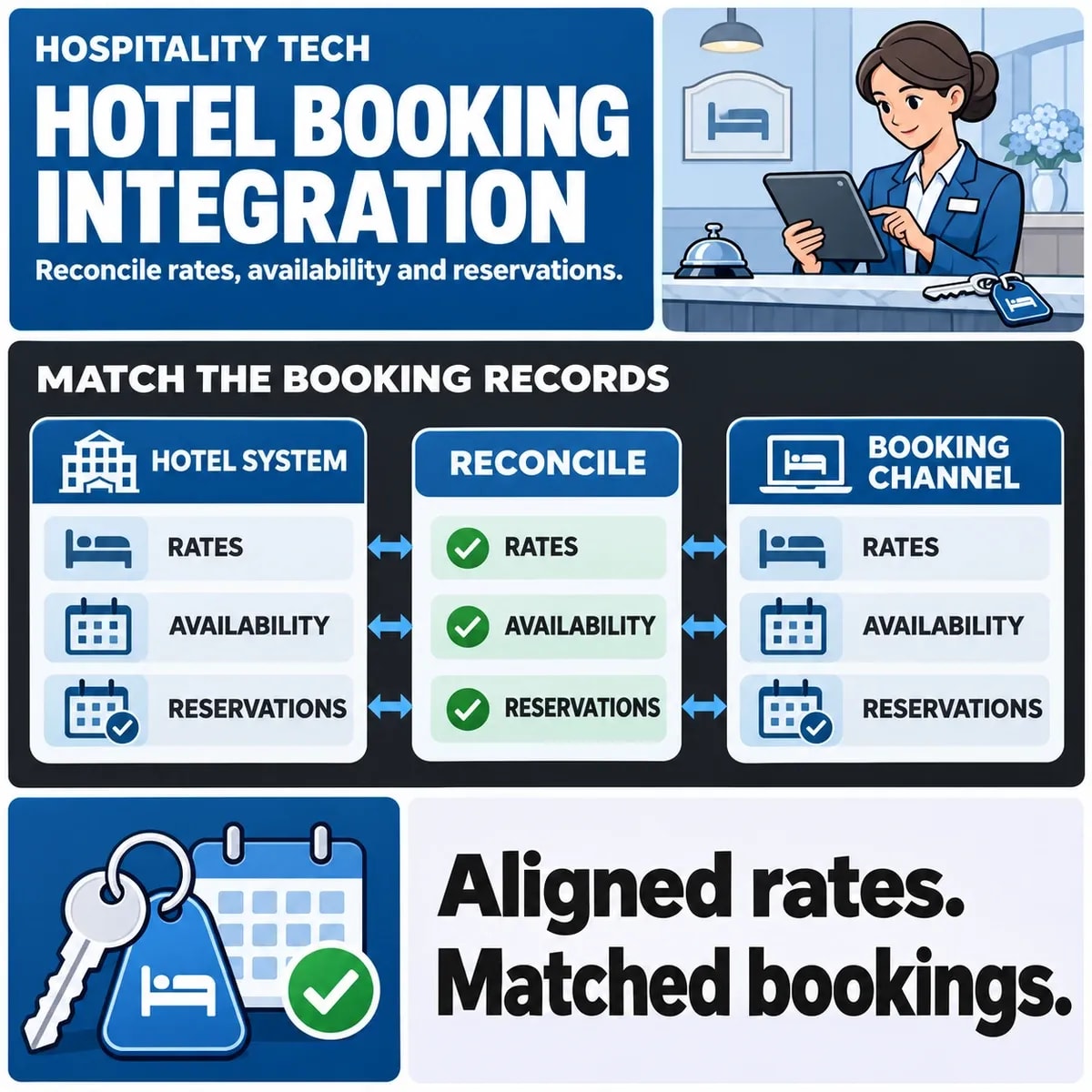

A hotel booking integration should reconcile rates, availability, restrictions and reservations as related but separate information. Start with consistent room-type and rate-plan mappings, then define how booking changes affect room-date inventory. A successful update request alone does not establish that every connected selling channel now holds the intended state.
The scope depends on the hotel's property management system, booking engine and channel connections. Confirm the supported interfaces and account arrangements before promising a direct connection or a particular synchronisation behaviour.
Define the room-night and rate-plan mapping
Identify the sellable product in each system. A room type, an individual room, a rate plan and a night of availability are different concepts. The mapping should explain how the connected systems refer to the same intended offer.
Agree room, rate-plan and reservation identities during PMS and channel data integration.
Record property, room-type and rate-plan identifiers rather than matching on display names alone. Names can change, and two offers with similar names may have different conditions. Include occupancy or other distinctions where the provider contract uses them.
Booking.com's rates and availability documentation describes provider-specific structures for these exchanges. Use the actual selected interface and eligibility requirements; the existence of documentation does not establish that a hotel or supplier can use every operation.
Assign an owner for unmapped products. A newly created rate plan should not silently inherit another plan's rules or disappear from updates. Decide whether the integration holds it for review, excludes it visibly or follows another approved publication route.
Separate rates, inventory and booking restrictions
A price does not tell the whole selling story. Availability describes what can be offered for the relevant dates, while restrictions can limit the circumstances in which a stay may be booked. The integration needs the fields required by the actual hotel and provider model.
RMS's availability, rates and inventory guidance illustrates ARI data including restrictions and update conditions. Verify which fields and combinations apply to the hotel's connection instead of assuming every system uses identical semantics.
Define date interpretation explicitly. Arrival date, stay dates and departure date can have different roles. An update covering a range needs a clear meaning so the final night or boundary date is not included or excluded by accident.
Choose ownership for each field. If the PMS controls inventory and another approved system controls rates, document that split. Independent edits in several places can be overwritten even when every individual update technically succeeds.
Use test cases involving a closed date, a changed rate and a relevant stay restriction. A comparison of one room price cannot demonstrate that the offer is bookable under the intended conditions.
Map reservation creates, changes and cancellations
Give each reservation a stable cross-system reference and record its source. A modification should be connected to the existing booking rather than treated as a new unrelated stay.
Define how a changed stay affects the old and new room-date allocations. Moving dates, changing room type and cancelling a reservation are distinct operations. The integration must account for both released and newly committed inventory.
Consider a fictional reservation moved from one date range to another. The reconciliation should show the old allocation released according to policy, the new allocation applied and the reservation linked throughout. A new confirmation message alone does not demonstrate those inventory effects.
Repeated or delayed reservation events need an agreed treatment. Ask how the system identifies the same change and prevents an older update from restoring a state already superseded. Use the provider's actual version and operation behaviour rather than assuming arrival order is reliable.
Plan failed pushes and resynchronisation
Distinguish sending an update, receiving acceptance and observing the intended destination state. Some failures require retry; others indicate an invalid mapping or unsupported value. Unknown outcomes need reconciliation before another effect.
Identify exceptions that require custom hospitality workflows rather than assuming a default connector covers every rule.
Choose the operational response when a channel remains stale. The hotel needs to know which property, product and dates are affected, what evidence exists and who can authorise a correction or selling restriction.
A resync should have a defined source and scope. Republishing a snapshot without considering reservation changes during the refresh can recreate inconsistency. Ask the implementation team to explain how the starting state and concurrent activity are accounted for.
Keep partial success visible. An update across several products or dates may not have one uniform result. The support view should identify failed parts rather than treating the entire batch as either complete or absent.
Use a room-date reconciliation worksheet
The following hypothetical worksheet helps structure investigation. It is not a measured channel comparison or evidence that overbooking has been eliminated.
| Comparison | Question to resolve | Evidence and owner |
|---|---|---|
| Room type and rate plan | Do both sides refer to the same sellable product? | Approved mapping and product owner |
| Dates and restrictions | Are the applicable stay and closure rules aligned? | Attributed values and date interpretation |
| Inventory after a reservation change | Has the same booking update been applied? | Reservation identity and change history |
| Stale channel state | Was the update accepted, and is a resync appropriate? | Connection evidence and authorised escalation |
Compare like with like. A total across all room types can conceal a mismatch in the particular product being sold. Record the observation time and pending work so a temporary difference is not confused with a persistent mapping error.
Have reservations staff review at least one change and cancellation case. They should be able to explain the booking's current state and the next action without interpreting raw API responses.
Rehearse a reservation change arriving during a resync. In the fictional example, a guest moves to another room type while the integration is republishing room-date values. Ask which reservation version the snapshot includes, how the later change is recognised and who reviews a remaining difference. Reapplying a full quantity without understanding that boundary can conceal the very booking activity the team needs to preserve.
Also check the guest-facing handoff after an uncertain booking response. The website should retain the original reference and use the booking engine's supported recovery route. Encouraging another reservation immediately can create a second operation before the first outcome is known. This is separate from the ARI comparison but belongs in the overall website and PMS scope.
Agree the hotel website and PMS handoff
Confirm where the guest completes a reservation and which system supplies the confirmation. A website embedding or linking to a booking engine has a different responsibility from one creating reservations through an API.
Bring mapping examples, rate ownership, failure handling and reconciliation responsibilities into the project scope. The useful outcome is a connection with explicit selling rules and visible exceptions, supported by evidence for the actual systems involved.
Discuss system ownership and exceptions for hotel website booking integrations with ZakCodeX.