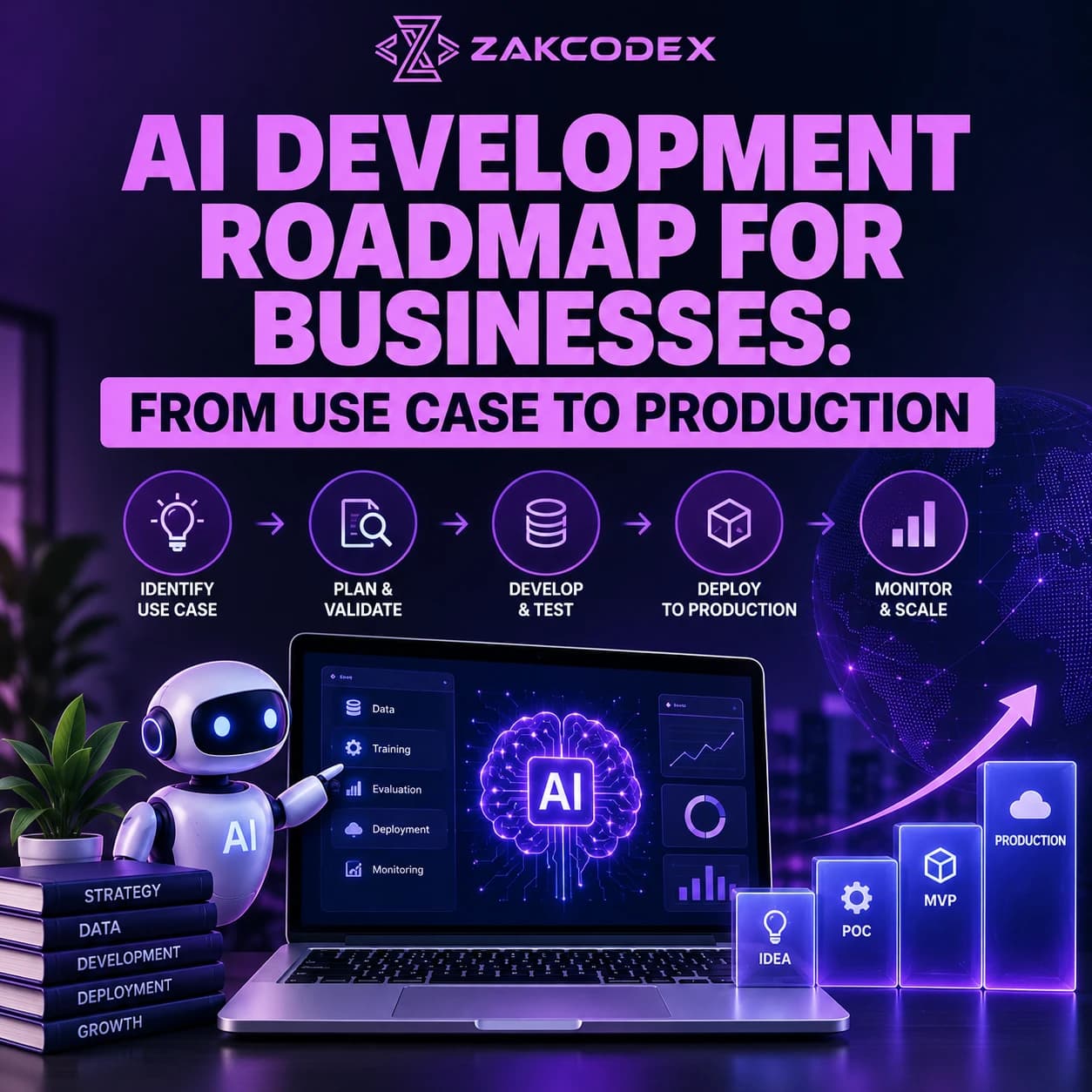
An AI implementation roadmap is a staged plan for turning a business problem into a deployed, monitored and improving AI system. It covers use-case validation, data readiness, architecture, testing, integration, security and governance. Successful delivery requires more than model selection: each stage must establish whether the proposed system is useful, reliable and operable.
Businesses evaluating AI development services should distinguish a convincing demonstration from a dependable product. The AI development process creates and integrates the capability; the AI development lifecycle also includes monitoring, maintenance and eventual replacement. A roadmap connects both to accountable business outcomes.
What does the roadmap look like?
A practical AI implementation strategy uses evidence-based checkpoints from discovery through operation. The stages overlap and may repeat. Security and governance begin during discovery, even though they also require explicit release checks.
| Stage | Main Goal | Typical Output |
|---|---|---|
| Business discovery | Define the problem | Baseline, owner and objectives |
| Use-case validation | Check value and suitability | Prioritised use case and non-AI baseline |
| Data assessment | Establish readiness | Source inventory and quality gaps |
| Technical feasibility | Test constraints | Approach shortlist and acceptance thresholds |
| Architecture | Design boundaries | System design and integration contracts |
| POC | Test the riskiest assumption | Evidence to proceed, revise or stop |
| MVP | Validate real user value | Limited usable product |
| Integration | Connect business workflows | Versioned application and pipelines |
| Testing | Evaluate system behaviour | Quality, security and load results |
| Governance | Assign risk accountability | Controls and release decision |
| Production deployment | Operate safely | Controlled release and rollback plan |
| Monitoring | Maintain outcomes | Metrics, alerts and improvement backlog |
Stage 1: Which business problem should AI solve?
Start with an observable problem, affected users and a measurable outcome. “We need AI” provides neither a design requirement nor a success test. Document what the system should do, what it must not do and who owns the result.
Suitable AI use cases for business include support classification, document processing, lead scoring, demand forecasting and recommendations. These can target repetitive work, customer experience, revenue, efficiency or risk reduction. Record current handling time, error rates, volumes and constraints before estimating benefits.
| Requirement | Prefer initially |
|---|---|
| Exact calculations or stable conditions | Deterministic software or rules |
| Moving work through predefined steps | Workflow automation |
| Interpreting variable language or predicting patterns | AI with validation and oversight |
Prioritise business impact, feasibility, available data, complexity, risk, adoption and time to value. A valuable but high-risk use case may need assisted operation; a low-impact, complex idea may not justify development.
Stage 2: Is the data ready?
Data readiness for AI means having suitable, accessible information with clear ownership and permitted uses. More data does not automatically mean better results. Poor labels, missing history and inconsistent records can undermine evaluation.
Inventory structured CRM and ERP records, databases, documents, customer interactions and internal knowledge bases. Check APIs, historical coverage, labelled examples and real-time availability where required. An AI data strategy should define quality checks, access, privacy, retention and responsibility for correcting sources.
Stage 3: Is the use case technically feasible?
Feasibility requires acceptable reliability within latency, cost and infrastructure constraints. A model that answers correctly but too slowly may still fail the workflow. Define explainability, integration, security and human-review requirements before testing.
For classification, examine false positives and false negatives. Check scalability, regulatory constraints and whether reviewers can handle the expected exception volume.
Stage 4: Which AI approach fits?
Choose the simplest approach that meets the business requirement. Existing models may avoid unnecessary custom training. Compare AI model selection options on representative data rather than demonstrations.
| Approach | Suitable use case |
|---|---|
| Predictive machine learning | Demand forecasting, lead scoring and recommendations |
| Classification and language processing | Enquiry categorisation and information extraction |
| Deep learning and computer vision | Image-based inspection where suitable data exists |
| Generative AI and large language models | Drafting, summaries and document comparison |
| Retrieval with a model | Answers grounded in approved organisational information |
| Rules plus AI | Interpretation followed by controlled business actions |
Start with prompts and existing foundation models where suitable. Retrieval supplies context; fine-tuning changes model behaviour through training examples. Custom model development needs evidence that alternatives cannot meet requirements. Agents are relevant when flexible tool selection is necessary, not as a default architecture.
Stage 5: What architecture is needed?
Design the application, model, API and data layers together. Security boundaries must control what information enters the model and what actions its output can trigger. Human approvals belong in the workflow design.
Specify databases, retrieval indexes or vector databases where useful, authentication, permissions, logging and cloud infrastructure. Map third-party AI APIs to internal CRM, ERP, SaaS and workflow systems. Record audit trails and define behaviour when dependencies fail.
Stages 6–7: How do POC, prototype and MVP differ?
An AI proof of concept tests feasibility; a prototype explores interaction; an AI MVP tests useful delivery with real users. Production adds operational obligations. These labels describe purposes, not guaranteed readiness levels.
| Milestone | Question answered | Required evidence |
|---|---|---|
| AI POC | Can the approach work? | Representative evaluation against a baseline |
| AI prototype | Can users understand the interaction? | Usability observations |
| AI MVP | Does a limited workflow deliver value? | Adoption, corrections and outcome metrics |
| Production AI | Can it operate dependably? | Monitoring, ownership and recovery controls |
Use limited but representative data to test the riskiest assumption first. Stop or redesign a POC when reliability, economics or data access cannot meet agreed criteria. A successful demonstration does not waive later checks.
The MVP needs usable interfaces, authentication, integrations, error handling, monitoring and human-in-the-loop controls appropriate to its exposure. Observe real workflows and collect feedback, including whether users spend more time correcting outputs than they save.
Stage 8: How is the system developed and integrated?
AI application development combines ordinary software engineering with model integration. Front-end, backend, APIs, databases and deployment pipelines remain essential. The model must fit the existing business software.
Use version control and CI/CD for application changes. Track model, prompt, data-pipeline and configuration versions together. Handle timeouts, partial failures and duplicate requests so retries do not create duplicate CRM records or repeated downstream actions.
Stage 9: How should AI testing work?
AI testing combines functional checks with evaluation of uncertain outputs. Conventional assertions remain necessary, but model performance must also be assessed across representative cases and relevant user groups. Keep evaluation examples separate from training or tuning.
- Model evaluation: assess task accuracy, unsupported claims and relevant bias.
- Software checks: test APIs, integrations, permissions and error paths.
- Operational checks: test latency, load, outages and recovery.
- Adversarial checks: test malicious inputs and prompt injection where relevant.
- User acceptance: review edge cases, explanations and exception handling.
Repeat regression evaluation after model, prompt or retrieval changes. Human review should use documented criteria.
Stage 10: How should governance and security work?
AI governance assigns responsibility for risks, decisions and escalation throughout the lifecycle. Artificial intelligence security includes ordinary application controls plus model-specific abuse and data-leakage risks. The NIST AI Risk Management Framework provides a voluntary structure for managing AI risks.
Limit sensitive data, enforce access controls and approvals, and protect logs. Evaluate hallucinations, bias, explainability and prompt injection where applicable. Assess vendor retention, data use, service changes and exit arrangements.
UK organisations should assess applicable UK GDPR duties, including whether a data protection impact assessment is required. The ICO's AI governance guidance explains the need for context-specific assessment. Requirements depend on the use case and jurisdiction.
Stage 11: What makes AI production-ready?
Production AI serves real workflows with defined availability, support and recovery arrangements. AI model deployment alone is insufficient. An AI deployment strategy must include release criteria and a safe fallback.
Provision model serving or third-party APIs, cloud resources and containers where useful. Test latency, scalability, failover and access. Release gradually using feature flags where appropriate, retain previous versions and rehearse rollback of compatible application and model configurations.
Stage 12: What should be monitored after launch?
AI monitoring must track model behaviour, system reliability and business outcomes. Deployment starts ongoing operation rather than ending the AI project lifecycle. Changed inputs can degrade a previously acceptable system.
Monitor failed requests, latency, errors, user feedback, overrides, API or token usage and infrastructure cost. Evaluate data drift and changes in predictive performance. Measure unsupported-answer rates through labelled sampling where feasible; live accuracy may require delayed ground truth.
MLOps connects model delivery with evaluation and operational pipelines, as described in Google Cloud's MLOps guidance. Retraining, prompt improvements or model replacement should pass evaluation before release.
Why can a POC fail to reach production?
A POC may prove model capability while leaving integration, ownership and economics unresolved. Common AI implementation challenges include prototype-only architecture, no production data pipeline and weak user adoption. Overengineering cannot compensate for absent business value.
Require an owner, security design, integration plan and operating budget before expansion. Address unreliable outputs, high inference cost, missing monitoring and vendor lock-in explicitly. If the organisation cannot support the resulting system, pause rather than relabel the prototype as production.
What determines timeline, cost and delivery approach?
AI implementation cost and timing depend on uncertainty and scope, not a universal package. Simple AI integration may reuse existing infrastructure; moderate applications add workflows; complex enterprise AI solutions add cross-department dependencies and governance.
| Cost category | Examples |
|---|---|
| Upfront development | Discovery, data engineering, models, UI, integrations and testing |
| Recurring infrastructure | AI APIs, serving, compute, storage and monitoring |
| Ongoing maintenance | Security updates, evaluation, support and optimisation |
Data readiness, custom training, POC scope, security review and user acceptance affect the schedule.
| Approach | When it fits |
|---|---|
| Off-the-shelf SaaS | Standard needs with acceptable controls |
| AI APIs or low-code tools | Limited integration and supported workflows |
| Custom application | Distinct workflows, permissions or interfaces |
| Custom model | Validated requirements unmet by available models |
| Hybrid | Existing capabilities plus targeted custom development |
How should maturity and success shape the roadmap?
Match ambition to support capacity and measure outcomes beyond model accuracy. A small business can test one assisted task; a startup or SaaS company must also validate product adoption. SMEs need workflow integration; enterprises need shared governance and departmental ownership.
Compare model metrics with business KPIs, completion time, productivity, customer experience, adoption, reliability and cost per accepted outcome. Track human intervention rather than hiding it. Expand AI implementation for business only when dependable performance and measurable usefulness justify the next stage.