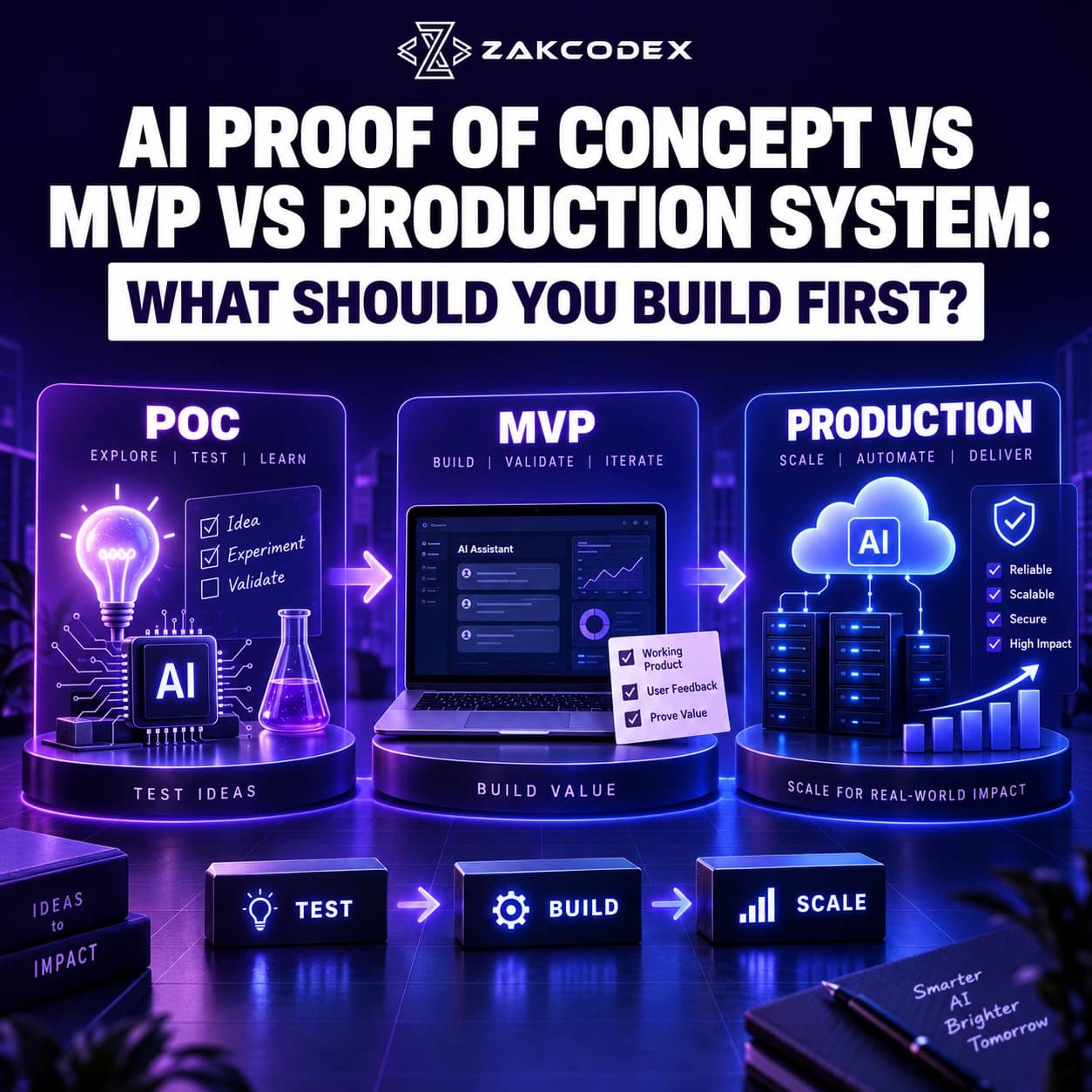
The proof of concept vs MVP decision depends on what remains uncertain. Build an AI proof of concept to test technical feasibility, a prototype to explore the experience, an MVP to validate real user and business value, or a pilot to test controlled operational use. A production system must operate reliably, securely and maintainably under its intended workload.
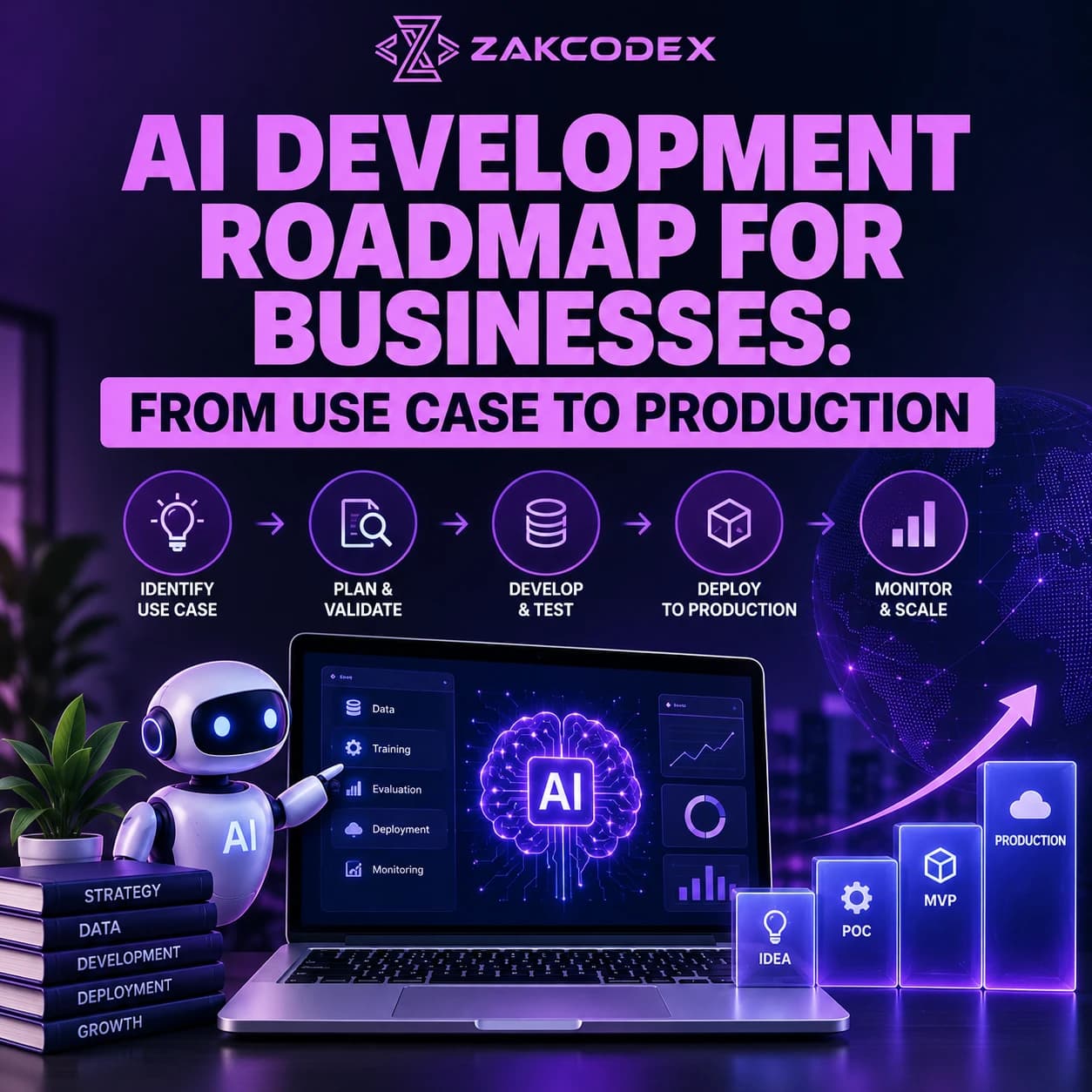
A possible journey is Business Problem → Feasibility → POC → Technical Evidence → MVP → User and Business Evidence → Pilot → Production → Monitoring and Scale. In AI product development, these are decision tools, not mandatory milestones. Build the smallest system that answers the most important remaining question.
How do POCs, prototypes, MVPs and pilots differ?
Each approach validates a different kind of uncertainty. Agree the intended evidence before choosing a label, because organisations sometimes use these terms differently.
| Stage | Main goal | Typical users | Validates | Production ready? |
|---|---|---|---|---|
| POC | Test feasibility | Engineers and specialists | Technical approach | Usually not |
| Prototype | Explore experience | Research participants | Flow and concept | Usually not |
| MVP | Test core value | Real target users | Demand and workflow fit | Can be, for its scope |
| Pilot | Validate operation | Selected users or department | Real-world readiness | Controls must suit exposure |
| Production | Deliver ongoing value | Intended user population | Continued service performance | Required for intended use |
A feasibility study assesses data, technology, constraints and economics; a POC experimentally tests a critical assumption. Proof of value asks whether solving the problem creates a worthwhile benefit. Technical success alone cannot establish that benefit.
A prototype may simulate AI to explore interactions without proving model feasibility. An AI MVP lets real users complete the core workflow.
What is the central difference between a POC and an MVP?
An AI POC asks whether an approach can work; an AI MVP asks whether a usable solution creates enough value to continue. The POC narrows technical uncertainty, while the MVP tests behaviour beyond stakeholder enthusiasm.
| Area | POC | MVP | Production |
|---|---|---|---|
| Goal | Feasibility evidence | Core value validation | Reliable continuing service |
| Users | Controlled evaluators | Target users | Supported population |
| Technical quality | Experimental scope | Usable core workflow | Operationally maintained |
| AI evaluation | Task feasibility tests | Quality plus usefulness | Continuous regression checks |
| Data | Representative sample | Controlled real inputs | Reliable governed pipelines |
| Integrations | Test critical assumptions | Core connections | Resilient contracts |
| Security | Protect experimental exposure | Protect real use | Ongoing full-scope controls |
| Scalability | Estimate constraints | Support limited demand | Validate intended workload |
| Monitoring | Experiment logs | Errors and user outcomes | Alerts and observability |
| Business validation | Initial plausibility | Observed value | Continuing economics |
An MVP is not permission to release unsafe or unreliable software. “Minimum” describes scope; a narrowly scoped MVP may already be production-ready for its audience. Conversely, a feature-rich demonstration may lack basic operational controls.
What should you build first?
Select the experiment that addresses the largest consequential unknown. Skip stages only when existing evidence answers their questions.
| Situation | POC | Prototype | MVP | Pilot | Production |
|---|---|---|---|---|---|
| Novel model capability | Best fit | Optional | Usually premature | Later | Premature |
| UX uncertainty | Optional | Best fit | Useful next | Later | Usually premature |
| Demand uncertainty | If technically needed | Useful | Best fit | Useful | Expansion premature |
| Operational uncertainty | Targeted tests | Optional | Possible vehicle | Best fit | Gate first |
| Proven use case | Optional | Optional | Useful | Risk-dependent | Possible |
| High-risk environment | Useful | Useful | Controlled scope | Strong candidate | Evidence required |
A familiar AI API with known data quality and established integration patterns may justify starting with an MVP. A small, predictable application can be built directly for production when technical, user, economic and operational assumptions have sufficient evidence.
A novel document interpretation task may need a POC first. An assistant whose main uncertainty is whether employees understand its suggestions may benefit from a prototype. Neither example dictates a universal sequence.
What should an AI proof of concept validate?
A POC should test the riskiest assumption using representative inputs and explicit success criteria. Its output is evidence for a decision, not merely a convincing demonstration.
- Data feasibility: availability, permissions, completeness, labels, consistency and freshness.
- Model feasibility: task quality, context handling, consistency and unacceptable errors.
- Technical feasibility: latency, API behaviour, critical integrations and operable infrastructure.
- Economic plausibility: likely inference, correction and support costs.
For document extraction, include incomplete scans, unusual layouts and missing fields. Compare field correctness and review effort with the current process. For generative output, test unsupported claims, omissions and inconsistent responses rather than judging fluency alone.
Use held-out cases and record model, prompt and configuration versions. The most powerful model is not automatically the most suitable if its latency or operating cost makes the workflow impractical.
Stop, narrow or change the approach when essential data is unavailable, unacceptable failures remain unresolved or economics fail. A stopped POC can still provide valuable evidence by preventing unsupported investment.
What must an AI MVP prove?
An AI MVP should demonstrate that intended users can complete a meaningful workflow and receive useful value. Evaluate behaviour, effort and outcomes rather than interest in the idea alone.
Include a usable interface, relevant onboarding, authentication, necessary backend storage, core integrations, basic monitoring and feedback. Exclude unrelated features that do not test the hypothesis.
Measure task completion, repeat use, abandonment, manual overrides, correction time and support issues. Interview users about where AI helps and where it adds work. An answer can be technically accurate but arrive too late or require too much verification.
Business feasibility includes problem importance, adoption, operational impact and continuing costs. An MVP that saves one activity but creates another should be evaluated across the whole workflow, not only the automated step.
When should an MVP enter a pilot?
Run a pilot when controlled real-world operation can expose uncertainties that laboratory tests or limited product use cannot. Restrict the audience, workflow and authority according to risk.
A pilot might involve one department or selected customers, with named owners and clear exit criteria. Test CRM, ERP, document stores, communication tools and database integrations under realistic permissions and exception handling.
Human review should have a defined purpose: checking consequential outputs, handling exceptions or approving irreversible actions. Specify reviewer capacity, escalation and responsibility. Review introduces cost and delay, so include both in the pilot's economics.
Where appropriate, shadow operation can compare recommendations without changing live decisions. Any pilot affecting real users or data still needs suitable security, privacy and support; a restricted rollout is not an exemption.
What makes an AI system production-ready?
Production readiness combines validated value with reliable, secure and maintainable operation. Model accuracy is only one component of that decision.
| Area | Readiness evidence |
|---|---|
| Product | Core value demonstrated; edge cases understood |
| AI | Evaluation suite, versioning and failure policy |
| Data | Reliable inputs, quality checks and privacy controls |
| Technical | Stable deployment, capacity tests and recovery |
| Security | Authentication, authorisation and protected secrets |
| Operations | Owners, alerts, support and cost monitoring |
Define behaviour for missing data, invalid output, provider outages, rate limits and integration failures. Use bounded retries, safe fallbacks, escalation or graceful degradation. Validate outputs before database writes or API actions; grounding and constrained workflows reduce risk without guaranteeing correctness.
Assess sensitive inputs, retention, provider policies, access and data minimisation from the experimental stage onwards. Governance requirements depend on industry, geography and decision impact. NIST's AI Risk Management Framework provides a voluntary foundation for considering trustworthiness through design, development, use and evaluation.
Do not automatically promote POC code into production. Review authentication, data pipelines, error handling, deployment, testing and operational ownership, then retain or replace components according to their suitability.
How do costs, timelines and infrastructure change?
Scope, data readiness, integrations, evaluation, design and governance determine time and cost. Comparing responsibilities is more useful than inventing a universal AI POC cost or MVP timeline.
| Stage | Main investment | Infrastructure emphasis |
|---|---|---|
| POC | Data preparation and model experiments | Limited environment and logging |
| MVP | Interface, backend and core workflows | Stable deployment and basic monitoring |
| Pilot | Operational validation and support | Controlled access and realistic dependencies |
| Production | Reliability, security and maintenance | Capacity, observability and recovery |
Separate initial engineering from recurring API calls, tokens, compute, storage, vector/database infrastructure, monitoring and human correction. Low experimental spending does not predict economical operation at sustained volume.
Hosted APIs can accelerate experiments while introducing provider limits, data-processing conditions and usage costs. Self-hosting offers different control but adds capacity, patching and infrastructure responsibilities.
Test concurrent requests, data growth, queues and downstream bottlenecks. Streaming can improve perceived responsiveness; background jobs suit work that need not finish immediately. Caching or smaller models may help where correctness and quality allow. None supplies a universal latency solution.
What monitoring is needed after launch?
Monitor both application health and AI usefulness. A healthy server can still return unsupported, incomplete or inappropriate answers.
Track errors, latency, usage, cost, quality samples, user corrections and provider changes. Diagnose inputs, model versions and retrieval context where relevant, while avoiding unnecessary sensitive logging.
MLOps brings deployment, evaluation, versioning and monitoring into repeatable machine-learning operations; Google Cloud's MLOps guidance describes this broader operational discipline. LLMOps applies similar practices to language-model applications, including prompts and retrieval configurations.
Monitor changing input data and predictive performance where drift is relevant. Re-run evaluations after model, prompt or pipeline changes and keep rollback options. AI behaviour can change even when application code remains unchanged.
What evidence should unlock the next investment?
Use decision gates with documented outcomes and accountable owners. Passing a gate means the relevant uncertainty is sufficiently resolved for the next exposure, not that all risk has disappeared.
- Business gate: define the problem, baseline and value hypothesis.
- Technical gate: demonstrate representative data, quality, integration feasibility and viable cost assumptions.
- User and business gate: show core workflow success, useful output and observed adoption.
- Operational gate: validate security, recovery, support, monitoring and intended workload.
- Ongoing review: compare real outcomes with assumptions and improve or stop accordingly.
Avoid undefined experiments, idealised data, feature-heavy MVPs without real users and production launches without ownership. Start with the biggest uncertainty, preserve evidence and scale only when technical feasibility and business value support further investment.