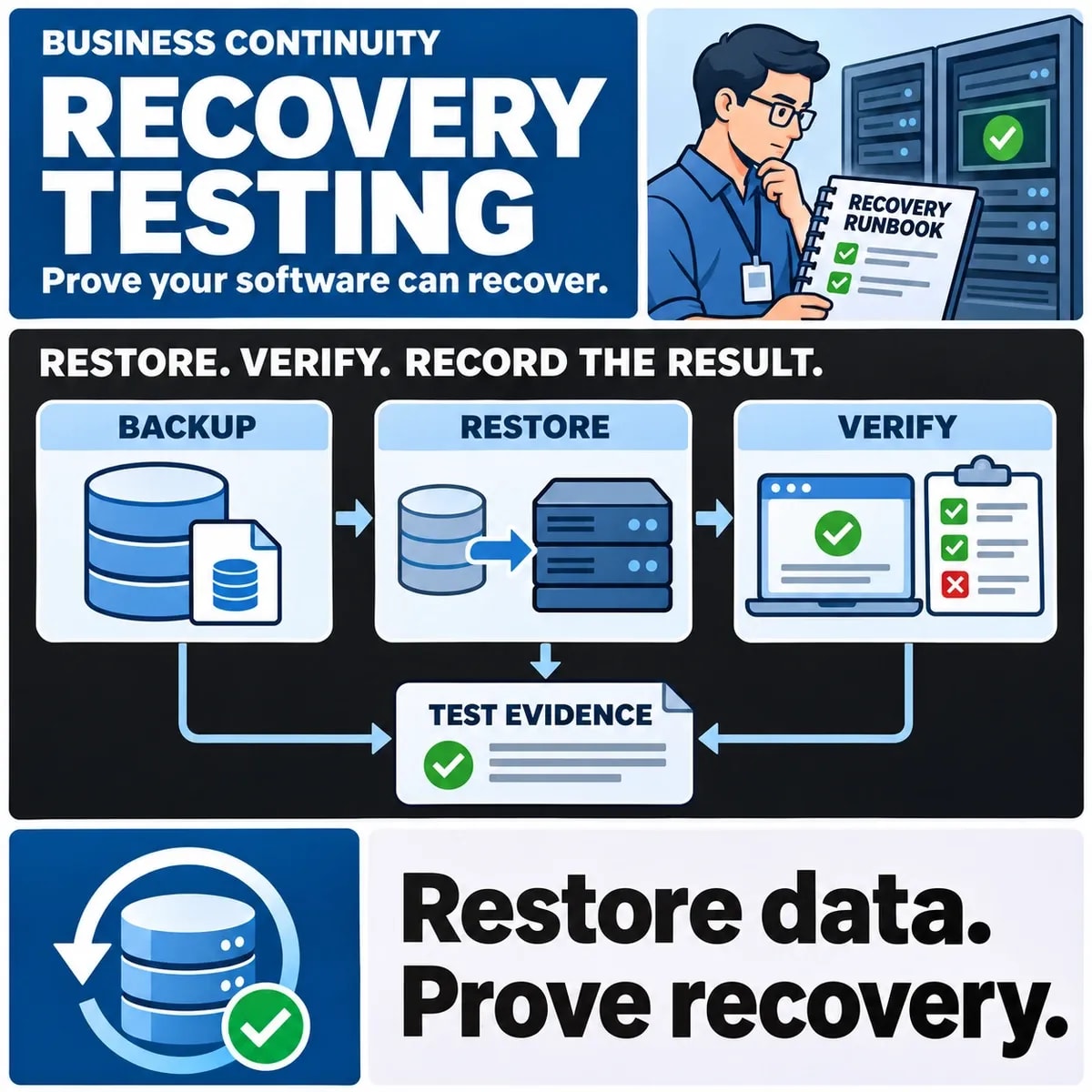

A disaster recovery test should show whether a defined business process can recover under stated conditions, with evidence for the resources, application and representative work. A backup existing or a server starting is only part of that picture. Agree the recovery question, objectives and exercise boundary before interpreting the result.
The practical output is a record of what was attempted, what was observed, which objectives were met and which gaps still have owners. Avoid claiming a recovery capability that the exercise did not demonstrate.
Define the business recovery question and objectives
Start with the service the business needs to resume. For a fictional order-management application, the question might be whether authorised staff can locate restored orders and complete a controlled test workflow after the approved recovery sequence.
Set recovery objectives with the responsible business and technical owners. Recovery time and acceptable recovery point describe different concerns. The appropriate targets depend on the process and its dependencies; there is no universal figure suitable for every application.
Google Cloud's disaster recovery testing guidance connects exercises with response requirements, dependencies and lessons. Use those principles to define a test that can support the intended decision rather than simply demonstrating that a recovery tool runs.
Choose the failure scenario explicitly. Loss of a resource, unavailable credentials and a wider dependency outage may demand different preparation. State which scenario the exercise addresses and which assumptions remain intact.
Also record who authorises the exercise and who can stop it. This article describes planning and evidence; it does not authorise a production failover or provide commands to run against live systems.
Identify dependencies and the exercise boundary
List the application, data stores, configuration, identity services and external connections needed for the selected business process. Include the people and access needed to carry out recovery. An otherwise complete restore can remain unusable if nobody can obtain an essential permission.
Choose an approved setting and controlled data. A recovery environment must not accidentally send real customer communications or duplicate fulfilment work through live integrations. Explain which external systems are simulated, disconnected or included under authorised arrangements.
Record differences from production. Reduced data, missing network paths or simplified identity can limit the conclusion. These limits belong beside the observations, not hidden in a general environment note that the final reviewer may miss.
Identify the selected restore point and its relationship to current business activity. The exercise needs to explain what data should be present and which later activity is intentionally outside that point. Otherwise a missing record can be mistaken for a restore defect or overlooked as expected loss.
Choose representative recovery checks
Separate resource restoration from application and business verification. A resource can exist while its configuration is wrong; an application can load while its relationships or permissions prevent useful work.
Agree the evidence needed for recovery verification and software testing, beyond a successful infrastructure job.
AWS Backup's restore-testing documentation describes testing restore viability and duration within its supported service. Treat those results as evidence for that restore scope, not proof that every business dependency has recovered.
For the fictional order application, use a controlled order known to belong to the selected restore point. Check its relevant fields and relationships, authenticate through the intended route and perform an approved non-production workflow. Keep external effects controlled.
Include failure and access observations. Can the team identify an unavailable dependency? Does the recovered application reject an inappropriate role? The chosen checks should follow the business recovery question rather than becoming an unrelated catalogue of every possible test.
Define how timing is measured. Record the start and end events and distinguish hands-on restore time from the elapsed time until the business check passes. A duration without its measurement boundary is difficult to compare with an objective.
Keep a recovery evidence record
The following hypothetical record is a practical structure. It contains no invented measured recovery time or claim of a real exercise.
- Scope and authority: the selected process, approved setting, resources and responsible people.
- Inputs: restore point, versions, required dependencies and configuration assumptions.
- Objectives: agreed targets and the events used to assess them.
- Observations: resource restoration, application access and representative business checks.
- Gaps: failed checks, missing evidence and environment limitations.
- Decision: what the exercise supports, who reviewed it and which remediations remain open.
Use references to controlled evidence rather than copying sensitive data into a broad report. A reviewer should be able to locate the relevant log, check or record through the appropriate access route.
Keep unsuccessful attempts visible. A later success does not erase the dependency that delayed the first attempt. Understanding the interruption may be essential to deciding whether the recovery process is operable under the intended conditions.
Distinguish an observed result from a planning estimate. If a dependency was simulated or a step was only discussed, label it accordingly. A tabletop decision can be useful evidence of preparedness without being described as a completed technical recovery.
Assign remediation and repeat the relevant checks
Each gap needs an owner, intended correction and closure evidence. “Improve documentation” is less useful than identifying the missing dependency, updating its recovery instructions and demonstrating the affected step.
Assign remediation and repeat checks within the agreed application maintenance responsibilities.
Choose repeat checks based on the change. A corrected restore instruction may need the restore step repeated, while a changed identity dependency may affect the full application journey. Do not treat editing the runbook as proof that the revised sequence works.
Keep the recovery plan current as the application changes. New services, data stores and integrations can alter the boundary. Agree a review and exercise approach appropriate to the actual system and risk rather than asserting a universal cadence.
Introduce a deliberately missing dependency in the fictional exercise, such as an unavailable configuration reference in the approved test environment. Observe whether the runbook identifies it, whether the team finds the responsible owner and how the gap affects the recovery decision. Do not substitute an improvised production credential or make an unapproved connection merely to complete the exercise.
The result may be a correctly identified limitation rather than a passed business check. Record that distinction, correct the dependency under the appropriate authority and repeat the affected path. This makes the exercise useful even when the initial recovery cannot be completed, while preserving an honest account of what has actually been demonstrated.
Separate ongoing recovery from migration rollback
Migration rollback concerns a particular cutover and the activity around it. Disaster recovery concerns restoring an ongoing service after the selected disruption. They can share dependencies and techniques while requiring different decisions and evidence.
A useful exercise leaves the business with a bounded statement: this process was checked under these conditions, these observations support the result and these gaps remain. That is more actionable than an unsupported declaration that the software is fully disaster-proof.
Discuss cloud application recovery requirements with ZakCodeX alongside the business owners of the affected workflows.