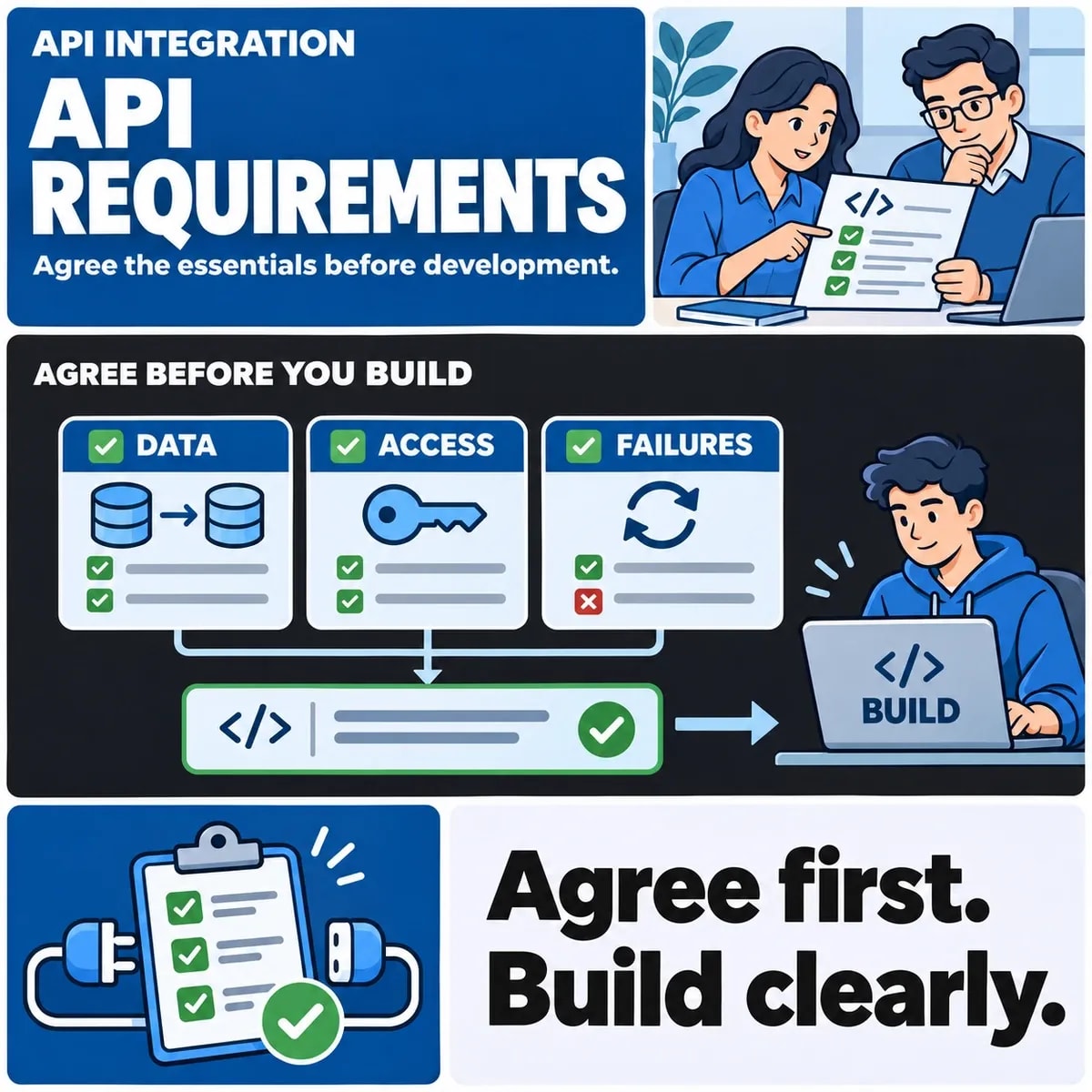

Before API integration development starts, agree the business operation, data ownership, access, failure handling and acceptance evidence. The result should be a shared specification that explains what the connection must do and who resolves each important decision. A list of endpoints alone rarely answers those questions.
The most useful checklist exposes uncertainty early. It distinguishes a confirmed rule from an assumption, names the person who can settle that assumption and shows how the eventual integration will be accepted. That gives buyers and developers a clearer basis for scope, estimates and delivery decisions.
Start with the business operation and systems of record
Describe the trigger and the outcome in everyday operational terms. For a fictional sales-order connection, that might be: an accepted order should create the appropriate accounting record, with a visible exception when the customer cannot be matched. Specify what starts the process and what staff should see when it finishes.
Name the source of truth for each important piece of information. The CRM might own the customer relationship while another system owns an account code. Calling one application “the master system” is too broad if ownership changes by field or operation.
Identify business workflow constraints during custom software planning, especially where an integration changes how staff work.
Record what remains manual. Perhaps a person must approve a new account before the integration can use it. That is a legitimate boundary if it is agreed and visible. It becomes a defect in the project when one team assumes the approval is automated and another assumes staff will handle it.
Also describe direction and timing. A one-way publication feed differs from two-way synchronisation. An overnight batch has different user expectations from a request made during checkout. Avoid putting “real time” into the specification without explaining the business delay that can actually be tolerated.
Specify the data contract with real examples
Give the engineering team representative records that are safe to share. Include ordinary data and awkward cases: missing values, changed identifiers, closed accounts and records containing characters or dates that require careful handling. A field list without example meanings can hide disagreement.
Microsoft's REST API design guidance describes explicit resource representations and interface conventions. For a buyer, the practical implication is to agree the meaning of requests and responses, rather than leaving business decisions to an unexplained technical mapping.
Name the owner of each field
For every important field, record its source, destination, required status, transformation and decision owner. If “customer” can mean an individual, a company or an accounting account, choose the intended entity. If a status is translated, list the accepted values and what happens when an unfamiliar value arrives.
Identifiers deserve particular attention. Explain how a record is found, whether its identifier can change and how a duplicate is recognised. Agree the interpretation of dates, time zones, empty values and deletions. A blank field must not accidentally become an instruction to erase valid destination data.
Describe destructive changes explicitly. Closing an account, removing a relationship and correcting a spelling mistake are different operations, even if each appears as an updated record. Include an example of each relevant case and decide whether staff can reverse it. A field mapping cannot safely stand in for a missing business decision about deletion or historical records.
Make access and environment requirements explicit
Identify the authorised way to obtain access, the environments available for development and testing, and the person responsible for each permission. The specification should describe the required access without containing passwords, tokens or private customer records.
Ask whether the test environment represents the features the integration needs. A demonstration account may lack a production feature or contain unrealistic data. Record those differences so a successful test is not interpreted as evidence for a capability that was never exercised.
Include ownership of credential rotation, access removal and incident response. These responsibilities continue after launch. A connection that works only while an individual employee's account remains active creates an operational dependency that the buyer should understand.
Confirm provider prerequisites separately from implementation choices. Access might depend on a particular contract, approval or supported API. Do not assume that a public documentation page proves the buyer's account can use every described capability.
Assign failure handling and ongoing ownership
Work through what happens when the receiving system is slow, unavailable or unable to accept a record. Decide which failures can be retried, which require a business correction and which leave an outcome uncertain. Use the actual providers' documented limits rather than adopting a generic retry count.
Define the support record. An operator should be able to identify the affected business operation, understand the last known result and find the owner of the next decision. Logging a technical exception without a usable record reference may leave staff unable to help a customer.
Reconciliation is a separate requirement from delivery. Specify how the business will compare the intended state with the destination state, how discrepancies are prioritised and who can approve a correction. This matters when individual requests appear successful but the overall set of records is incomplete.
Finally, assign change ownership. Agree who monitors provider changes, reviews field additions and maintains the mapping. An interface version is useful context, but it does not remove the need to manage changed business rules.
The handover also needs a practical access route to diagnostics. Identify who can see failed operations, which references they will use and when an issue moves from technical support to the business data owner. If nobody owns a missing account match, adding more automatic retries will not resolve the underlying decision.
Turn requirements into acceptance evidence
Use a short requirements record for each meaningful operation. The following fictional example is a starting structure, not a complete accounting specification.
| Decision area | Example requirement | Evidence and owner |
|---|---|---|
| Purpose | Create an accounting record from an accepted sales order | Operations owner confirms the intended business result |
| Identity and mapping | Match the approved customer account and translate the agreed order fields | Data owner reviews a representative source and destination pair |
| Exception | Do not invent an account code when no approved match exists | Named team receives a visible unresolved record |
| Recovery | Investigate an uncertain destination outcome before repeating the action | Integration owner can locate the original operation |
| Acceptance | Check ordinary, missing-data, duplicate and recovery cases | Business approver records the result and remaining exceptions |
Write expected outcomes before reviewing the delivered integration. For a missing customer match, the outcome might be a held record and a routed exception rather than a successful destination entry. That makes failure behaviour a designed part of the workflow.
Keep an explicit decision register beside the checklist. “Tax-code mapping still requires the business owner's decision” is more useful than silently choosing a value to make a test pass. An unresolved requirement can affect cost and timing even when the endpoint itself is straightforward.
Use the specification to scope the next step
A specification is ready to support delivery planning when the main operation, access route, data rules and acceptance owner are clear enough to review. It need not predict every future exception. It should identify what is known, what remains open and how those open items will be resolved.
For the broader project questions surrounding this specification, see the software discovery phase.
Ask the proposed delivery team to explain the same sample operation back to you, including its failure path. This simple review often reveals differences between a technical connection and a useful business process. Resolve those differences before they become hidden implementation assumptions.
Discuss unresolved system integration requirements with ZakCodeX before turning assumptions into a development scope.