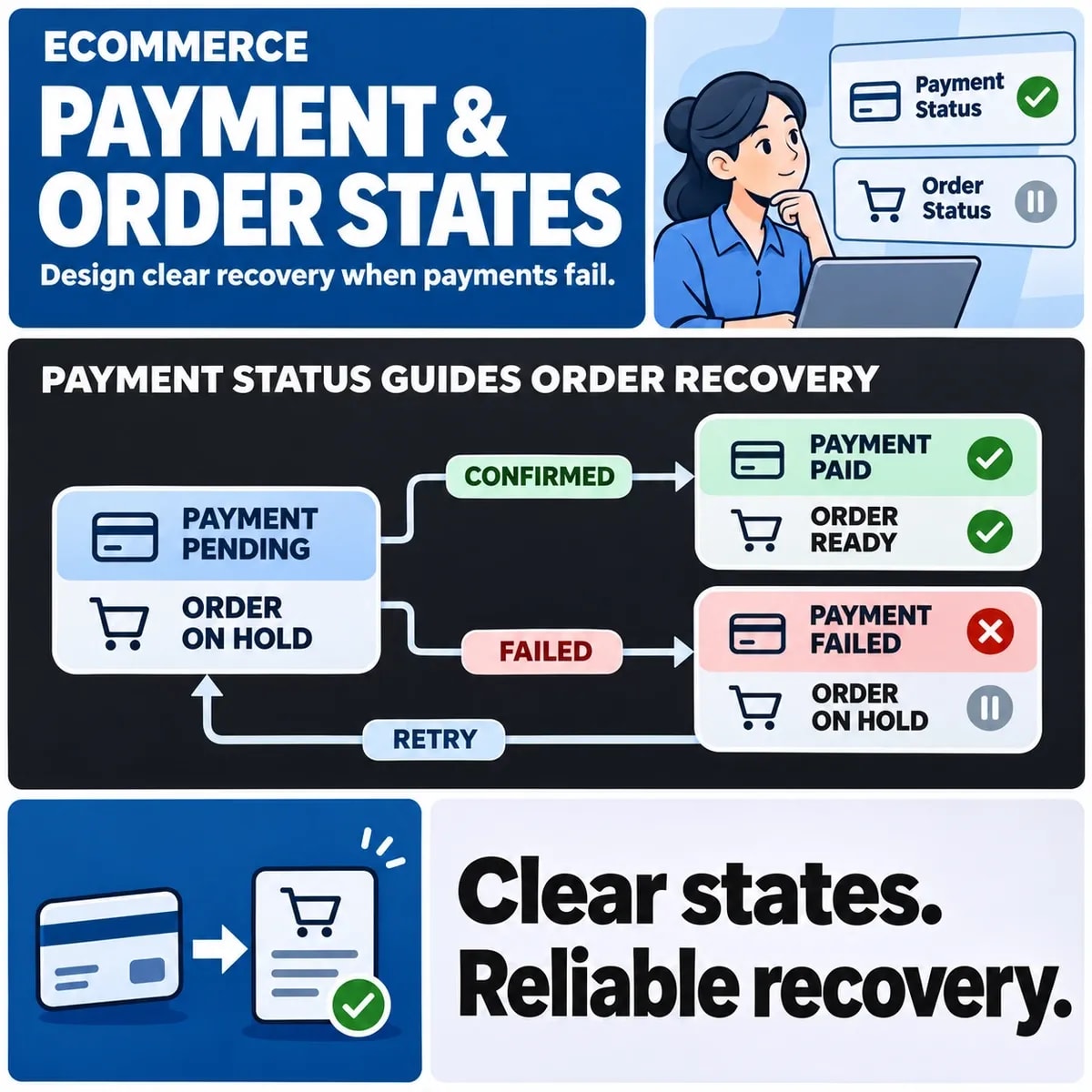

Design ecommerce recovery around separate payment, order and fulfilment states. When a response is delayed or a checkout is interrupted, establish what happened to the existing operation before creating another charge or order. A missing confirmation screen is not evidence that the payment failed.
The business needs a clear response for confirmed success, required customer action, confirmed failure and uncertainty. Each branch should connect the customer message to an operational owner and the evidence needed to resolve it.
Separate payment, order and fulfilment state
A payment provider records the payment process. The shop records the order, and another system may record picking or dispatch. These records are related but can progress independently. An integration should describe those relationships rather than forcing them into one ambiguous “complete” flag.
Stripe's PaymentIntent lifecycle documentation describes provider-specific payment states and transitions. Use the selected provider's actual contract when interpreting a result; do not assume another provider uses the same names or recovery options.
Shopify's checkout payment troubleshooting guidance also illustrates why a payment problem and the existence of an order are separate questions. The integration needs enough references to investigate both sides.
Agree the fulfilment boundary explicitly. Which payment evidence allows an order to progress? What happens when the payment is confirmed but an order is held for a separate reason? The answer depends on the business and provider, so it belongs in the requirements rather than an inferred status mapping.
Identify attempts and business operations
Record the checkout or order identity, payment attempt identity and relevant provider reference. Distinguish retrying delivery of a notification from starting a new payment attempt. They can look similar in a log while having different business consequences.
Agree operation references and reconciliation before implementing payment system integration.
A customer may return to checkout, use a different method or refresh a page. Specify how the application recognises the existing operation and decides whether another attempt is appropriate. Use the provider's supported mechanisms rather than inventing identifiers that it cannot reconcile.
Also identify related effects, such as sending an order confirmation or requesting fulfilment. Repeated payment notifications should not independently repeat every downstream action. The design needs operation-level evidence as well as a record that a message arrived.
Keep diagnostic references usable for support without spreading payment or customer details unnecessarily. Staff need a route to the appropriate evidence, not an unrestricted copy of every payload.
Define customer action, waiting and failure branches
When the provider requires a supported customer action, explain that step clearly and preserve the intended order context. Do not display the same message used for a confirmed rejection if the customer still has a valid action to complete.
When the result is pending or unknown, use wording that reflects the evidence. A controlled waiting or review route can prevent the interface from encouraging another purchase while the original operation remains unresolved.
For a confirmed failure, offer only options supported by the actual provider and shop policy. Avoid promising that a bank will release funds within an invented period or that a retry cannot create another payment-related record.
Specify what happens if the customer closes the browser. The workflow cannot depend solely on a success page loading. Operations should be able to locate the attempt and continue reconciliation through the agreed provider and order records.
Consider interrupted navigation separately from a deliberate cancellation. Leaving a page does not necessarily cancel an operation already submitted. The interface and support procedure should describe the state the system can establish.
Reconcile delayed and conflicting outcomes
Notifications may arrive after a browser has shown an error or after another event has been processed. Define which evidence establishes the current result and how an older update is handled. Do not let arrival order alone decide the business truth.
Work through a fictional case: a shopper submits a payment, the connection drops and the shop has no confirmed result. The next step is to investigate the existing provider attempt. Creating a new attempt immediately could add another operation without resolving the first.
If the payment is confirmed but its order link is missing, route the inconsistency for reconciliation. The correct response is not automatically a refund, another charge or a new order. Those decisions require the business policy and evidence for the actual case.
Give unresolved records an owner and a visible status. Decide how staff are alerted, which references they inspect and what closes the exception. A queue labelled “payment errors” is inadequate if nobody can distinguish failed attempts from uncertain ones.
Use a provider-qualified recovery table
The table below is a hypothetical requirements aid. Its labels need mapping to the selected provider; it is not a universal payment state machine.
| Observed evidence | Decision to specify | Customer or operations response |
|---|---|---|
| Customer action remains required | Do not treat the attempt as confirmed payment | Present the supported next step |
| Outcome unknown after interruption | Reconcile the existing attempt before another effect | Show a waiting or review route with a useful reference |
| Payment confirmed; order linkage missing | Hold the inconsistency for investigation | Provide provider and shop references to the owner |
| Failure confirmed | Apply the approved retry or cancellation policy | Explain the next valid option without promising a bank outcome |
Review each row with support and fulfilment staff. Ask what they would see, what they may change and which actions remain prohibited while the outcome is unknown. This exposes gaps that a successful checkout demonstration will not show.
Acceptance cases should include repeated notifications, a closed browser, a late success and an unavailable destination system. Observe the payment, order and related effects together. A successful HTTP response alone does not establish that the overall recovery behaved correctly.
Give support a fictional late-success case to rehearse. The customer reports an error, then the provider confirms the original payment while the shop's order remains unresolved. Ask which reference support searches, who can create or repair the order relationship and what prevents fulfilment from starting twice. Record the decision in terms of the existing attempt rather than asking the customer to repeat checkout as a diagnostic step.
Review customer return links too. A browser returning from the provider should lead to an evidence-based view of the attempt. A URL parameter saying that the journey succeeded should not be the sole basis for marking an order paid. The implementation must use the provider's supported verification route and preserve the distinction between navigation and confirmed payment evidence.
Design recovery messages and ownership together
The customer message should correspond to a process someone owns. If the page says the team is reviewing an order, define how that review begins and what evidence the team can access. Do not create reassuring copy for an absent operational workflow.
Make waiting, action-required and support routes clear in the checkout user experience.
Keep the initial scope focused on the actual checkout and providers involved. Subscription collection, refund decisions and bank settlement can introduce separate requirements. The useful deliverable is a reviewable recovery process for the shop's real states and failure paths.
Discuss payment and order-state ownership for ecommerce checkout development with ZakCodeX.