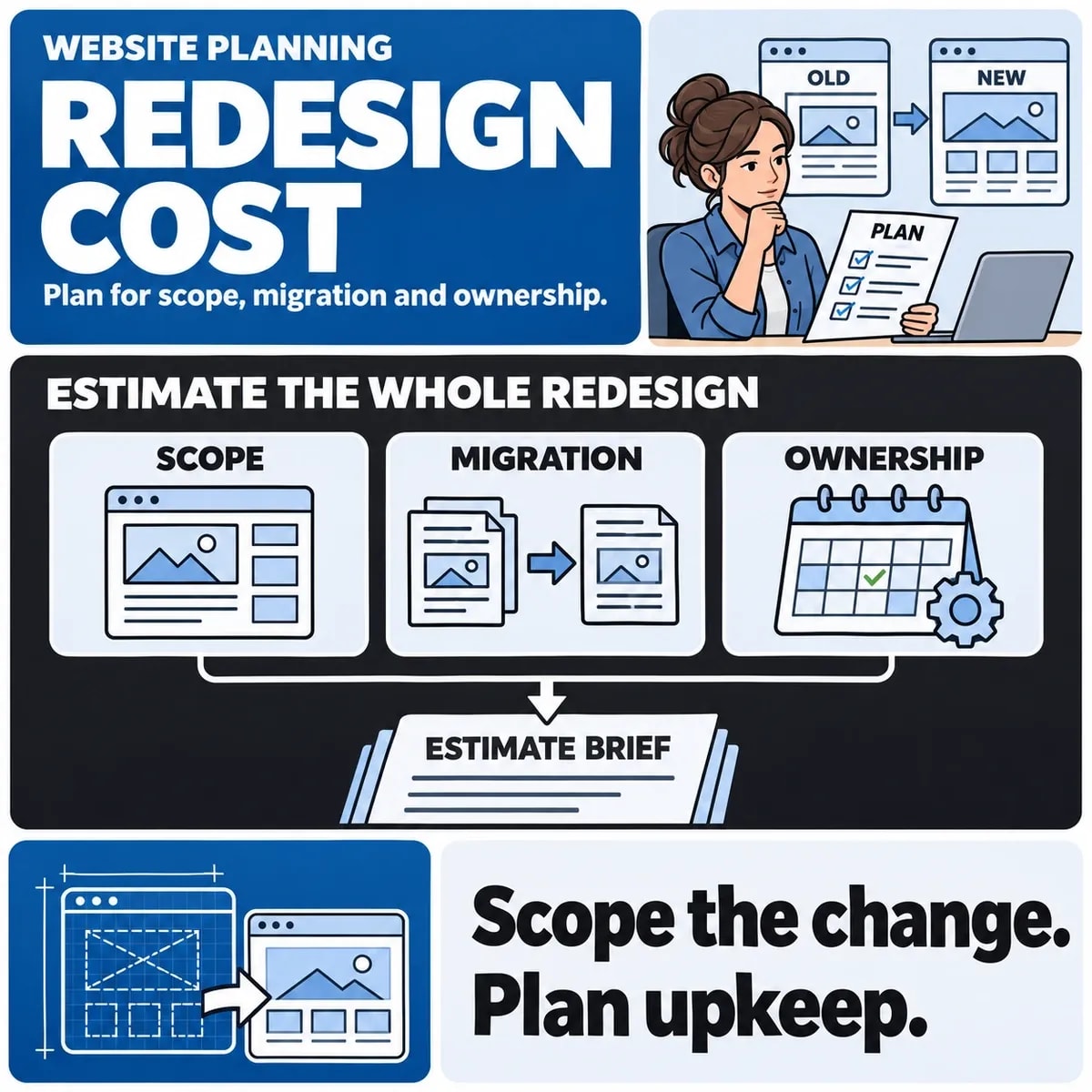

A website redesign costs the work needed to change an existing site and release the replacement safely. A new visual style may be only one part of that work. Content decisions, enquiry forms, account access, search visibility and the people maintaining the site can change the budget substantially.
There is no useful fixed price without a boundary. Begin by deciding what must improve, what can be retained and what evidence will establish that the replacement works. The worksheet below turns those decisions into estimate inputs rather than presenting an unsupported market price list.
Define the reason for the redesign
Write the problem as an observable task: prospective clients cannot distinguish services; editors cannot update project examples; or enquiries fail on a particular device. A request to make a site modern leaves suppliers guessing about the work that will be accepted.
Choose a small set of success measures and record their current measurement quality. For example, measure completed enquiry submissions and whether they reach the responsible team. A redesign can improve the journey, but its price does not establish a future conversion rate or a guaranteed increase in organic traffic.
Count templates and behaviours, not just pages
Twenty pages using one well-defined service template may require less design and development than five pages with distinct interactive workflows. Count reusable layouts separately from content records. Include navigation, search, forms, consent states and missing-page behaviour in the inventory.
| Work area | What to count or inspect | Estimate evidence |
|---|---|---|
| Design system | Layouts, components and responsive states | Approved examples and component list |
| Content | Records to retain, edit, merge or retire | URL inventory with an owner per decision |
| Integrations | Enquiry routing, CRM, booking and analytics | Test access and expected outcomes |
| CMS | Editing roles, reusable fields and previews | Representative editor tasks |
| Release | Migration, assurance, monitoring and recovery | Acceptance and launch responsibility plan |
Identify whether the existing platform is the obstacle. If the CMS already supports the required editing model, replacing it creates work that needs a separate justification. Retaining a suitable platform can still involve new templates, content cleanup and integration testing.
Make a retain, change and investigate worksheet
Consider a hypothetical professional-services site with six reusable templates, forty content records and one CRM enquiry connection. Its owner wants clearer service navigation and easier case-study editing. Those are planning assumptions for this example, not a ZakCodeX project or a delivery estimate.
- Retain: working article URLs, approved copy, brand assets with known rights and suitable hosting.
- Change: service navigation, case-study fields, enquiry feedback and three weak mobile layouts.
- Investigate: undocumented form routing, old redirects and editor permissions.
Ask each supplier to price the same version of this worksheet. Keep investigation items separate until evidence resolves them. A low total that assumes all existing content is ready is not comparable with a proposal that includes rewriting and migration.
Calculate a budget using explicit assumptions
Use this structure: agreed person-days by work area multiplied by the applicable day rate, plus named third-party and one-off expenses. Person-days are effort, not elapsed calendar days. If roles have different rates, calculate each line separately.
For arithmetic only, suppose a fictional plan allocates 4 days to discovery, 5 to design, 10 to development, 4 to content migration and 5 to testing and release. That is 28 person-days. At an entirely assumed blended rate of £600 per day, the example subtotal is £16,800. These figures are chosen to demonstrate the calculation; they are neither market benchmarks nor ZakCodeX prices.
If integration investigation identifies another 4 person-days at that same assumed rate, the illustrative subtotal becomes £19,200. Hosting, paid assets, licences, applicable tax and ongoing support remain separately identified. Replace every assumption with a scoped supplier estimate before using the worksheet for a purchasing decision.
Budget content and URL migration deliberately
For each current URL, record its proposed destination, content owner and any change to its purpose. Keep useful existing addresses when there is no reason to change them. New navigation does not require every article or service path to move.
Where URL changes are necessary, Google's site-move guidance describes preparation, mapping, redirects and monitoring. Include that work in the release plan. Redirects do not remove the need to test destination content, internal links and important customer journeys.
Include accessibility and business acceptance
Make accessibility part of design and implementation scope, with agreed evaluation activities and responsibility for fixes. The W3C accessibility planning guide treats accessibility as continuing work across a website's lifecycle. An automated score alone is insufficient evidence of a usable redesign.
Write acceptance examples such as completing an enquiry with keyboard navigation, understanding validation errors and editing a case study without breaking its layout. Test representative devices and content lengths. Agree who approves these tasks and how defects are distinguished from newly requested features.
Separate launch costs from ongoing ownership
Identify who owns hosting and domain accounts, deploys updates, reviews dependencies, restores backups and investigates failed enquiries. Ask which ongoing tasks are included and which need a separate estimate. A site that is cheaper to launch can still require more work from the owner's team.
Plan a controlled release, a recovery route and a short period of monitoring after launch. Keep a record of approved content and configuration so unexpected behaviour can be investigated. Define a process for later improvements rather than quietly including an unlimited backlog in a maintenance fee.
Request a comparable redesign proposal
Send the URL inventory, template list, retain/change worksheet, content responsibilities and acceptance examples together. Ask suppliers to identify exclusions, client dependencies and uncertain work. Have them explain the practical consequence of each cheaper or more ambitious option.
A website development brief can then focus on the changes that support enquiries and maintainability. If the project includes a shop, use the ecommerce development cost guide for its distinct catalogue, checkout and operational requirements rather than treating them as ordinary marketing pages.