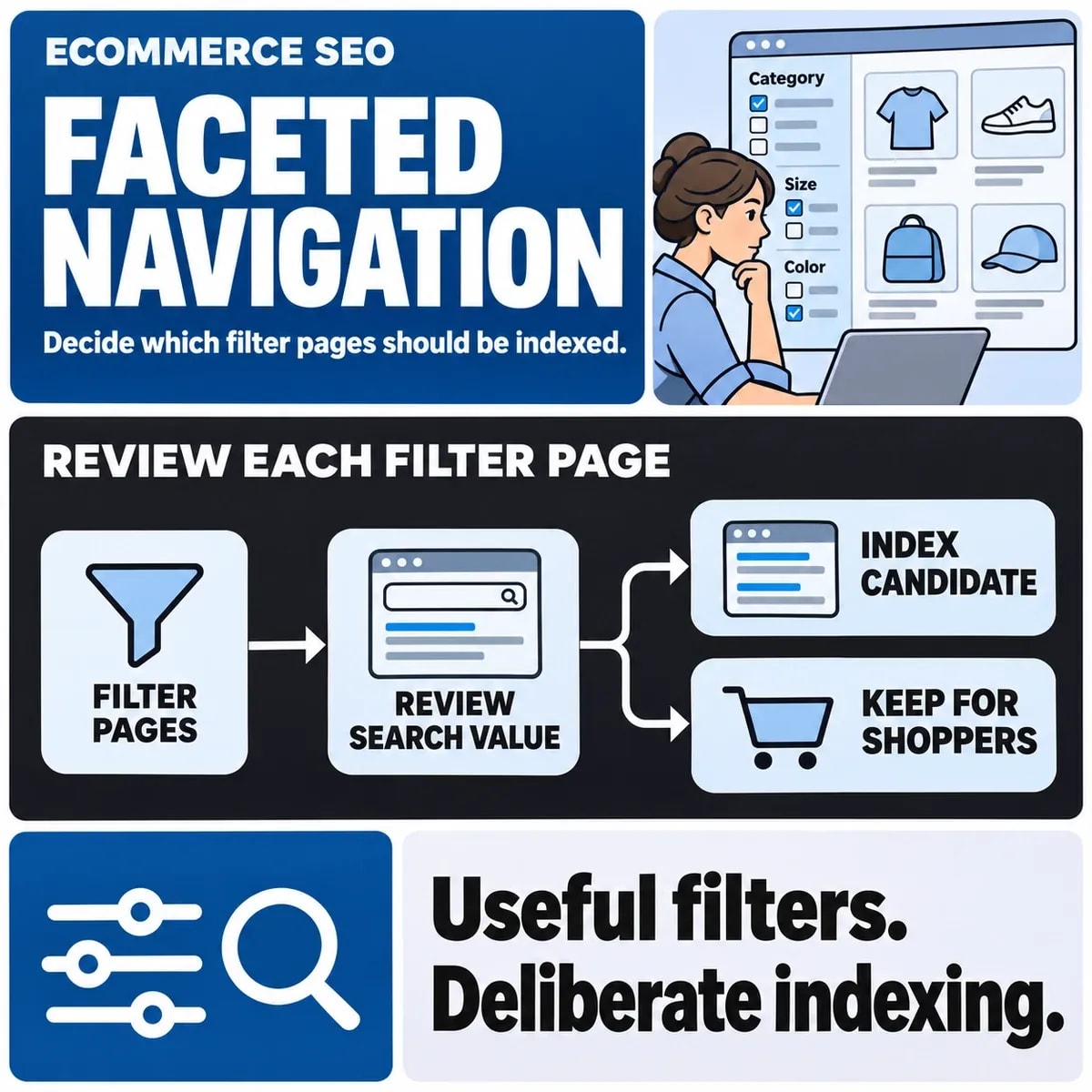

Faceted navigation lets a shopper narrow a catalogue by attributes such as size, colour, material or price. When each combination creates a crawlable URL, a small set of filters can produce many similar pages. The SEO decision is which combinations deserve a search landing page and how the remaining states should behave.
Start with the catalogue and the customer task. A filter can be useful to a shopper without needing a separate place in search results. Document those two purposes before changing robots rules or canonical URLs.
Inventory the URL patterns first
Collect examples from category links, filter controls, pagination, sorting and internal search. Record the parameter names and whether changing their order produces another URL. Include combinations with no products and selections that repeat the same attribute.
For a fictional shop, /chairs?material=oak describes a material selection, while /chairs?sort=price changes presentation. The examples illustrate different purposes; they are not proposed ZakCodeX URLs or instructions to change a live store.
Choose indexable combinations deliberately
A potential landing page needs a coherent product selection, a useful search purpose and a maintainable URL. Review demand alongside catalogue depth, stock behaviour and the ability to provide accurate headings and content. A keyword estimate alone is insufficient if the selection is usually empty.
| URL purpose | Question | Possible decision to review |
|---|---|---|
| Stable product subcategory | Does it meet a distinct customer need? | A deliberately maintained landing page |
| Sort order | Does the underlying product set change? | A presentation state rather than a new search destination |
| Multiple narrow filters | Is there useful demand and enough inventory? | Keep for shoppers while controlling unnecessary discovery |
| Impossible combination | Can this selection ever return a useful page? | Consistent unavailable-state handling |
The decisions depend on the store. A wholesale catalogue and a seasonal retailer may need different policies even when they use the same ecommerce platform.
Separate crawl control, noindex and canonical signals
Robots.txt controls crawler access. A noindex instruction asks a supported search engine not to index a page it can retrieve. A canonical identifies a preferred representative for similar content. These mechanisms address different questions and should not be added interchangeably.
If crawling is blocked, Google may not retrieve a page's noindex instruction. See Google's noindex documentation before combining controls. A canonical is a signal, not a substitute for a complete URL policy or a guarantee that a crawler will stop requesting variants.
Define rules for unnecessary combinations
Google's faceted-navigation guidance describes ways to limit unnecessary URL spaces and considerations for pages that should be crawled. Review the patterns the application actually generates. A broad rule can also match a useful category or parameter used by an important journey.
Keep an explicit exception list for intended landing pages. Check how links, sitemaps, canonical signals and crawler rules interact. Avoid treating every filtered page as identical to the unfiltered parent when the product selection or intent is meaningfully different.
Keep the shopping experience intact
Customers should retain understandable filter labels, removable selections and a clear way back to a broader catalogue. Test browser navigation, shared links and returning from a product page. Search controls should not accidentally break a shopper's selected state.
For an empty result, explain how to broaden the selection and preserve useful context. Separately review the correct HTTP and indexing behaviour for unavailable combinations. A visual message alone does not establish how a crawler interprets the URL.
Test a matrix before releasing changes
Include the unfiltered category, an intended landing page, a sorting state, a narrow multi-filter state, pagination and a zero-result combination. For each, record the response, robots access, index instruction, canonical, links and visible product set. Test representative URL encodings and parameter orders rather than only one convenient example.
Use staging or a safe crawl to review proposed rules. Any significant canonical or URL migration needs its own impact assessment and approval. Keep a before-state so an overly broad rule can be identified and corrected through the release process.
Measure exposure and crawl behaviour separately
After an approved change, check intended landing pages in Search Console and review available crawl evidence for unwanted patterns. Indexing changes can take time. Keep the dates and distinguish a reduction in unnecessary requests from a change in product-page visibility or sales.
Use the Shopify SEO overview for broader store checks. A focused technical SEO review can scope the URL policy, while ecommerce development addresses the filter interface and application behaviour. Agree their acceptance criteria together.