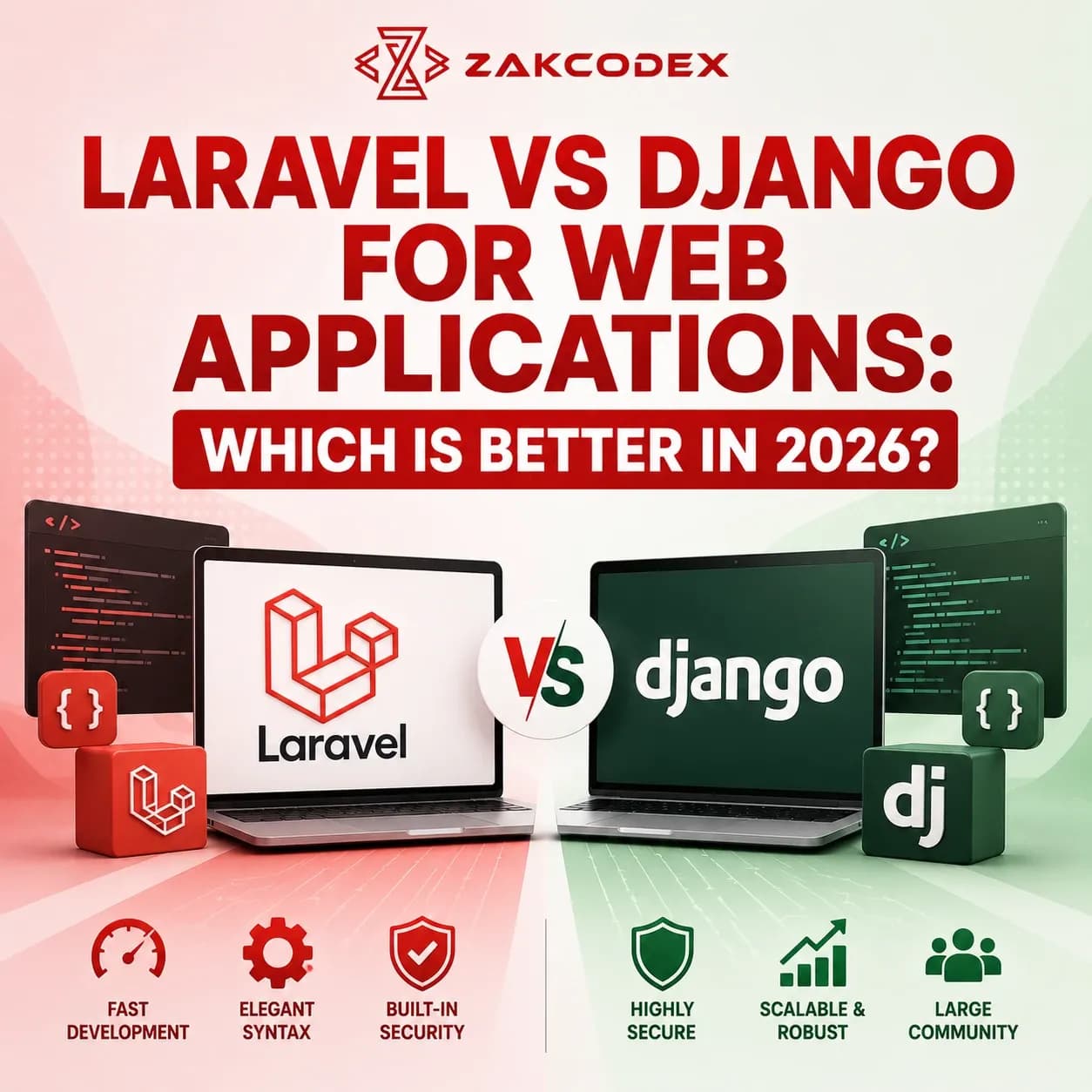
Choosing between Laravel and Django for web application development in 2026 depends heavily on your product's core functional requirements: Django is the superior choice for AI-driven platforms, complex data analytics engines, and machine learning integrations due to Python’s dominance in data science and its rigorous built-in security features, whereas Laravel is the better option for consumer-facing SaaS platforms, rapid MVPs, and business automation software owing to its elegant syntax, highly integrated ecosystem, and flexible architectural velocity. Neither framework is universally superior, but making the wrong selection can lead to extensive technical debt, slower development cycles, and high refactoring costs as your business attempts to scale.
For modern engineering teams, choosing a backend framework dictates more than just runtime execution speeds; it governs developer experience, onboarding friction, and infrastructure costs. A well-considered comparison of django vs laravel ensures that technical leaders can correctly match their long-term system architecture goals with their team's engineering velocity. Let us dive deep into the technical nuances of these two foundational web development ecosystems to guide your enterprise roadmap.
What Is Laravel?
Laravel is a highly expressive, open-source php framework built around the Model-View-Controller (MVC) architectural pattern. Created by Taylor Otwell, it abstracts common web applications tasks - such as routing, user session handling, secure caching, and complex database mapping - into an intuitive syntax. It represents the pinnacle of modern enterprise-grade laravel web development, enabling rapid application delivery without sacrificing system flexibility.
In 2026, the modern laravel framework relies heavily on highly advanced asynchronous architectures, offering native support for isolated background workers, sophisticated event broadcasting, and real-time network states. It transforms PHP away from historical scripting perceptions into a robust environment designed specifically for scalable web applications. By minimizing boilerplate code, it empowers developers to focus cleanly on writing unique business logic.
What Is Django?
Django is a high-level, open-source python framework that follows the Model-Template-Views (MTV) architectural pattern. Adhering strictly to a "batteries-included" design philosophy, it provides virtually every utility necessary for web application development right out of the box. Developed originally to manage fast-paced newsroom operations, it is specifically engineered to help developers move applications from initial concept to deployment as quickly as possible.
As the cornerstone of modern Python web development, the django framework provides direct, native compatibility with Python’s massive artificial intelligence, deep learning, and data analytics ecosystems. This structural alignment makes it the primary default backend framework for data-intensive systems, computational applications, and complex enterprise automation tools.
Laravel vs Django Overview
The core structural divergence between php laravel vs python django comes down to their design philosophies. Laravel prioritizes developer expressiveness, creative flexibility, and a highly integrated, modern developer ecosystem. Django prioritizes absolute architectural discipline, implicit security defaults, and robust data isolation structures. Selecting the proper environment requires comparing these foundational paradigms side-by-side.
| Feature | PHP Laravel Framework | Python Django Framework |
|---|---|---|
| Core Architecture | Model-View-Controller (MVC) | Model-Template-View (MTV) |
| Primary Language | PHP (Strictly typed object-oriented features) | Python (Highly readable, dynamic/strongly typed) |
| Ecosystem Philosophy | Flexible, expressive, fluid framework configurations | Rigid, highly disciplined, "batteries-included" model |
| Database Mapping | Eloquent ORM (Active Record pattern) | Django ORM (Data Mapper pattern) |
| Native Admin Interface | Requires external tooling (Laravel Nova / Filament) | Built-in, fully customizable admin dashboard |
| Ideal Core Use Cases | SaaS platforms, rapid custom MVPs, business automation | AI integrations, machine learning systems, data analytics |
Performance Comparison
When measuring django vs laravel performance, both platforms offer excellent optimization strategies for real-world scenarios. Raw benchmarks historically favored PHP's execution velocity over Python for basic computational tasks. However, in django vs laravel 2026 metrics, raw computational capability is rarely the true system bottleneck - overall throughput depends primarily on database optimization, indexing strategies, and I/O management structures.
For high-traffic scenarios, assessing laravel vs django performance requires looking at runtime enhancements. Laravel utilizes high-performance caching layers and application persistent runtimes like Laravel Octane (running Swoole or RoadRunner) to boot code directly into RAM, removing the traditional PHP bootstrap latency. Django counters this effectively with built-in support for asynchronous views and async ORM drivers, allowing it to manage concurrent I/O operations without blocking execution threads. For simple web views, Laravel slightly outpaces Django, whereas Django handles sustained data processing operations with lower memory degradation.
| Performance Metric | Laravel (Octane) | Django (Async Mode) |
|---|---|---|
| Execution Speed (Raw CPU) | Fast (Optimized JIT compiled execution) | Moderate (Interpreted, dynamic execution) |
| Asynchronous Scaling | Excellent via Swoole/RoadRunner co-routines | Excellent via native ASGI and async views |
| Memory Management | Persistent in-memory states across requests | Predictable, highly stable multi-thread models |
| I/O Bottleneck Resistance | High throughput under persistent connections | High capacity for handling long-polling tasks |
Security Comparison
When determining which framework is more secure, Django maintains a slight architectural advantage due to its strict structural enforcement. The Django framework treats security as a fundamental requirement rather than an operational option. It prevents typical web vulnerabilities out of the box by automatically injecting CSRF tokens into forms, sanitizing dynamic inputs against SQL Injection, and deploying cryptographic tools for user sessions. Its built-in user authentication subsystem is structurally isolated, leaving very little room for configuration errors.
Laravel also includes world-class security frameworks out of the box. It forces parameterized database requests using Eloquent ORM, manages automated CSRF token generation, and provides comprehensive middleware configurations to sanitize web traffic. The primary difference is that Laravel remains highly flexible; it gives engineers the freedom to bypass default safety systems for custom implementations, which can accidentally introduce risks if the team lacks strict oversight. Django's rigid, unyielding structures make it harder for engineers to inadvertently introduce critical bugs.
Scalability
When asking is django more scalable than laravel, the answer is closely tied to how you scale your underlying database and infrastructure. Both frameworks scale effectively horizontally when combined with load balancers, shared state caches like Redis, and distributed container systems like Docker and Kubernetes. Proof of this can be found in platforms like Instagram (which uses Django) and major global enterprise systems powered by Laravel.
Django is uniquely optimized for data-level scalability. Its integrated Data Mapper ORM allows engineers to cleanly decouple complex database queries from application models, making it a perfect fit for complex backend architecture demands. Laravel scales cleanly by breaking applications down into independent worker queues. However, for systems handling heavy processing loads, Laravel's monolithic defaults mean you must scale the entire application block, unless you deliberately adopt a microservices pattern early on.
Development Speed & Market Velocity
Laravel delivers exceptional time-to-market speed for initial application releases. The expansive laravel ecosystem provides robust, official packages for almost every standard SaaS requirement: authentication setups (Breeze/Jetstream), secure billing (Cashier), and serverless execution (Vapor). This lets development teams skip architectural configuration completely and focus exclusively on core feature development.
Django achieves highly competitive initial velocity because of its absolute "batteries-included" framework model. It provides a production-ready administrative panel, user authentication, and data management interfaces immediately upon initialization. The only drawback occurs when your application deviates heavily from Django’s predefined architectural expectations - customizing its core default systems can sometimes require more effort than building a modular component from scratch in Laravel.
Learning Curve & Onboarding
When evaluating which framework is easier to learn, the answer depends entirely on your engineering team's background. Python is famous for its simple syntax, making Django's code highly readable. However, learning the framework itself requires grasping advanced concepts like MTV architecture, strict administrative setups, and implicit database rules, which can feel challenging for junior developers.
Laravel features an exceptionally expressive syntax that is intuitive for anyone with a background in modern web engineering. Its extensive documentation and premier educational resources (like Laracasts) make onboarding incredibly smooth. While developers must understand object-oriented design and dependency injection, the framework's overall logic feels natural to pick up quickly.
API Development & Tooling
Modern applications depend heavily on powerful API architectures to connect frontends and mobile apps. Django excels at this using the django rest framework (DRF). DRF provides an exceptionally robust toolkit for building web APIs, featuring comprehensive data serialization layers, strict authentication policies, and a built-in browsable web interface that simplifies API debugging for front-end teams.
Laravel offers an equally impressive developer experience for rest api development via Laravel API Resources and Laravel Sanctum. Sanctum provides a lightweight, secure authentication setup for SPAs and mobile applications without the complexity of full OAuth2 systems. When full OAuth compliance is required, Laravel Passport integrates seamlessly. This lightweight modular approach makes building rapid API endpoints straightforward and clean.
Database Support & Mappings
Laravel utilizes Eloquent ORM, which implements the Active Record pattern. In Eloquent, every database table corresponds directly to a single model instance. This makes database interactions highly intuitive and remarkably fast to write. However, for highly complex data analytical queries involving deep, multi-table joins, the Active Record pattern can sometimes trigger structural inefficiencies (like the N+1 query problem) unless developers explicitly optimize their requests.
Django employs its own Django ORM, utilizing a Data Mapper approach that separates database operations from domain logic. This framework is highly optimized for complex schema designs, multi-table queries, and cross-database scaling. It handles indexing and migration management beautifully, making Django the clear winner for applications that manage dense, deeply interconnected data schemas.
Community, Packages, & Ecosystems
The Python django ecosystem is deeply integrated with the wider global data science and machine learning communities. If your web application requires native tools for natural language processing, predictive analysis, or data parsing, Django gives you direct access to premier libraries like NumPy, Pandas, and TensorFlow.
The PHP laravel ecosystem is arguably the most unified and commercially focused toolset in backend framework development. Supported directly by a dedicated core team, first-party tools like Laravel Horizon (for queue monitoring), Forge (for server provisioning), and Nova (for admin interfaces) ensure enterprise-grade reliability and seamless integration, avoiding the compatibility risks often found in open-source libraries.
Hosting, Infrastructure, & Deployment
Django relies on modern ASGI or WSGI server configurations (such as Gunicorn or Uvicorn) to bridge Python execution with web platforms like Nginx. It deploys cleanly across all major cloud providers and fits naturally into Dockerized container pipelines for microservices layouts.
Laravel runs efficiently on standard web environments utilizing PHP-FPM and Nginx. The framework offers unparalleled serverless scaling via Laravel Vapor, which automates deployment across AWS Lambda. For traditional infrastructure setups, tools like Laravel Forge completely simplify continuous deployment management.
Development & Operational Cost
Long-term maintenance costs are heavily driven by engineering availability and infrastructure footprints. While we analyze localized regional trends in our guide to laravel development cost uk, global choices between Laravel and Django show a few key differences.
| Operational Metric | Laravel Infrastructure | Django Infrastructure |
|---|---|---|
| Initial Setup Capital | Lower (Fast out-of-the-box prototyping) | Moderate (Requires configuration alignment) |
| Talent Availability | Abundant (High global PHP developer density) | Highly Competitive (Python talent demands premium fees) |
| Server Infrastructure Footprint | Highly efficient when optimized via Octane/Redis | Predictable, minimal memory overhead for data processing |
| Long-Term Tech Debt Risk | Moderate (Requires code discipline) | Lower (Strict conventions keep code structured) |
Architectural Choice by Business Scale
Laravel for Startups
For early-stage companies, product-market fit is the ultimate goal. Laravel is an exceptional fit here because it allows small engineering teams to build, secure, and ship full-featured software products in record time. By handling authentication, queues, and billing right out of the box, it lets startups launch and iterate rapidly before their runway capital evaporates.
Django for Startups
Startups should choose Django if their core value proposition centers around proprietary AI models, predictive data analysis, or intricate automation algorithms. Building the web portal on the exact same Python stack that runs your data science models eliminates complex API handshakes and speeds up development for data-focused products.
Laravel for Enterprise Applications
Large organizations value Laravel because of its predictable codebase structures, extensive first-party tools, and large developer talent pool. It simplifies team collaboration on massive, multi-tenant software platforms by providing standardized methods for security audits, data management, and background task routing.
Django for Enterprise Applications
Django is a premier choice for enterprise web applications that require absolute data separation, strict compliance frameworks, and heavy analytical processing. Its highly disciplined design ensures large engineering teams can maintain clear code boundaries across massive, long-term software platforms.
Pros and Cons
Laravel Advantages
- Highly expressive syntax that significantly reduces developer fatigue.
- Outstanding first-party ecosystem (Horizon, Octane, Nova) offering enterprise-ready stability.
- Eloquent ORM makes standard relational database operations incredibly intuitive.
- Rapid deployment velocity, making it perfect for custom MVPs and SaaS platforms.
- Large global developer community, which simplifies team scaling and hiring.
Laravel Disadvantages
- Active Record database design can require extra optimization for massive data-heavy queries.
- Flexibility can lead to inconsistent code styles if teams lack strict guidelines.
- Not natively aligned with modern AI or machine learning workflows.
Django Advantages
- Strict architectural discipline that minimizes security risks and technical debt.
- Direct integration with Python’s premier AI, data analytics, and machine learning libraries.
- Built-in, fully operational admin panel that saves significant back-office development time.
- Data Mapper ORM is highly optimized for complex, interconnected data models.
- Clear focus on explicit code patterns, making large codebases easier to audit.
Django Disadvantages
- Monolithic "batteries-included" approach can feel rigid for tiny, lightweight applications.
- Can have a steeper initial learning curve for teams transitioning from traditional web development stacks.
- Requires careful architectural planning to match the rapid feature-delivery speed of Laravel.
Decision Matrix: Choosing the Right Stack
Use this targeted architectural matrix to quickly map your key project goals to the right backend framework.
| Core Project Goal | Recommended Stack | Primary Reason |
|---|---|---|
| AI / Machine Learning Integration | Django | Native compatibility with Python's premier data science libraries. |
| Rapid SaaS Launch / Fast MVP | Laravel | Extensive pre-built tooling enables rapid feature delivery. |
| Highly Complex Data Analytics Portal | Django | Data Mapper ORM handles complex relational schemas beautifully. | Laravel | Sanctum and Eloquent provide an incredibly streamlined dev experience. |
| High-Security, Compliant Enterprise App | Django | Strict framework rules enforce security defaults automatically. |
Final Recommendation
Selecting between laravel vs django is not about choosing the more powerful framework; it is about choosing the tool that aligns best with your product vision and team capabilities. If your roadmap focuses on rapid time-to-market, consumer SaaS features, and clean relational database web architectures, choosing Laravel will give your team excellent development velocity. For a detailed look at how it compares to asynchronous JavaScript systems, explore our analysis on laravel vs node js.
Conversely, if your application relies on artificial intelligence, complex machine learning processing, or heavy data-science workflows, choosing Django is the ideal architectural path. Evaluate your team's core language experience, your data complexity, and your AI goals to choose the framework that will best support your long-term engineering success.