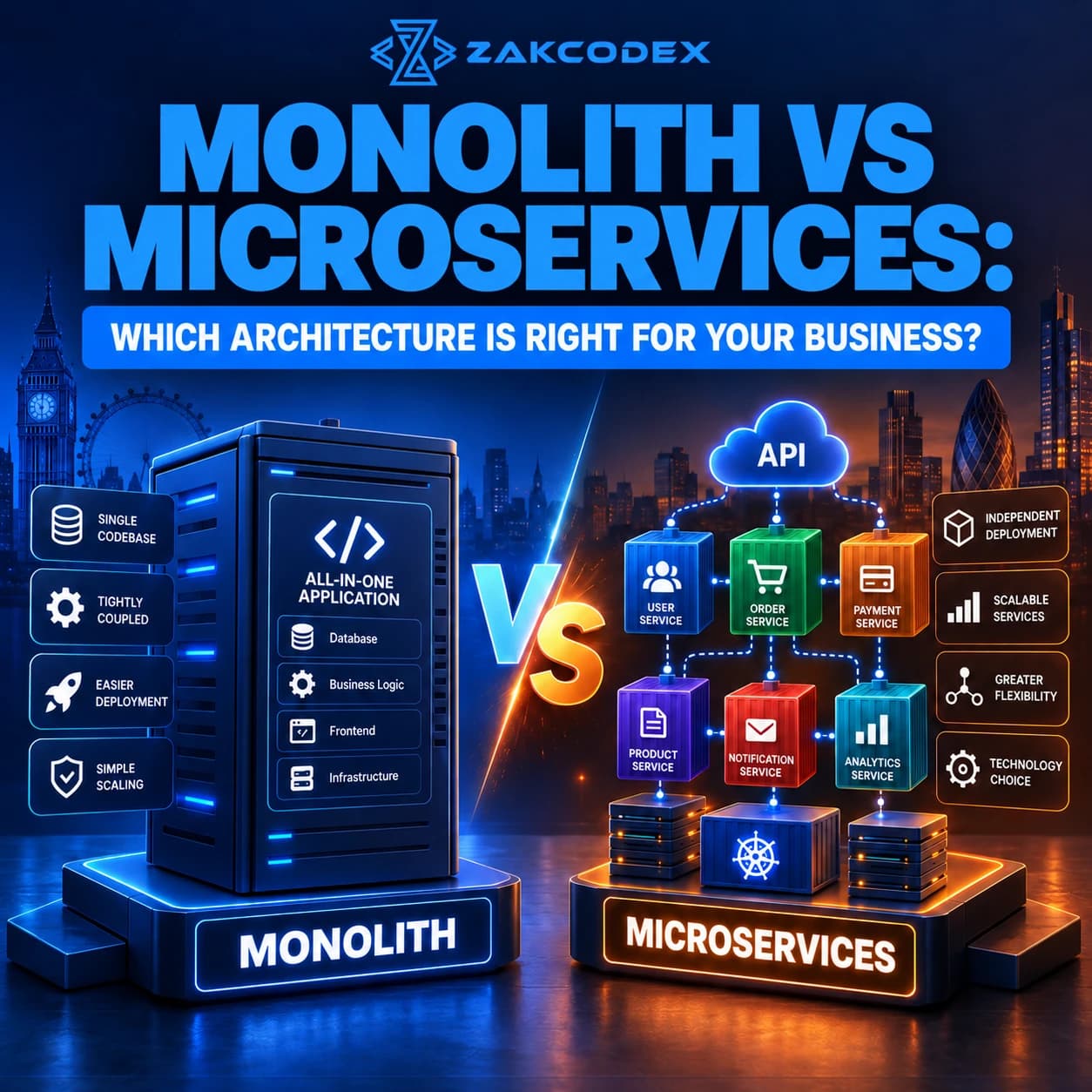

Choosing between Laravel and Node.js for backend development in 2026 depends entirely on your project requirements: Laravel is the superior choice for database-driven enterprise systems, rapid MVPs, and robust business applications due to its structured ecosystem, built-in security, and low maintenance overhead, whereas Node.js is the better option for high-throughput real-time systems, microservices architectures, and I/O-intensive web applications that benefit from asynchronous, non-blocking single-threaded JavaScript execution. Neither is universally superior, but selecting the wrong system can result in severe architectural bottlenecks, bloated budgets, and delayed product launches.
As businesses demand faster time-to-market and seamless user experiences, backend architecture decisions dictate long-term engineering velocity. A flawed technological choice can saddle technical leaders with compounding tech debt and massive refactoring costs. This guide breaks down the core structural differences between these environments to help you select the ideal framework for your engineering roadmap.
What Is Laravel?
Laravel is an open-source, server-side PHP framework designed following the Model-View-Controller (MVC) architectural pattern. Created by Taylor Otwell, it abstracts complex backend functionality - such as routing, authentication, sessions, caching, and database management - into an elegant, developer-friendly syntax. In 2026, the framework remains the gold standard for PHP web development, empowering teams to build secure, highly maintainable web apps without reinventing foundational components.
Modern Laravel development heavily features sophisticated asynchronous capabilities, natively handling heavy background jobs, complex queue processing, and real-time event broadcasting. It shifts PHP away from its legacy scripting roots, transforming it into an expressive toolset tailored for advanced web development services. By eliminating boilerplate code, it allows developers to focus exclusively on custom business logic.
What Is Node.js?
Node.js is an open-source, cross-platform JavaScript runtime environment built on Google Chrome's V8 JavaScript engine. Introduced by Ryan Dahl, Node.js shifted web engineering by allowing developers to execute JavaScript on the server side, enabling unified full-stack JavaScript development. Utilizing an event-driven, non-blocking I/O model, it is highly efficient and lightweight for managing massive concurrent network connections.
Rather than functioning as a predefined framework, Node.js operates as a runtime ecosystem. Developers typically pair it with a lightweight node.js framework like Express.js, Fastify, or NestJS to construct resilient APIs and distributed architectures. In modern custom software development, it serves as a foundation for scalable applications, real-time data streaming platforms, and microservices.
Laravel vs Node.js Overview
The core structural divergence between these technologies lies in their runtime philosophies and architectural design patterns. The choice is not merely between two languages - PHP and JavaScript - but between a comprehensive, batteries-included framework and a modular, highly composable runtime environment.
| Feature | PHP Laravel Framework | JavaScript Runtime (Node.js) |
|---|---|---|
| Core Architecture | Model-View-Controller (MVC) | Event-driven, Non-blocking asynchronous I/O |
| Primary Language | PHP (Strictly typed via modern features) | JavaScript / TypeScript |
| Ecosystem Philosophy | "Batteries-included" unified framework | Highly modular, unopinionated ecosystem |
| Concurrency Model | Multi-threaded per process (Traditional) or Event-driven (Octane) | Single-threaded event loop with worker threads |
| Database Integration | Eloquent ORM (Built-in Active Record) | Decoupled (Prisma, TypeORM, Mongoose) |
| Ideal Use Cases | SaaS platforms, CRM engines, complex e-commerce, enterprise systems | Streaming, IoT, chat applications, microservices, high-concurrency APIs |
Performance Comparison
When assessing laravel vs node js performance, Node.js historically held a clear advantage due to its non-blocking event loop. Because Node.js handles thousands of concurrent requests without spawning separate OS threads, it achieves incredibly low latency for I/O-bound operations. This makes it perfect for processing high-frequency data payloads without consuming excessive CPU resources.
However, the performance equation changed dramatically with the introduction of laravel octane vs node js benchmarks. Laravel Octane supercharges application speed by serving requests via high-performance application servers like Swoole or RoadRunner. By keeping the application booted in memory across requests, Octane eliminates traditional PHP bootstrapping overhead. While Node.js still leads in pure raw execution speed and raw concurrent request handling, Laravel Octane easily closes the gap for standard business logic and API use cases.
| Performance Metric | Laravel (Standard) | Laravel Octane | Node.js (Express/Fastify) |
|---|---|---|---|
| Execution Model | Request-response lifecycle | Persistent in-memory state | Persistent event loop |
| I/O Bottlenecks | Blocking synchronous I/O | Asynchronous co-routines | Non-blocking asynchronous I/O |
| Reqs per Second | Moderate | High / Extreme | Extremely High |
| Memory Usage | Clears per request | Persistent, requires clean state | Persistent, risk of memory leaks |
Development Speed & Time-to-Market
For engineering velocity, the laravel framework provides unmatched out-of-the-box speed. It comes equipped with native authentication engines, automated database migrations, an integrated mailer, queue workers, and a robust object-relational mapping tool (Eloquent ORM). Developers can launch an MVP rapidly because they do not waste cycles configuring standard infrastructure or picking third-party packages.
Conversely, starting a backend application with Node.js requires significant setup. Developers must actively choose their database ORM, design validation layers, configure authentication protocols, and establish a clear file structure. While this unopinionated approach offers maximum flexibility, it frequently causes configuration fatigue and slower initial development cycles, unless a rigid framework like NestJS is adopted from the start.
Learning Curve & Developer Onboarding
The learning curve depends entirely on your team's existing language capabilities. Node.js leverages JavaScript, meaning frontend engineers can transition to server-side development relatively seamlessly. This shared language model makes unified full-stack engineering simpler for small teams.
Laravel requires comfort with object-oriented programming (OOP) principles and modern PHP patterns. While the syntax is incredibly expressive, developers must understand MVC structures, dependency injection, and framework-specific abstractions. Fortunately, the onboarding friction is heavily mitigated by extensive documentation and world-class educational ecosystems like Laracasts.
Scalability & System Architecture
Node.js shines brightly in microservices architectures and distributed computing layouts. Because it is inherently lightweight, deploying individual Node.js instances inside Docker containers to manage distinct API endpoints is standard practice. This approach allows infrastructure teams to scale individual services horizontally based on targeted demand, reducing overall hosting overhead.
Laravel scales remarkably well horizontally when combined with load balancers, managed databases, and centralized caching layers (such as Redis). However, its monolithic nature means you are typically scaling the entire application block rather than isolated microservices. For standard enterprise application workloads, Laravel scales effectively to millions of users, though it requires intentional architectural planning around queue workers and cache invalidation.
Security Frameworks
Laravel provides exceptional built-in security, making it highly secure out of the box. The framework natively injects protection against Cross-Site Scripting (XSS), Cross-Site Request Forgery (CSRF), and SQL Injection. By forcing parameterized queries via Eloquent and handling password hashing automatically, Laravel ensures applications remain secure by default without requiring specialized security engineering.
Node.js adopts a bare-minimum approach to security. The runtime does not provide native protection mechanisms against web vulnerabilities. Engineering teams must manually integrate security packages (like Helmet), configure CORS policies, and strictly sanitize data inputs. While a Node.js system can be made perfectly secure, the responsibility rests completely on the developers, introducing human-error risks if security best practices are overlooked.
API Development & Architecture
When engineering high-throughput API layers, both environments provide robust toolsets, but serve different architectural patterns. Node.js is frequently the default choice for lightweight, stateless rest api development, acting as a fast data aggregation proxy layer between frontend clients and distributed microservices.
Laravel offers an exceptional developer experience for complex api development via Laravel API Resources. This tool provides an elegant data transformation layer, ensuring database structures are never leaked directly to frontend consumers. Coupled with built-in authentication systems like Laravel Sanctum or Passport, building secure, version-controlled APIs with granular permissions is remarkably streamlined.
Real-Time Applications
Node.js is built specifically for real-time application paradigms. Its event-driven, WebSocket-friendly nature allows it to maintain millions of persistent, open connections with minimal memory overhead. This makes Node.js the undisputed industry standard for collaborative document suites, live chat platforms, multiplayer dashboards, and high-frequency IoT ingest engines.
Laravel handles real-time data streaming through event broadcasting systems linked to WebSockets via tools like Laravel Reverb or Soketi. While this lets Laravel developers easily push real-time alerts and state updates to the frontend, the underlying architecture still requires a stateful companion server. For systems where real-time streaming is the central feature, Node.js remains the structurally superior choice.
Database Support & Persistence Layers
Laravel includes Eloquent ORM, arguably the most developer-friendly Active Record implementation in backend development. It simplifies relational operations, eager-loading relations, and database migrations across MySQL, PostgreSQL, SQLite, and SQL Server. Database work in Laravel feels highly unified and consistent.
Node.js relies entirely on the external open-source ecosystem for database persistence. Developers must manually pick and integrate tools like Prisma, TypeORM, or Mongoose (for MongoDB). This modular approach provides excellent flexibility, allowing teams to seamlessly pair a Node.js runtime with non-relational NoSQL databases or specialized graph databases for complex data topologies.
Community, Packages, & Ecosystem
The Node.js ecosystem is powered by npm (Node Package Manager), the largest software registry in existence. The sheer volume of community packages ensures that almost any integration, library, or API wrapper already exists. However, npm requires diligent maintenance due to frequent package deprecations and potential supply-chain security vulnerabilities.
Laravel operates within the PHP Composer package manager. While smaller than npm, the quality control within the Laravel ecosystem is extraordinarily high. First-party packages maintained directly by the Laravel team - such as Horizon for queue management, Nova for admin panels, and Cashier for Stripe billing integrations - provide enterprise-grade stability that eliminates the compatibility risks often found in open-source libraries.
Hosting, Deployment, & Serverless
Deploying a traditional Laravel application requires a standard web server environment running PHP-FPM alongside Nginx or Apache. To simplify this process, the ecosystem offers specialized hosting and DevOps management tools like Laravel Forge and Vapor (for serverless AWS Lambda execution). These tools make deployment automation relatively straightforward.
Node.js boasts near-universal deployment compatibility. It runs natively across every major cloud platform, from basic PaaS options like Heroku to serverless environments like AWS Lambda, Vercel, and Google Cloud Functions. Its quick startup times make it an exceptional match for modern serverless infrastructure deployments.
Development & Maintenance Cost
From a budgeting perspective, understanding long-term maintenance costs is vital. A detailed breakdown of regional operational budgets is covered in our analysis of laravel development cost uk, but general architectural costs follow distinct trends.
| Cost Category | Laravel Approach | Node.js Approach |
|---|---|---|
| Initial Build Cost | Lower (Fast MVP generation, built-in scaffolding) | Higher (Custom infrastructure setup required) |
| Long-Term Maintenance | Lower (Standardized framework code rules) | Higher (Frequent dependency updates, custom architectures) |
| Infrastructure Costs | Standard (Optimized via caching/Octane) | Highly Efficient (Low footprint for microservices) |
| Developer Sourcing | Cost-effective (Abundant PHP engineering talent) | Competitive (High demand for JavaScript/TypeScript) |
Architectural Choice by Business Scale
Laravel for Startups
For early-stage startups, time-to-market is the ultimate survival metric. Laravel allows small engineering teams to build, secure, and ship full-featured software products in record time. The framework handles security, user authentication, and billing systems out of the box, allowing startups to rapidly iterate based on customer feedback before run-rate capital evaporates.
Node.js for Startups
Startups should choose Node.js if their core product relies heavily on continuous real-time data syncs, instantaneous messaging features, or processing highly distributed IoT streams. Furthermore, if a startup's engineering team consists purely of frontend JavaScript developers, using Node.js keeps the stack unified, eliminating the need to hire specialized backend engineers early on.
Laravel for Enterprise Applications
Large-scale enterprise platforms require strict architectural consistency, long-term code maintainability, and predictable security structures. Laravel's highly standardized configuration ensures that large, distributed development teams can collaborate seamlessly on massive codebases without inventing divergent architectural patterns. It simplifies audit logging, compliance, and multi-tenant database scaling.
Node.js for Enterprise Applications
In massive corporate infrastructures, Node.js serves as an exceptionally efficient integration layer. It is widely used by enterprises to build high-performance API gateways, aggregate data across disparate legacy legacy platforms, and power complex microservices networks that handle hundreds of thousands of requests per minute with minimal server footprints.
Pros and Cons
Laravel Advantages
- Comprehensive, built-in ecosystem that drastically reduces structural boilerplate code.
- Exceptional out-of-the-box protection against standard web vulnerabilities.
- Eloquent ORM offers intuitive, expressive relational database interactions.
- Laravel Octane provides massive performance boosts for high-traffic environments.
- Highly structured framework design ensures long-term codebase maintainability.
Laravel Disadvantages
- Can feel unnecessarily heavy for tiny, single-purpose microservices.
- Legacy synchronous execution models require additional configuration (Octane) to match Node.js speeds.
- Deeply tied to the PHP ecosystem, which may not align with JavaScript-focused teams.
Node.js Advantages
- Extremely fast raw performance when managing asynchronous, I/O-heavy concurrent workloads.
- Enables full-stack JavaScript development, maximizing code reuse between frontend and backend.
- Perfect structural match for decoupled, event-driven microservices architectures.
- Massive npm package ecosystem provides instant access to thousands of external libraries.
- Lightweight footprint makes it highly optimized for serverless deployments.
Node.js Disadvantages
- Unopinionated design can lead to inconsistent code structures and technical debt without strong architecture rules.
- No built-in security features, making security compliance entirely manual.
- Unsuited for heavy CPU-bound computational algorithms due to its single-threaded nature.
Decision Matrix: When to Choose Which?
To help visualize the final selection, use this targeted architectural decision matrix based on your core application requirements.
| Project Requirement | Recommended Stack | Primary Architectural Reason |
|---|---|---|
| Rapid MVP / Standard SaaS Platform | Laravel | Built-in auth, billing, and database tooling speeds up time-to-market. |
| Real-Time Chat / Collaborative Tools | Node.js | Asynchronous event-loop handles persistent WebSockets seamlessly. |
| Data-Heavy Relational CRM / ERP | Laravel | Eloquent ORM makes complex relational schemas highly maintainable. |
| Microservices / Serverless Architecture | Node.js | Lightweight footprint and rapid cold-start execution properties. |
| Strict Budget & High Security Needs | Laravel | Native security protections minimize custom security testing expenses. |
| High-Throughput Streaming API Proxy | Node.js | Non-blocking I/O effortlessly aggregates distributed data feeds. |
Final Recommendation
Selecting between node js vs laravel is not a matter of finding the absolute best technology, but rather finding the right tool for your specific engineering goals. If your web application centers around structured business logic, comprehensive relational databases, deep security compliance, and an urgent time-to-market window, choosing php laravel vs node js defaults clearly to Laravel to maximize development efficiency.
If your roadmap requires building a fast, lightweight real-time data engine, highly decoupled microservices, or a streaming platform handling massive concurrent requests, choosing laravel vs node js which is better breaks clearly in favor of Node.js. Evaluate your team's current language competencies, your security requirements, and your long-term scaling strategy to make the optimal choice for your software project.