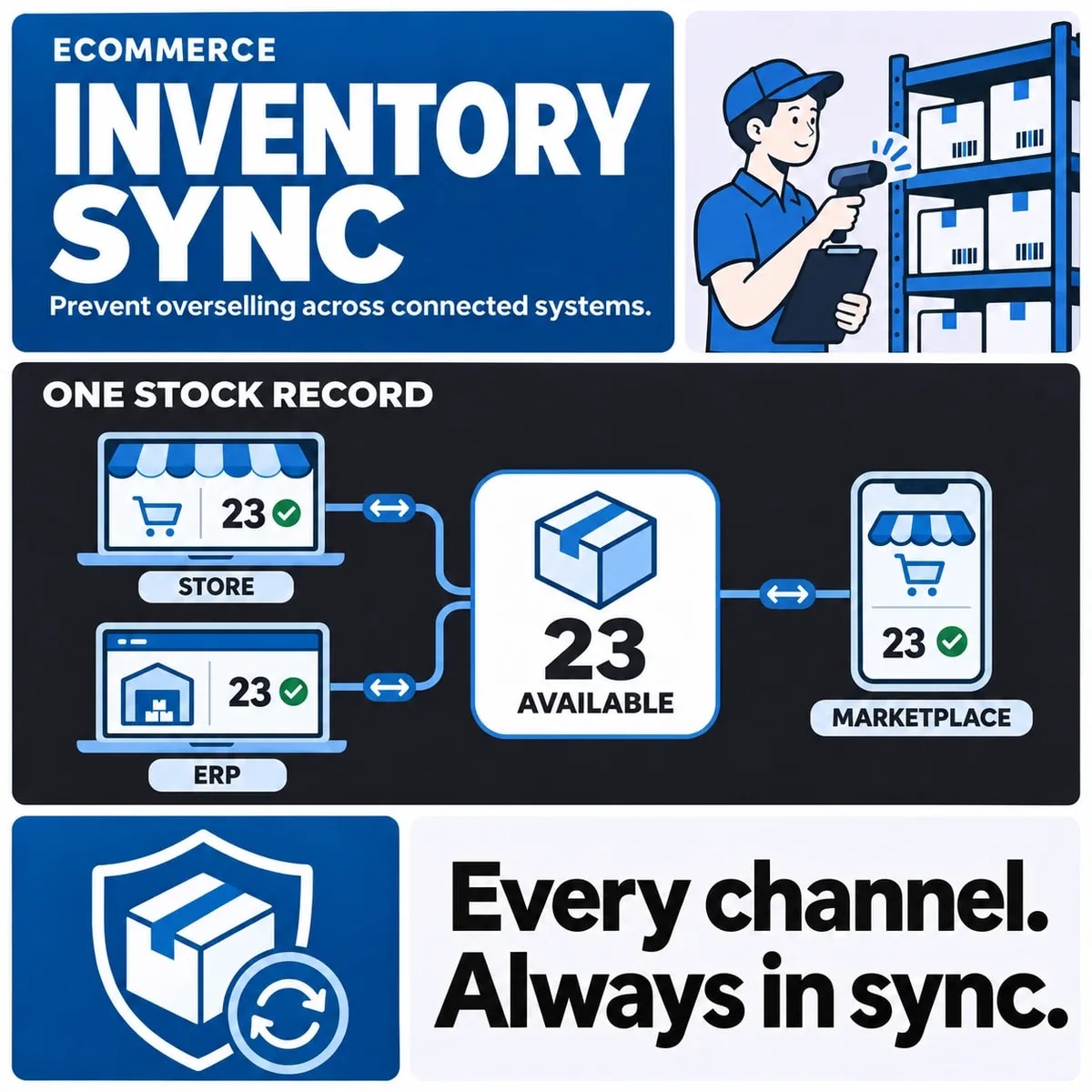

Reliable ecommerce inventory sync starts with agreement on what each quantity means and which system owns it. Separate physical stock, reservations, available-to-sell quantities and channel offers. Then define how orders, cancellations, returns and delayed updates change those quantities.
Synchronising one number more frequently cannot resolve conflicting definitions or guarantee that overselling never occurs. The business needs explicit selling rules and a way to reconcile channels when their records diverge.
Name the inventory quantities before choosing a sync method
Ask what “stock” means in each connected system. Warehouse stock may include units already reserved, awaiting inspection or unavailable for another reason. A storefront usually needs a quantity it may offer, which can differ from the physical count.
Shopify's inventory-state documentation distinguishes quantities such as on hand and available within its model. Other platforms may use different states or terminology. Map their actual contracts rather than assuming identical labels mean identical quantities.
Write a small glossary for the integration. Include location, variant and unit of measure. A product total spread across warehouses may be unsuitable for a channel that can fulfil only from one location. A carton and a single item must not become interchangeable because they share a product description.
Record when a quantity becomes authoritative. A warehouse count, a reservation and a return inspection describe different facts at different points in time. Their update delays and approval steps should be visible in the requirements.
Assign one owner for each field and transition
Define ownership by field and operation. The warehouse may own physical adjustments while the ecommerce platform owns the initial order event. A connected system can consume those facts without becoming entitled to overwrite them.
Assign field ownership and exception handling during inventory integration planning.
Specify stable identifiers for variants, locations and relevant business operations. Product names change and are rarely a reliable integration key on their own. Identify how new products, retired variants and unmatched records enter the mapping process.
Decide whether the integration sends absolute quantities, movements or reservation instructions. Each contract has different reconciliation questions. Applying a movement twice can duplicate an adjustment; applying an old absolute quantity after a newer one can overwrite valid work.
Ownership also applies to corrections. If a marketplace quantity differs from the warehouse, identify who decides whether to republish, hold the listing or investigate. Allowing staff to edit every system independently can cause a correction to be overwritten by the next sync.
Model orders, cancellations and returns
Work through a hypothetical stock ledger. Assume 10 usable units on hand and 2 valid reservations. Under this fictional policy, 8 units are available. If the business chooses to hold a buffer of 1, it offers 7. These values illustrate the calculation; they are not recommended settings or observed customer figures.
- An accepted order creates the agreed reservation or stock transition.
- A confirmed cancellation releases the relevant reservation once.
- A repeated cancellation encounters the existing outcome rather than releasing another unit.
- A returned item follows inspection rules before it becomes available again.
If Shopify is one channel, check its inventory behaviour when agreeing Shopify development requirements.
Keep the distinction between a cancelled order and a refunded payment. They may be related, but the stock decision depends on fulfilment and the actual item state. A dispatched item cannot automatically become available because a payment operation occurred.
Define partial cases too. One line may be cancelled while another is fulfilled. A return can contain fewer items than expected, or include a damaged item. The integration needs references at the level where these business decisions occur.
Have operations review the ledger in ordinary language. They should be able to explain where a unit is, whether someone has reserved it and which channel may offer it. If they cannot, choosing a transport method is premature.
Plan for simultaneous orders and delayed events
Two channels can accept demand close together. Decide where the authoritative reservation or allocation decision occurs and what each channel can promise before that decision is confirmed. Publishing a recent quantity does not necessarily reserve the remaining unit for a particular buyer.
Ask the delivery team to explain competing orders for the final available unit. The expected outcome might include an explicit refusal or an exception process, depending on platform capability and the business's selling policy. Do not hide that decision behind the phrase “real-time sync”.
Delayed and out-of-order updates require a defined rule. Identify the source operation and relevant version or sequence evidence. A late event should not silently undo a later accepted state.
Plan interruption behaviour. If a channel cannot receive updates, decide whether selling continues with a buffer, pauses for affected items or follows another agreed rule. The choice depends on the products, channel controls and operational consequences, not a universal buffer size.
Keep unknown outcomes visible. A timeout after sending a reservation does not show whether the destination accepted it. Reconcile that operation before repeating a stock movement that might already have happened.
Reconcile channels and route exceptions
Compare expected and observed states using the correct definitions and time references. A comparison between physical stock and offered stock can flag a difference that is completely intentional. Reconciliation should account for reservations, buffers and pending work.
A useful exception identifies the product and location, the two compared states, the relevant operations and the next decision owner. Avoid a generic alert that says only “inventory mismatch”.
Group cases by likely action: missing mapping, rejected update, stale quantity, duplicate movement or unresolved order. Some need a data correction; others need operational investigation. Automatic retries should not conceal a repeated invalid mapping.
Also choose how an initial sync or resync establishes its starting point. A fresh snapshot and events arriving during its creation can overlap. Ask how the design avoids missing or repeating the activity between them, and what evidence will demonstrate the intended result.
Consider a stock count corrected while an order is being processed. In the fictional ledger, the count owner changes the usable on-hand quantity, while the order system still holds a valid reservation. Ask how the final available quantity is derived without erasing either fact. A correction to physical stock should not automatically cancel a customer's reservation or add back a unit already committed elsewhere.
Keep this case separate from ordinary event delay. The two systems may both be current about different facts. The resolution depends on the agreed quantity model and ownership, so a reconciliation screen should expose the contributing quantities rather than offer only a button to copy one displayed total over the other.
Scope the integration around the real selling process
Prepare representative products and journeys before requesting implementation estimates. Include multiple locations if relevant, a cancellation, a partial return and a competing-order case. Identify the actual platform access and features available to the business.
The resulting scope should describe quantities, ownership, reservations, recovery and reconciliation. That gives the team a practical basis for reducing stock inconsistencies while keeping unavoidable limits and manual exception work visible.
Discuss the stock states and reconciliation needed in your ecommerce system development with ZakCodeX.