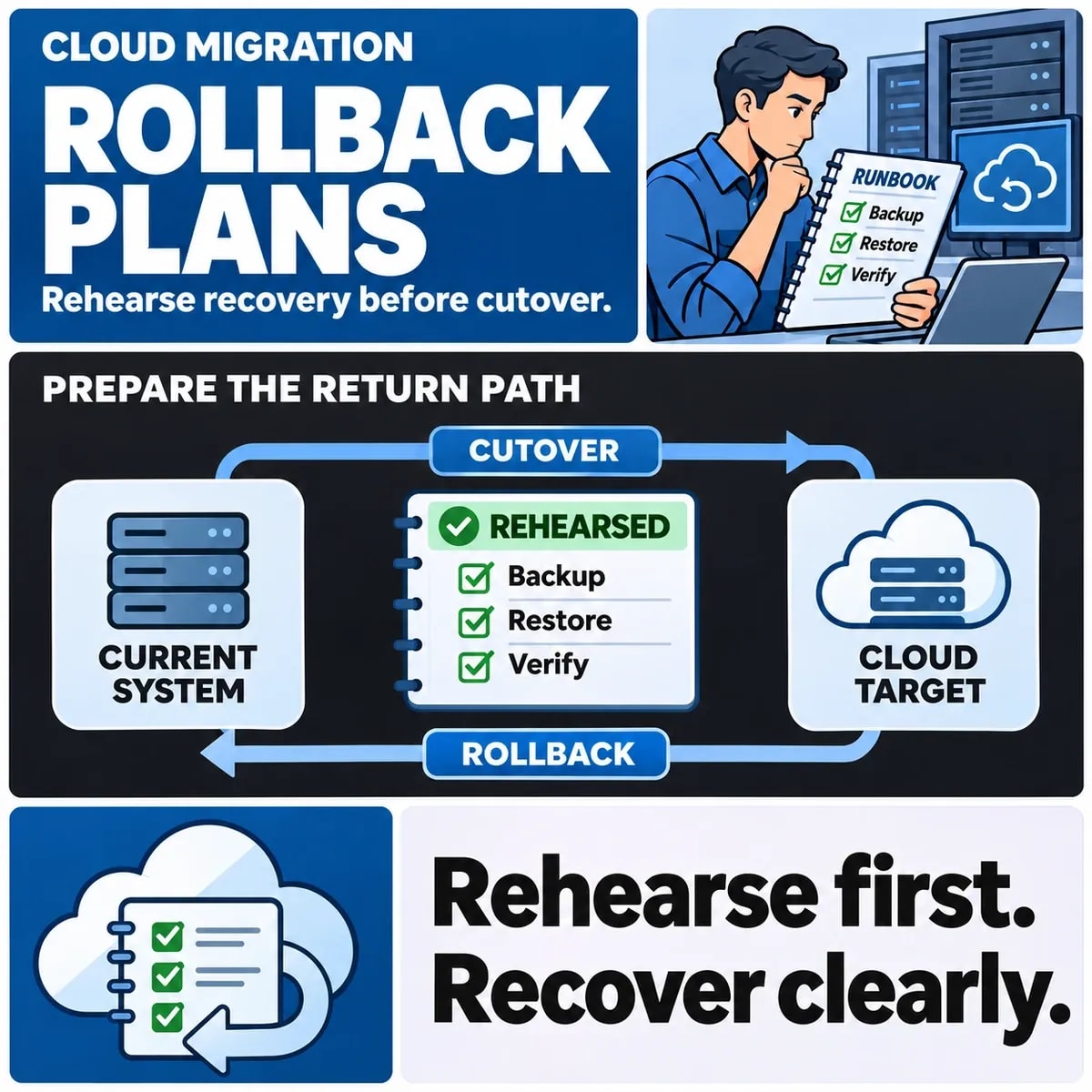

A cloud migration rollback plan needs more than instructions for switching to an earlier environment. It should identify decision triggers, an accountable owner, the last point where reversal remains practical, and the treatment of business activity created after cutover. Rehearse those decisions before production traffic moves.
The difficult question is often not whether infrastructure can be restored. It is whether the business can return to a coherent state without overlooking orders, updates or external actions. A useful rehearsal makes those dependencies and uncertainties visible while there is still time to resolve them.
Separate migration rollback from disaster recovery
Keep the scope clear. Migration rollback concerns a planned change from one operating arrangement to another. Disaster recovery concerns restoring ongoing operations after a disruption. They may share tools, but their starting conditions, decision windows and data histories can differ.
When the migration also changes the application, consider the wider legacy software modernisation decisions.
Define what is moving: applications, databases, files, network routes and integrations may change at different moments. A single “switch back” instruction can conceal a sequence that must remain coordinated. Ask which parts can be reversed independently and which would create a mismatched application or data state.
Record the business outcome the cutover must preserve. Staff need to know whether they can continue accepting work, whether a transaction is safely recorded and which system is authoritative. Those questions are more useful than an unqualified claim that rollback is available.
Identify checkpoints and the last reversible point
Choose checkpoints that correspond to meaningful evidence. Examples might include restored-data checks, identity access, a representative workflow and confirmation that a required integration is operating. The actual sequence should follow the dependencies of the migration.
Identify cloud application dependencies that could make a successful infrastructure move an incomplete business cutover.
For each checkpoint, state the expected evidence, who reviews it and which decisions are permitted. A failed check might mean pause, investigate, reverse an earlier step or continue under an approved exception. Avoid leaving those alternatives to an improvised discussion during the change window.
The last reversible point is a decision boundary, not necessarily a timestamp chosen in advance. It may depend on whether new transactions have entered the destination or whether an external change can be undone. Make the conditions observable so the cutover lead can recognise them.
Also define what happens if evidence arrives late. If a downstream owner cannot confirm the result, the team should know whether the change waits or proceeds under a particular authority. Silence should not become an accidental approval.
Resolve what happens to post-cutover writes
AWS's migration rollback guidance discusses recovery strategies when migration does not go to plan. The important planning lesson is to consider the migration state and data created around cutover, rather than assuming that restoring an earlier environment resolves the entire business outcome.
Read-only windows and continuing transactions
Identify every writer: staff, website requests, scheduled jobs and connected systems. A user-facing application may be paused while a background process continues to update records. The requirements should explain whether writes stop, are queued or are captured for later reconciliation.
Use a hypothetical order application. After users switch to the new environment, an order is accepted and a warehouse request is sent. Returning to the old database could omit the order, while repeating the warehouse request could duplicate an external effect. The recovery decision needs evidence from both systems.
Reconciliation after either recovery route
Agree how new activity will be identified and accounted for if the team reverses the cutover or repairs the destination. Include the owner of unmatched records and the authority needed for corrections. A technical restore and a business reconciliation are separate pieces of work.
Do not promise a universal zero-loss reversal. The available route depends on the actual architecture, provider behaviour and operations already performed. Where a decision is unresolved, keep it visible in the plan rather than disguising it as a tested recovery capability.
Rehearse the decision log in a safe setting
A rehearsal should exercise the people and decisions as well as the technical sequence. Use an approved setting and clearly defined test data. This article describes a planning exercise; it does not instruct an unapproved production failover or provide commands to run against live systems.
- State the checkpoint. In the fictional exercise, application checks pass but a required downstream update is not confirmed.
- Record the known facts. The destination contains new work; the team has not yet established the downstream result.
- Name the decision owner. The cutover lead pauses progression and obtains the relevant technical and business evidence.
- Choose an authorised recovery branch. Reversal or forward recovery follows the pre-agreed conditions, including treatment of new activity.
- Verify the business result. The exercise is not closed merely because the original application becomes reachable.
Introduce an information gap deliberately. Ask who can find the original operation, who can approve a correction and how long the team can wait within the actual change arrangements. These answers reveal missing responsibilities without inventing a standard recovery window.
Record cutover evidence and unresolved exceptions
Keep a usable record of the environment, data point, checks, decisions and remaining issues. A log that says “rollback successful” is difficult to assess if it does not explain what was recovered or which activity was reconciled.
| Record | Question it should answer |
|---|---|
| Starting state | Which application, data and dependency versions were involved? |
| Checkpoint evidence | What was observed, by whom, and what remained unknown? |
| Decision | Who authorised pause, reversal or forward recovery, and why? |
| New business activity | Which writes or external effects needed reconciliation? |
| Closure | Which business checks passed and which follow-ups still have owners? |
Distinguish a corrected plan from a completed rehearsal. If the exercise exposes a missing integration check, document the change and the evidence still required. Updating the runbook is progress, but it does not establish that the revised sequence has been demonstrated.
Store references to evidence where the responsible team can find them, with appropriate access. Avoid scattering sensitive migration data through informal messages when a controlled record can identify the relevant transaction or log.
Give the rehearsal team two separate observations: the application responds normally, but an external warehouse has accepted a request that the old environment cannot see. Ask what evidence would make reversal acceptable. If the answer is merely that the old server is healthy, the business-effect question remains unresolved. Record who obtains the warehouse reference and who decides how the accepted order will be represented after either recovery branch.
Agree recovery responsibilities before the migration
The project owner, cutover lead and business process owners should be able to explain the same recovery branches. Confirm the escalation route and authority to stop. A supplier's technical readiness cannot substitute for the business deciding which unresolved outcomes it can accept.
Use the rehearsal to improve the migration plan while changes are still manageable. The deliverable is a decision process supported by evidence: what to inspect, when to pause, how to choose a recovery route and how to account for new activity. Keep ongoing disaster-recovery exercises separate from this cutover-specific scope.
Discuss cutover decisions and recovery ownership as part of cloud migration planning with ZakCodeX.