
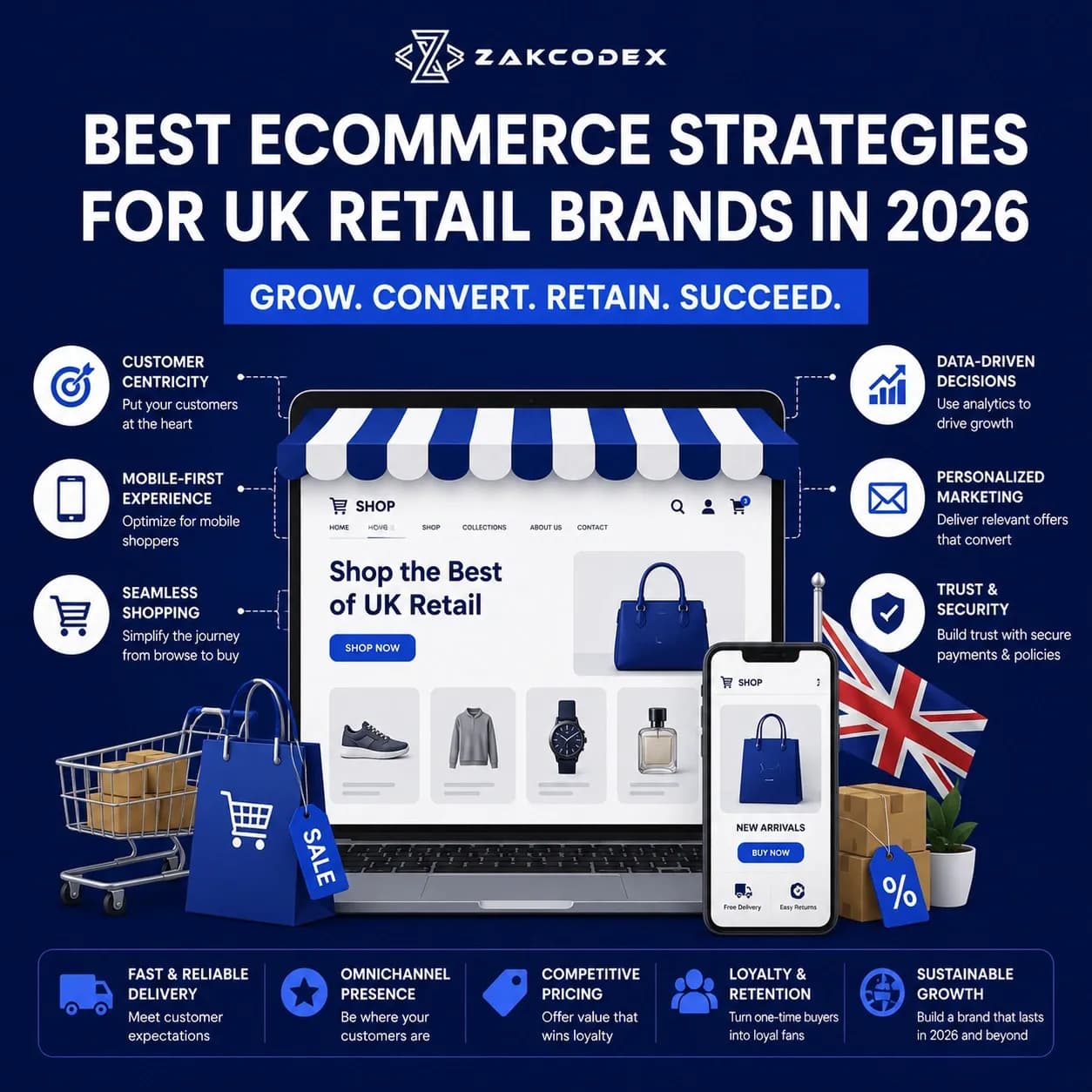
The UK ecommerce market continues to evolve at an unprecedented pace. Consumer expectations are higher than ever, competition is increasing across every retail category, and artificial intelligence is reshaping how shoppers discover products online. For UK retail brands, success is no longer determined solely by product quality or pricing. Instead, it depends on delivering seamless customer experiences, personalized shopping journeys, and omnichannel engagement.
Whether you're a fashion retailer, home décor brand, electronics store, or direct-to-consumer business, implementing the right ecommerce strategies can significantly increase conversions, customer retention, and long-term profitability.
In this guide, we'll explore the most effective ecommerce strategies for UK retail brands and how businesses can leverage modern technology, AI, and customer-centric marketing to achieve sustainable growth.
Why Ecommerce Strategy Matters for UK Retail Brands
The UK remains one of the world's largest ecommerce markets. Modern consumers expect convenience, personalization, fast delivery, and consistent experiences across multiple channels.
Retailers that invest in omnichannel experiences and digital transformation often outperform businesses relying solely on physical stores. Industry reports indicate that omnichannel retailers continue to experience stronger growth compared to businesses operating through a single sales channel.
Today's successful retail brands focus on:
- Customer Experience (CX)
- Conversion Rate Optimization (CRO)
- AI-Powered Personalization
- Mobile Commerce
- Social Commerce
- Omnichannel Retailing
- Customer Retention
- Data-Driven Marketing
1. Build a High-Performance Ecommerce Website
Your ecommerce website serves as your digital storefront. A slow, outdated, or poorly designed website can significantly impact conversion rates.
Key website optimization practices include:
Fast Loading Speed
Website speed directly affects:
- User experience
- Search engine rankings
- Conversion rates
- Bounce rates
Retail brands should aim for:
- Core Web Vitals optimization
- Fast server response times
- Optimized images
- CDN implementation
- Lightweight themes
Mobile-First Design
A large percentage of UK consumers shop using smartphones. Therefore, every ecommerce store should prioritize:
- Responsive design
- Mobile-friendly navigation
- Fast checkout experience
- Mobile payment integration
User Experience (UX)
Great UX improves engagement and sales.
Focus on:
- Clear navigation
- Product filtering
- Search functionality
- Easy checkout process
- Trust signals
- Customer reviews
For businesses looking to create a scalable ecommerce platform, professional Shopify development solutions can provide significant advantages. Explore Shopify Web Development Services offered by ZakCodeX to build high-performing ecommerce stores tailored for modern retail growth.
2. Implement AI-Powered Personalization
Personalization has become a major competitive advantage for UK ecommerce businesses.
Modern consumers expect:
- Relevant product recommendations
- Personalized offers
- Customized shopping experiences
- Behavioral targeting
Research shows that personalized experiences significantly improve customer loyalty and purchasing behavior. Consumers are more likely to engage with brands that understand their preferences and shopping habits.
Personalization Techniques
Use:
- Product recommendation engines
- AI-powered search
- Dynamic content
- Personalized email campaigns
- Behavioral segmentation
Benefits
- Increased Average Order Value (AOV)
- Improved customer retention
- Higher conversion rates
- Better customer satisfaction
3. Create a Strong Omnichannel Retail Strategy
One of the most effective ecommerce strategies for UK retail brands is omnichannel retailing.
Customers frequently interact with brands across multiple touchpoints, including:
- Ecommerce websites
- Mobile apps
- Physical stores
- Social media platforms
- Email marketing
- Marketplaces
Successful retailers provide a seamless experience across all channels. Research indicates that omnichannel approaches continue to drive customer engagement and business growth.
Omnichannel Best Practices
Click and Collect
Allow customers to:
- Buy online
- Pick up in-store
Unified Customer Data
Create a centralized customer profile across all channels.
Consistent Branding
Ensure:
- Pricing consistency
- Product consistency
- Messaging consistency
Integrated Inventory Management
Enable real-time inventory visibility.
4. Leverage Social Commerce
Social commerce is rapidly becoming a critical sales channel for UK retailers.
Consumers increasingly discover products through:
- TikTok
- YouTube
Studies show that social platforms significantly influence purchasing decisions among UK consumers.
Social Commerce Strategies
Shoppable Posts
Allow customers to purchase directly from social platforms.
Influencer Marketing
Collaborate with:
- Industry experts
- Micro-influencers
- Content creators
User-Generated Content (UGC)
Encourage customers to share:
- Reviews
- Product photos
- Testimonials
Live Shopping
Live commerce events help brands:
- Demonstrate products
- Build trust
- Increase conversions
5. Optimize Ecommerce SEO
Search Engine Optimization remains one of the highest ROI marketing channels for ecommerce brands.
Effective ecommerce SEO involves:
Keyword Optimization
Target:
- Commercial keywords
- Transactional keywords
- Informational keywords
Examples:
- UK fashion retailer
- online clothing store UK
- ecommerce growth strategies
- Shopify development agency
Category Page SEO
Optimize:
- Meta titles
- Meta descriptions
- Internal links
- Product descriptions
Product Page SEO
Include:
- Unique content
- Product specifications
- Customer reviews
- Structured data
Technical SEO
Focus on:
- Crawlability
- Site architecture
- Schema markup
- XML sitemaps
6. Improve Conversion Rate Optimization (CRO)
Generating traffic is only half the battle.
Retail brands must continuously optimize conversion rates.
Effective CRO Strategies
Simplify Checkout
Reduce friction by:
- Minimizing form fields
- Offering guest checkout
- Supporting digital wallets
Trust Signals
Display:
- Security badges
- Customer reviews
- Refund policies
- Delivery information
Product Reviews
Reviews improve:
- Trust
- Social proof
- Conversion rates
A/B Testing
Test:
- Headlines
- CTAs
- Product layouts
- Checkout flows
7. Invest in Customer Retention
Acquiring new customers is often more expensive than retaining existing ones.
Customer retention strategies include:
Loyalty Programs
Reward repeat customers with:
- Points
- Discounts
- Exclusive offers
Email Marketing
Use email automation for:
- Welcome sequences
- Cart abandonment
- Product recommendations
- Re-engagement campaigns
Subscription Models
Recurring purchases can increase:
- Customer lifetime value
- Revenue predictability
Customer Support
Provide:
- Live chat
- AI chatbots
- Multi-channel support
8. Use Data Analytics for Smarter Decisions
Data-driven ecommerce businesses consistently outperform competitors.
Monitor key metrics such as:
Conversion Rate
Measures sales performance.
Average Order Value (AOV)
Tracks revenue per order.
Customer Lifetime Value (CLV)
Measures long-term customer profitability.
Cart Abandonment Rate
Identifies checkout issues.
Retention Rate
Measures customer loyalty.
Use analytics platforms to identify:
- Customer behavior
- Sales trends
- Marketing performance
- Product opportunities
9. Embrace AI and Automation
Artificial Intelligence is transforming ecommerce operations.
Retail brands should implement:
AI Chatbots
Benefits include:
- 24/7 support
- Faster response times
- Reduced support costs
Automated Marketing
Automate:
- Emails
- SMS campaigns
- Customer segmentation
Predictive Analytics
Forecast:
- Demand
- Inventory needs
- Customer behavior
AI Product Recommendations
Improve personalization and increase revenue.
10. Choose the Right Ecommerce Platform
Your ecommerce platform directly affects scalability and growth.
Shopify remains one of the most popular ecommerce solutions due to:
- Ease of use
- Scalability
- Security
- Extensive integrations
Professional Shopify development helps businesses build customized online stores that support growth objectives.
If you're planning to launch or scale a Shopify store, ZakCodeX offers comprehensive Shopify development solutions designed specifically for ecommerce brands.
Future of Ecommerce for UK Retail Brands
The future of UK ecommerce will be shaped by:
- Artificial Intelligence
- Hyper-Personalization
- Social Commerce
- Voice Search
- Omnichannel Experiences
- Predictive Analytics
- Customer Experience Optimization
Retailers that embrace innovation while maintaining a customer-first approach will be positioned for long-term success.
As demonstrated by recent investments from major UK retailers in ecommerce technology, digital transformation continues to be a strategic priority for maintaining competitiveness and improving customer experiences.
Conclusion
The most successful UK retail brands are no longer relying on a single growth tactic. They combine ecommerce SEO, AI-powered personalization, omnichannel retailing, social commerce, customer retention, and data-driven decision-making to create exceptional customer experiences.
By implementing these ecommerce strategies, retailers can increase visibility, improve conversion rates, strengthen customer loyalty, and drive sustainable revenue growth.
Whether you're launching a new online store or scaling an established retail business, investing in the right ecommerce technology and development partner can accelerate your success. ZakCodeX helps ecommerce brands build powerful Shopify stores designed for performance, scalability, and long-term growth.