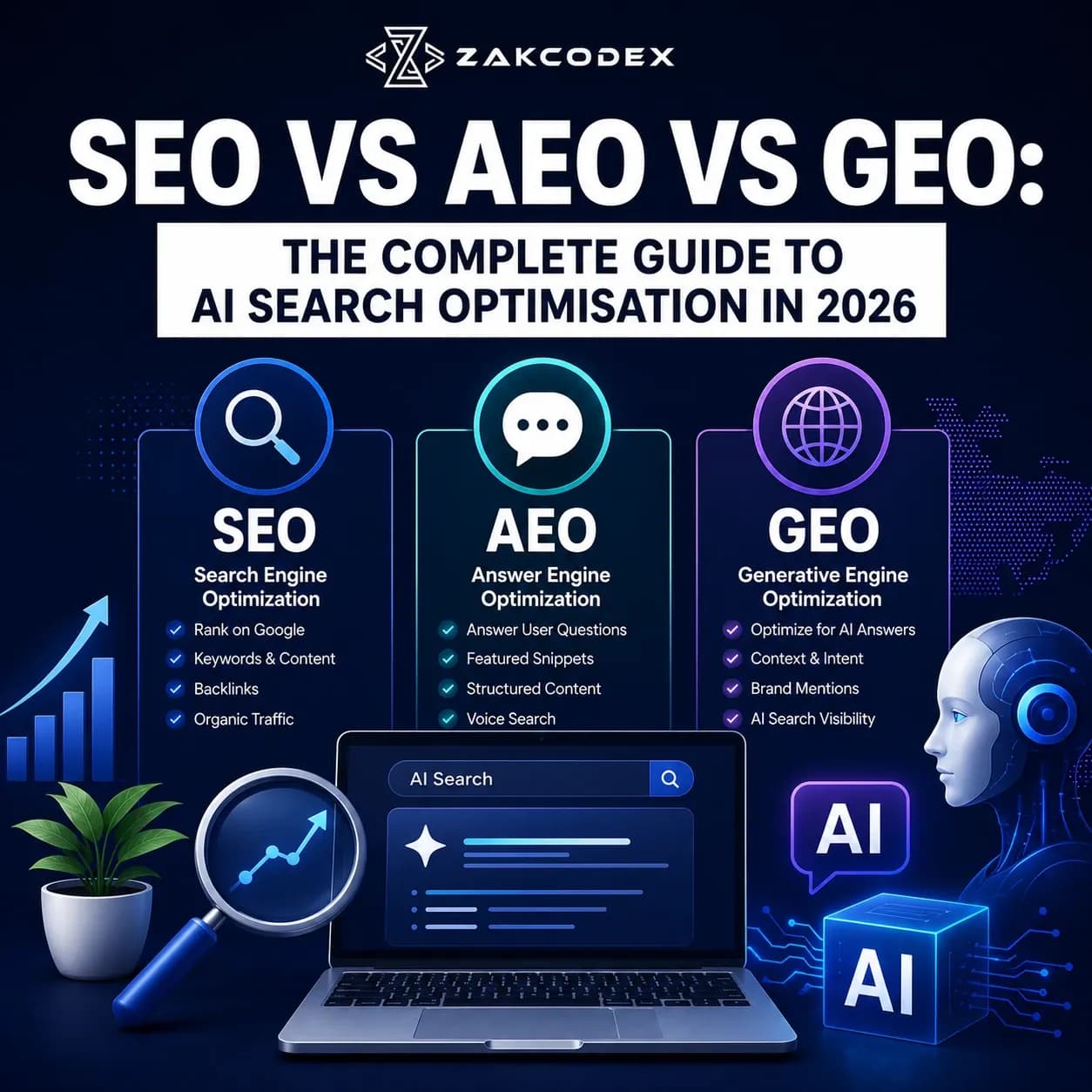
The core difference in seo vs aeo vs geo lies in their target landscapes: SEO (Search Engine Optimisation) optimizes websites for traditional blue-link search engine result pages, AEO (Answer Engine Optimisation) targets direct, zero-click conversational answers on voice devices and chatbots, and GEO (Generative Engine Optimisation) shapes multi-modal content to ensure citations within AI-synthesised, generative summaries. Rather than replacing each other, these three paradigms form a unified strategy required to win visibility across modern multi-platform search environments.
Quick Answer Box: What is SEO vs AEO vs GEO?
• SEO: Focuses on organic ranking factors (keywords, backlinks, technical health) for traditional web browsers.
• AEO: Synthesizes bite-sized, structured schema arrays for rapid voice responses and single-answer conversational engines.
• GEO: Integrates domain authority, specific technical statistics, quotes, and structural citations to secure references inside large language models (LLMs).
As consumer journeys splinter across legacy search interfaces, standalone generative agents, and real-time citation engines, modern enterprise visibility demands a complete overhaul of traditional digital strategy. Relying solely on historical keyword density models leaves your brand entirely invisible to users querying generative platforms. This comprehensive, expert-level strategic framework breaks down the technical definitions, optimization mechanics, and practical business steps required to master ai search optimisation in 2026.
What Is SEO (Search Engine Optimisation)?
Traditional Search Engine Optimisation (SEO) is the foundational digital engineering practice of aligning a web property's indexability, structure, and keyword relevance with organic ranking algorithms like Google's Core systems. Its primary objective is to secure high-visibility real estate within traditional blue-link Search Engine Result Pages (SERPs), maximizing inbound organic click-through rates. Broadly categorized into targeted workflows like robust on-page SEO strategies, execution-led technical SEO implementations, and structured authoritative campaigns like programmatic link building, it remains the baseline requirement for maintaining sustainable digital visibility.
What Is AEO (Answer Engine Optimisation)?
Answer Engine Optimisation (AEO) is a specialized subset of digital marketing engineered to optimize corporate information for zero-click environments. The goal of answer engine optimisation is to format data so cleanly that conversational systems - such as voice assistants (Siri, Alexa, Google Assistant) and direct conversational interfaces - can instantly extract a single, precise, authoritative answer to a user's explicit question. Instead of driving traffic to a detailed landing page, AEO focuses on providing immediate transactional clarity directly within the user's current interface.
What Is GEO (Generative Engine Optimisation)?
Generative Engine Optimisation (GEO) is the newest frontier in digital visibility, focusing entirely on how large language models (LLMs) synthesize and summarize information. The primary objective of generative engine optimisation is to ensure your brand's data, research, and expert insights are selected as foundational source citations within generative AI answers, such as Google AI Overviews, ChatGPT, Claude, and Perplexity. GEO requires optimizing content specifically for the mathematical retrieval systems used by LLMs, such as Retrieval-Augmented Generation (RAG) applications.
Why AI Search Is Changing Digital Marketing
The rise of advanced llm optimisation models has fundamentally rewritten traditional conversion funnels. The classic user path - typing a fragment query, scanning a list of external URLs, and clicking through to evaluate multiple sources - is quickly giving way to direct, conversational answers. Users now expect highly tailored, aggregated summaries that resolve complex multi-step inquiries within a single interface, significantly reducing traditional organic click-through rates for informational queries.
For modern marketing teams, this shift requires a major pivot away from simple search engine visibility toward search everywhere optimisation. If your technical assets are not optimized to be ingested, understood, and cited by AI engines, your business risks losing touch with consumers who use AI platforms as their primary entry point to the digital economy.
SEO vs AEO vs GEO Overview: Key Differences
Understanding the exact seo vs aeo vs geo differences requires looking past basic marketing terminology to evaluate how information is retrieved, processed, and displayed by different architectures. When analyzing geo vs seo vs aeo patterns, the core differences center on the destination of the data and how the underlying discovery algorithms function.
Traditional SEO ranks independent URLs based on algorithmic crawling, processing, and link equity metrics. AEO extracts specific data strings to answer transactional questions instantly. GEO formats authoritative, deeply informative content layers to ensure inclusion inside AI-synthesised summaries. Evaluating seo vs geo vs aeo methods side-by-side helps technical teams build a balanced approach across every digital channel.
| Strategic Dimension | Traditional SEO | Answer Engine Optimisation (AEO) | Generative Engine Optimisation (GEO) |
|---|---|---|---|
| Primary Objective | Secure high organic positions for standalone URLs within search engines. | Provide the single definitive answer for zero-click queries and voice assistants. | Secure structural citations and references inside AI-synthesised engine responses. |
| Primary Platforms | Google Search, Bing Organic Index, DuckDuckGo. | Siri, Alexa, Google Home, transactional chat components. | Google AI Overviews, ChatGPT Search, Perplexity, Gemini, Claude. |
| Core Algorithmic Focus | Keywords, technical site health, domain backlink profile, click metrics. | Schema markup, explicit Q&A formats, semantic data fragments. | Information density, authoritative quotes, statistical validation, RAG matching. |
| Primary Content Types | Long-form blog guides, commercial collection grids, landing pages. | Structured FAQs, schema definitions, knowledge graphs, clear bullet lists. | Deep whitepapers, expert commentary, original data tables, research papers. |
| Primary Traffic Impact | High direct URL clicks to web landing pages. | Zero-click results; traffic is restricted to highly intentional brand searches. | Inbound citation clicks; drives users seeking in-depth source verification. |
Google Search vs AI Overviews vs ChatGPT vs Gemini vs Perplexity
To master modern visibility, you must understand the technical differences between different search formats. Traditional Google Search relies on indexing algorithms to sort individual matching web pages. Google ai overview optimisation builds directly on top of this framework, using generative models to display synthesized summaries at the top of the SERP while embedding clickable link cards to cite its sources.
In contrast, standalone engines like Perplexity, ChatGPT Search, and Gemini operate primarily as conversational answer engines. They ingest user prompts, dynamically fetch relevant contexts from the web using vector search, synthesize an authoritative response, and place clear citations adjacent to their claims. Winning visibility on these platforms requires formatting your data to be easily extracted by these real-time retrieval networks.
How Search Behaviour Is Changing in 2026
Consumer search behavior in 2026 is defined by natural language queries, multi-step prompts, and high expectations for direct answers. Instead of typing short keyword fragments like "best CRM UK", users query platforms with highly specific, conversational prompts: "Find a multi-tenant B2B CRM with a PHP framework that complies with UK GDPR and costs under £50k to implement."
This shift to long-tail, conversational queries makes traditional keyword matching obsolete. AI engines evaluate the underlying semantic intent of the query, requiring content that directly addresses complex, real-world user needs rather than simple keyword targets.
Content Optimisation Strategies
Winning visibility in this blended landscape requires a dual-track content strategy. You must maintain traditional optimization best practices while updating your content architecture to be easily ingested and cited by AI engines.
Content Optimisation for Traditional Search
Traditional search continues to demand clean on-page fundamentals. This includes writing highly engaging metadata strings, maintaining logical heading hierarchies (H1, H2, H3), and implementing strategic internal linking frameworks to ensure search crawlers can discover and index your pages effectively. Publishing regular, high-quality content remains a critical baseline, as detailed in our guide on does blogging help seo.
Content Optimisation for AI Search
Optimizing for AI search platforms requires structuring your content for easy data extraction. Large language models prioritize information density, clear statistical data, and expert consensus. To make your content highly attractive to AI retrieval models, use these structural formatting best practices:
- Lead with Clear Conclusions: Adopt an inverted pyramid writing style, stating core facts clearly in your opening paragraphs before expanding into deeper analysis.
- Integrate Specific Technical Statistics: AI models prefer structured data points. Include explicit percentages, financial ranges, and technical metrics inside valid HTML tables.
- Include Authoritative Quotes: Embed explicit quotes from verified internal subject-matter experts to reinforce your content's uniqueness and authority.
- Maintain High Information Density: Eliminate conversational filler text and fluff, focusing instead on delivering high thematic value per paragraph.
Advanced Semantic SEO, Entity-Based SEO, & Topical Authority
Modern search engines and AI models process content through the lens of semantic engineering. Instead of treating words as isolated text strings, they map relationships between real-world entities (concepts, organizations, people, and products). To rank effectively, your site must establish deep topical authority within your specific domain.
Building this authority requires designing a structured content repository that comprehensively covers your core themes. You can learn how to map out these deep keyword relationships in our strategic guide on how to complete a topical map for seo. This ensures your content uses the precise vocabulary, synonyms, and context clues that search engines expect from a true domain authority.
Structured Data, Schema Markup, and The Knowledge Graph
Structured data is the primary bridge between your website's content and an AI engine's knowledge graph. By adding rigorous schema markup (JSON-LD), you explicitly define the meaning of your data for search crawlers, removing any algorithmic ambiguity.
To support AEO and GEO visibility, you must look beyond basic article schemas to deploy advanced, specific schemas - such as Product, FAQPage, Organization, and TechArticle markup. This structured approach allows voice engines and conversational systems to parse, verify, and extract your content instantly for direct user answers.
EEAT, Trust Signals, and Reputation Systems
As generative tools flood the web with low-cost, automated text, search engines place immense value on Google's EEAT guidelines (Experience, Expertise, Authoritativeness, Trustworthiness). AI search engines are trained to prioritize high-trust sources to avoid spreading factual errors or hallucinations.
Building real EEAT requires embedding clear trust signals across your digital footprint. Ensure every article features a detailed author bio linked to a verified LinkedIn profile, cite credible third-party studies, display clear case studies, and maintain complete corporate transparency. For an entry-level framework on tracking these trust signals, check out our guide on what is seo reporting and why it matters.
Technical SEO & Internal Linking Architecture
A brilliant content strategy is completely ineffective if AI crawlers cannot access your site due to technical blockages. Your site must maintain a fast, highly accessible technical foundation that allows search bots to discover and parse your content with zero friction.
First, optimize your core site speed metrics, as detailed in our technical breakdown of core web vitals future technical seo optimization, ensuring rapid server response times. Second, build a highly organized internal linking layout using descriptive anchor text, which helps crawlers trace topic relevance across your pages. Finally, ensure your robots.txt file is correctly configured to allow major AI user-agents (like GPTBot, ClaudeBot, and Google-Extended) to safely crawl and ingest your informational content hubs.
Practical Optimization Frameworks
To align your digital presence with this blended search landscape, review these definitive optimization checklists tailored for each unique strategy.
GEO Best Practices Checklist
- Include distinct, verified statistical data points formatted inside semantic HTML tables.
- Incorporate direct quotes from recognized industry experts with clear professional citations.
- Ensure your brand name is consistently associated with your primary industry keywords across external digital publications.
- Publish comprehensive whitepapers that address complex, multi-layered industry problems.
- Maintain clean, well-optimized RSS and XML sitemap feeds to support rapid real-time AI indexing.
AEO Best Practices Checklist
- Structure your informational content around direct Question-and-Answer formats (e.g., using "What is..." or "How to..." headings).
- Write concise, direct answers under 50 words immediately following your question headers.
- Deploy flawless JSON-LD schema markup for FAQs, products, and services.
- Optimize your content for conversational speech patterns to win voice search queries.
- Use clean, numbered or bulleted lists to outline step-by-step processes clearly.
SEO Best Practices Checklist
- Secure authoritative backlinks from trusted, contextually relevant industry websites through strategic off-page SEO outreach.
- Optimize your page title tags, description metadata, and image alt text for target keywords.
- Maintain a logical, clean URL path structure across your entire site.
- Fix broken links, resolve redirect loops, and eliminate duplicate content issues.
- Ensure your website provides a flawless, high-speed mobile user experience.
Common Mistakes Businesses Make
The most damaging mistake companies make is continuing to produce low-value, keyword-stuffed content designed for legacy search engines. This low-quality text is instantly filtered out by modern quality algorithms and ignored by AI engines. Another critical failure is blocking AI crawlers entirely out of data privacy fears - while protecting sensitive user records is essential, blocking access to public informational blogs ensures your brand will never be cited in modern AI answers. Finally, neglecting structured schema markup forces algorithms to guess the meaning of your data, lowering your visibility across all search environments.
Which Strategy Should UK Businesses Prioritise?
Your strategic focus should be driven directly by your business model and target audience behavior. For transactional companies and local trades, prioritizing AEO delivers rapid value by securing direct voice and map search queries. For technology startups, professional service firms, and B2B enterprises, prioritizing GEO is vital to ensure your insights are featured when buyers use AI assistants to evaluate complex corporate tools.
| Business Model | Primary Focus | Strategic Rationale |
|---|---|---|
| Local Services & Retail | AEO + Local SEO | Captures high-intent voice searches and immediate map navigation queries. |
| B2B Software & SaaS | GEO + Semantic SEO | Ensures inclusion in AI-driven product reviews and technical evaluations. |
| Content Hubs & Publishers | Topical Authority + GEO | Establishes deep authority, securing citations across research summaries. |
Why SEO, AEO, and GEO Work Together
It is a mistake to view aeo vs seo vs geo or aeo vs geo seo difference as competing alternatives. In the modern digital landscape, these strategies function as complementary layers of a single, unified search footprint. When you write a deeply researched piece of content that includes expert quotes and clear data tables, you are simultaneously optimizing for all three environments.
Traditional search engines crawl your code, evaluate your backlinks, and award high organic positions. Generative engines process that same page, match its informational density against a user's long-tail prompt, and use it as a core citation. Conversational assistants extract your structured FAQ schema to answer voice queries instantly. A balanced approach across aeo vs geo in seo ensures your brand remains highly visible, no matter how a consumer chooses to search.
The Future of Search Beyond 2026
The search landscape is moving toward highly personalized, multi-modal, agentic interactions. Consumers will soon use autonomous AI agents that handle multi-step actions on their behalf - such as reading reviews, comparing technical pricing matrices, and completing transactions automatically via APIs. To remain visible in this agentic future, businesses must ensure their digital platforms are highly accessible to machines, offering clean API architectures, clear schema data, and indisputable brand authority.
Final Recommendation
Navigating the complex shift between geo vs seo vs aeo requires balancing long-term technical foresight with consistent, day-to-day execution. By building deep topical authority, maintaining an optimized technical architecture, and formatting data for clean machine ingestion, you protect your enterprise from technical obsolescence. Partnering with a dedicated seo service company or utilizing expert custom software development solutions ensures your platform is built to rank efficiently, scale smoothly, and sustain visibility across the entire AI economy.