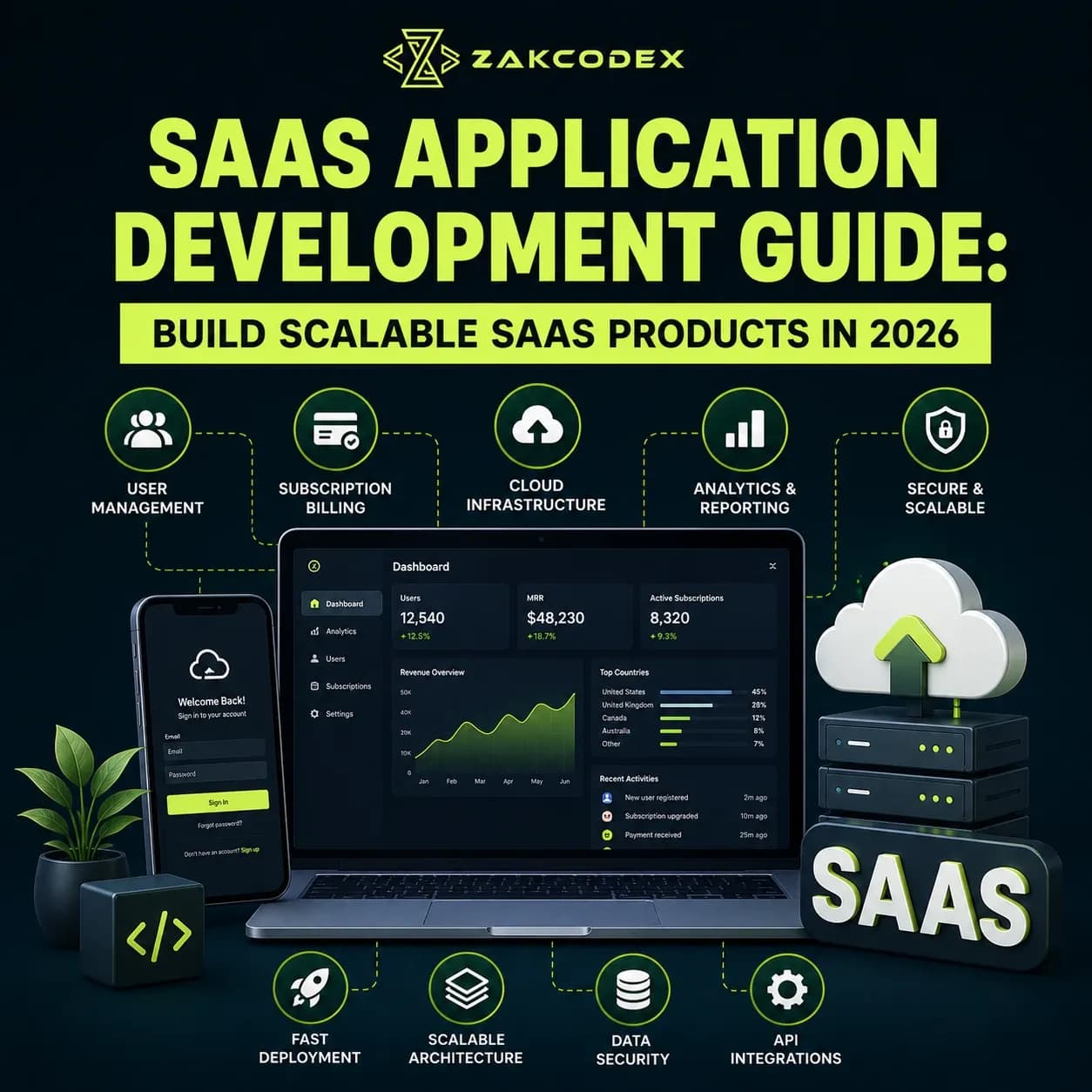
SaaS application development is the end-to-end software engineering process of conceptualising, building, securing, and maintaining an enterprise cloud-hosted software platform delivered to users via web browsers or APIs on a subscription basis. Forward-thinking startup founders, enterprise product managers, and CTOs invest in professional saas application development services when they need to transition from single-client custom software models to highly profitable, recurring-revenue digital platforms that serve thousands of distinct corporate tenants simultaneously from a unified code deployment. If your corporate roadmap requires launching an interoperable, high-performance web platform that scales infrastructure usage automatically, automates self-service onboarding, and protects user data isolation under strict regional laws, securing professional saas application development solutions is an absolute strategic necessity to avoid technical debt and speed up your time-to-market.
In 2026, the global Software-as-a-Service market demands pristine architectural choices right from your initial configuration files. Relying on fragmented infrastructure layouts, unvetted payment integrations, or weak data isolation patterns can saddle your business with massive multi-tenant security vulnerabilities, out-of-control cloud compute bills, and crippling data processing bottlenecks. This definitive technical guide breaks down the structural mechanics of professional saas application development, helping your enterprise design a resilient, market-ready cloud platform.
How SaaS Applications Work
Unlike traditional local installations or isolated single-tenant platforms, a modern saas cloud application development configuration operates as a centralized, multi-tenant digital ecosystem hosted entirely on scalable cloud hardware. When a customer accesses the platform, their web browser establishes an encrypted, stateless connection to a distributed load-balancer network. This layer instantly routes incoming traffic to active application clusters that process the user's business logic, while dynamically accessing a shared or isolated database tier using secure, localized query identifiers.
The core mechanic that drives a scalable saas application is the total separation of user presentation layers from core data processing engines. This allows your development team to push continuous codebase updates, deploy security patches, and modify database fields globally in real time without causing unexpected downtime or operational disruptions for active corporate subscribers.
Benefits of SaaS Application Development
Transitioning from traditional software models to custom saas software development workflows provides immense long-term commercial and operational advantages for scaling enterprises. From an engineering perspective, maintaining a unified, single-version codebase drastically reduces long-term software maintenance costs, allowing your engineering squads to optimize one master system rather than tracking hundreds of legacy, client-specific installations.
From a business standpoint, software as a service development unlocks highly predictable monthly and annual recurring revenue streams (MRR/ARR), which significantly boosts corporate valuations. It also enables completely automated self-service onboarding flows, allowing new global customers to register accounts, choose custom usage plans, configure data environments, and derive value from your software immediately without requiring manual configuration by a technical account management team.
Common SaaS Business Models in 2026
The choice of business model dictates how your underlying code structures must handle resource usage tracking, subscription billing, and data metering layers. Modern subscription based software platforms generally deploy one or a combination of the following billing models:
- Tiered Subscription: Features fixed monthly or annual access pricing tiers bounded by explicit feature sets, data capacity rules, or seats (e.g., Starter, Professional, Enterprise).
- Usage-Based / Metered: Charges tenants dynamically based on precise operational data volume processed, API execution counts, or runtime hours utilized.
- Freemium: Provides free access to a baseline tier of features, requiring paid upgrades to access premium integrations, higher security tiers, or advanced automations.
- Hybrid Pricing: Combines a predictable, baseline subscription fee with dynamic, usage-based surcharges for high-capacity corporate enterprise consumption.
Single-Tenant vs Multi-Tenant SaaS
Choosing your tenancy model is one of the most critical structural decisions made during early-stage saas product development. The selection dictates how customer information is isolated, how database migrations are handled, and how your infrastructure scales under intense usage loads.
In a single tenant saas architecture, every customer receives a completely dedicated, isolated software instance and a completely independent database layer. This structure provides unparalleled security isolation and effortless customization flexibility, but introduces high cloud hosting costs and massive maintenance overhead. Conversely, a multi tenant saas architecture utilizes a single, unified codebase and hosting environment to serve all customers simultaneously, using logical data markers or schema separation to isolate information, delivering maximum cost-efficiency and effortless scalability.
| Architectural Metric | Single-Tenant SaaS Model | Multi-Tenant SaaS Model (Recommended) |
|---|---|---|
| Data Isolation Security | Absolute (Physical isolation across separate databases) | Logical (Enforced via strict query filtering or separate schemas) |
| Infrastructure Hosting Costs | High (Dedicated computing nodes per customer) | Extremely Low (Shared resources lower idle server waste) |
| Maintenance Lifecycle | Complex (Requires updating instances individually) | Seamless (One global update updates all tenants instantly) |
| Scalability Capacity | Slower (Demands spawning new cloud nodes from scratch) | Instantaneous (Auto-scaling clusters expand automatically) |
Modern SaaS Architecture Paradigms
When designing a scalable platform, tech leaders must choose whether to structure their core logic as a modular monolith or a distributed microservices network. For early-stage products, starting with a well-structured modular monolith is highly recommended, as it eliminates unnecessary network complexity, minimizes early DevOps costs, and speeds up product validation cycles. As your platform scales up to handle millions of active processes, you can cleanly refactor heavy domain contexts into isolated microservices.
| Architectural Dimension | Monolithic Architecture Blueprint | Microservices Architecture Layout |
|---|---|---|
| Codebase Complexity | Low (Unified codebase, simplified testing) | High (Distributed services, complex network communication) |
| Deployment Pipeline | All-or-nothing (Must deploy entire block) | Independent (Deploy individual services without downing others) |
| Fault Isolation Safety | Low (A critical bug can crash the entire system) | High (A failed payment component does not break core analytics) |
| Initial Development Velocity | Extremely Fast (Ideal for rapid MVP validation) | Slower (Requires complex initial scaffolding) |
Cloud Infrastructure and Hosting Providers
To support a resilient cloud native saas product, selecting the proper cloud infrastructure hyperscaler is paramount. Modern platforms rely on multi-region, elastic cloud architectures to ensure 24/7 availability, protect data sovereignty, and maintain low latency for international subscribers.
| Hyperscaler Provider | Core Technical Strengths | Ideal Architectural Match |
|---|---|---|
| Amazon Web Services (AWS) | Unmatched service selection, mature container tools (EKS, ECS) | Highly complex, distributed enterprise global platforms |
| Google Cloud Platform (GCP) | Industry-leading Kubernetes management (GKE), advanced AI/ML loops | Data-heavy applications, AI-driven analytics, real-time products |
| Microsoft Azure | Flawless enterprise AD integration, exceptional compliance tooling | Corporate B2B platforms, healthcare tech, strict financial networks |
The SaaS Development Process
Building a successful subscription platform requires a systematic, multi-stage engineering methodology designed to mitigate market risk and eliminate technical debt early in the lifecycle.
| Development Phase | Core Technical Focus Areas | Key Operational Deliverable |
|---|---|---|
| 1. Product Discovery | User persona interviews, functional requirements documentation | Software Requirements Specification (SRS) |
| 2. Architectural Mapping | Tenancy mapping, data relation modeling, security definitions | Comprehensive System Architecture Blueprint |
| 3. Mobile & Web Styling | Mobile-responsive user flows, wireframing interaction models | Production-Ready UI/UX Prototypes |
| 4. MVP Engineering | Database construction, core feature code, billing integration | Functional Minimum Viable Product (MVP) |
| 5. Automated QA Testing | Multi-tenant data leaks checking, automated regression tests | Full Security and Performance Audit Report |
| 6. Deployment & Launch | CI/CD engine hookup, auto-scaling configuration, live monitoring | Production Live Cloud Deployment |
Choosing the Right Technology Stack
The technologies chosen during early architecture planning govern your long-term engineering speed, recruitment capacity, and infrastructure hosting budgets. Your stack must be highly optimized to manage stateless connection loops, perform secure data queries, and deliver fluid user interfaces across all devices.
For modern saas web application development, your team can choose between several high-performance backend languages, frontend engines, and database systems tailored to your specific application workflows:
- Backend Options: Node.js (Asynchronous TypeScript speed), Django (Python data processing power), or modern PHP via choosing an advanced laravel web development framework for rapid database scaffolding and built-in queue processing.
- Frontend Options: React, Vue.js, or Next.js to deliver highly responsive, single-page client dashboards with clean state management.
- Database Layer: PostgreSQL or MySQL for complex relational multi-tenant models with Row-Level Security (RLS); MongoDB or Redis for unstructured document caching and high-speed session tracking.
Essential Core SaaS Features
Every successful cloud platform requires a foundational layer of shared operational utilities. Before building your unique proprietary features, your engineering team must establish a bulletproof, reusable core architecture to handle basic administrative workflows:
Authentication and User Management
Security starts with robust user authentication. Modern systems implement Single Sign-On (SSO) protocols via OAuth2, SAML, or specialized identity providers (like Auth0 or Clerk) alongside mandatory Multi-Factor Authentication (MFA). Your backend must deploy Role-Based Access Control (RBAC) middleware to strictly define permission levels across different user tiers, ensuring a tenant's standard employee cannot access corporate billing settings.
Subscription Billing and Payment Integration
A dependable custom saas software application requires a highly secure, automated recurring billing engine. Developers integrate enterprise payment abstractions like Stripe Billing, Paddle, or Chargebee. The codebase must gracefully handle failed payment retries (dunning management), multi-currency conversions, real-time value-added tax calculations (VAT compliance), and dynamic account adjustments when users upgrade or downgrade mid-billing cycle.
SaaS Security Best Practices
Maintaining total saas security demands a layered defensive architecture across your entire web applications topology. First, enforce absolute data encryption across all vectors - utilising TLS 1.3 for data in transit and AES-256 for data at rest. Second, if your database utilizes a shared schema model, always implement strict database Row-Level Security (RLS) policies or use customized ORM scopes to prevent accidental multi-tenant cross-contamination.
Third, implement rigorous input sanitization and parameterized data fields across all API endpoints to protect against injection exploits. Finally, schedule regular, independent penetration testing and implement continuous, automated compliance tracking tools to keep your cloud environments fully aligned with international standards like SOC 2 Type II, ISO 27001, and UK GDPR.
Scalability, Performance, and API Integration
Ensuring your platform remains fast under intense user traffic requires building a distributed, event-driven data layout. Technical leaders use Redis caching tiers to store slow-moving relational queries and offload heavy computing processes - such as custom PDF invoice rendering or mass system notifications - to independent asynchronous worker queues. This keeps your main application process lightweight and fully responsive to user input.
Furthermore, designing your software using an api-first approach ensures seamless api integration. By building clean, well-documented RESTful or GraphQL endpoints from day one, you make it exceptionally simple for enterprise subscribers to safely connect your software to their internal data networks, CRMs, and custom automation tools, driving up long-term product stickiness.
Deployment, DevOps, and Continuous Delivery
Modern cloud software operations rely entirely on fully automated DevOps infrastructure pipelines. Developers bundle code into isolated Docker containers and deploy them into orchestration networks like Kubernetes or managed container environments (such as AWS ECS). This approach completely eliminates the classic "it works on my machine" engineering bottleneck.
By connecting code repositories to continuous integration and continuous deployment pipelines (CI/CD via GitHub Actions or GitLab CI), your engineering team can run automated test modules, verify data compliance rules, and push live system upgrades multiple times per day seamlessly without causing database lockouts or operational downtime for active clients.
SaaS Application Development Cost Factors
When estimating a realistic saas application development cost, business leaders must realize that project budgets depend completely on functional complexity and team location rather than fixed global pricing models. Building an initial Minimum Viable Product (MVP) through a professional custom software development company typically requires an investment of £25,000 to £50,000.
For high-performance, enterprise-ready platforms that incorporate customized multi-tenant architectures, deep third-party integrations, and strict compliance setups, development roadmaps generally span from £50,000 to £150,000+. Key cost drivers include data formatting workloads, the number of isolated external integrations required, your chosen technology stack, and regional software engineering talent rates, which we break down across localized markets in our analysis of laravel development cost uk.
SaaS Product Development Timeline
Bringing a modern software platform from initial discovery to live production deployment typically requires a timeline of 4 to 9 months depending on complexity. A lean MVP targeting a single, high-value user workflow can launch in approximately 12 to 16 weeks, while extensive enterprise-tier platforms demand longer validation and integration cycles.
Operational Architecture Tip: Avoid feature creep by focusing early workflows entirely on your core product utility. Building unnecessary add-ons before validating product-market fit introduces expensive technical debt and delays your initial release window.
Common SaaS Development Challenges
Building high-performing multi-tenant platforms introduces unique software engineering hurdles. Managing complex database migrations across thousands of active schemas without locking out live production tables presents a significant technical challenge. Developers must also prevent "noisy neighbor" scenarios, where an enterprise tenant running heavy data operations consumes shared server resources and slows down the application for other companies.
To address these challenges, technical teams implement strict API rate-limiting layers, deploy database connection pooling, and use elastic cloud auto-scaling. This ensures that individual traffic spikes are isolated automatically, protecting response times across your entire user network.
Best Practices for Successful SaaS Products
- Prioritise Seamless Onboarding: Keep the user journey to initial product value as short and frictionless as possible, using clean, self-guided interactive workflows.
- Build Extensible API Layers: Engineer your application with an API-first approach to support smooth third-party ecosystem integrations from day one.
- Automate testing early: Enforce mandatory unit and integration testing pipelines within your CI/CD setup to catch bugs before code reaches live cloud servers.
- Track detailed telemetry: Deploy advanced monitoring tools like Datadog or New Relic to maintain real-time visibility into infrastructure health, API slow points, and errors.
- Design for data portability: Ensure subscribers can easily export clean datasets at any time, building market trust and reducing friction during onboarding.
The Future of SaaS Development
The SaaS landscape is rapidly evolving away from broad, horizontal platforms toward highly specialized Vertical SaaS solutions engineered for specific industry workflows - such as legal compliance automation, advanced medical analytics, and complex logistics logistics. Modern systems are embedding autonomous artificial intelligence modules natively into core codebases, as explored in our strategic breakdown of ai development services. Rather than relying on basic static reporting views, next-generation platforms leverage built-in machine learning models to provide real-time predictive data patterns, automated workflows, and conversational natural language user interfaces.
Final Recommendation
Executing an optimized saas application development strategy requires a flawless balance between rapid development velocity and a resilient, secure system architecture. By choosing mature, standardized frameworks and enforcing clean multi-tenant data boundaries early on, you protect your company from expensive, deep refactoring debt post-launch. Partnering with an expert saas application development company or leveraging specialized, end-to-end saas web application development services ensures your cloud platform is engineered to convert traffic efficiently, maintain absolute security compliance, and scale smoothly as your recurring revenue subscription network expands.