In today's competitive ecommerce landscape, selecting the right platform can significantly impact your online business's growth, performance, and profitability. Two of the most powerful ecommerce platforms available are Shopify and Magento (Adobe Commerce). Both platforms offer robust features, but they cater to different business needs, technical requirements, and growth strategies.
If you're planning to launch a new online store or migrate from your current platform, understanding the differences between Shopify and Magento is essential. This comprehensive comparison will help you determine which ecommerce solution aligns best with your business goals.
What is Shopify?
Shopify is a fully hosted Software-as-a-Service (SaaS) ecommerce platform designed to help businesses quickly build, manage, and scale online stores without extensive technical expertise. It provides hosting, security, updates, payment processing, and a user-friendly interface all within a single ecosystem. Shopify is widely recognized for its ease of use, extensive app marketplace, and rapid deployment capabilities.
Businesses seeking professional Shopify store development often choose expert Shopify developers to maximize customization and conversion optimization. If you're looking for professional assistance, explore Shopify Web Development Services from ZakCodeX to build a scalable, high-performing ecommerce store.
What is Magento (Adobe Commerce)?
Magento, now known as Adobe Commerce, is an open-source ecommerce platform offering extensive customization and flexibility. Unlike Shopify, Magento requires hosting, server management, maintenance, and development expertise. It is often preferred by large enterprises, B2B organizations, and businesses with highly complex ecommerce requirements.
Magento provides complete control over your website architecture, user experience, integrations, and business processes. However, this flexibility comes with increased complexity, development costs, and ongoing maintenance responsibilities.
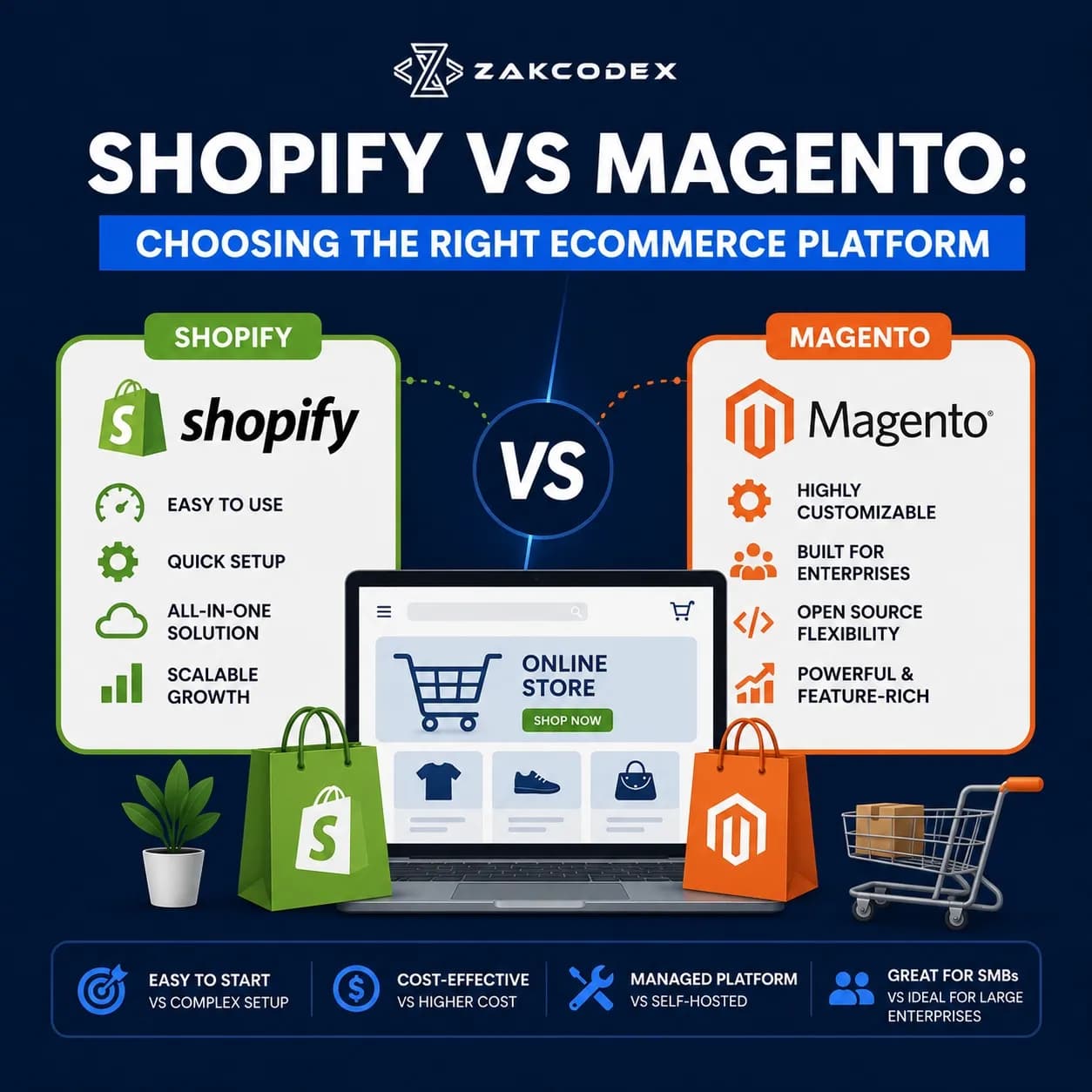
Shopify vs Magento: Quick Comparison
| Feature | Shopify | Magento (Adobe Commerce) |
|---|---|---|
| Hosting | Included | Self-hosted or managed hosting |
| Ease of Use | Beginner-Friendly | Requires Technical Expertise |
| Setup Time | Days | Weeks to Months |
| Maintenance | Managed by Shopify | Managed by Business |
| Security | Built-In | Self-Managed |
| Scalability | Excellent | Excellent |
| Customization | Moderate to High | Unlimited |
| Development Costs | Lower | Higher |
| Support | 24/7 Support | Developer/Agency Support |
| Ideal For | SMBs, Startups, Growing Brands | Enterprises, Complex Stores |
Ease of Use
Shopify: Simplicity at Its Best
Shopify is specifically designed for business owners who want to focus on sales rather than technical management. The intuitive dashboard allows users to:
- Add products
- Manage inventory
- Process orders
- Launch marketing campaigns
- Monitor analytics
Without coding knowledge, merchants can create professional online stores using drag-and-drop functionality and pre-built themes. Shopify's straightforward interface makes it an excellent choice for entrepreneurs and small-to-medium businesses.
Magento: A Developer-Centric Platform
Magento offers exceptional flexibility but comes with a steep learning curve. Setting up a Magento store often requires:
- PHP development expertise
- Server configuration
- Database management
- Security management
- Performance optimization
For businesses with dedicated development teams, Magento provides unmatched control. However, for non-technical users, the complexity can become a significant challenge.
Customization and Flexibility
Shopify Customization
Shopify provides thousands of apps and themes that extend functionality without requiring extensive coding. Businesses can customize:
- Store design
- Checkout experience
- Product pages
- Marketing workflows
- Customer engagement features
The Shopify App Store offers more than 8,000 integrations, making it easy to add advanced functionality when needed.
Magento Customization
Magento's greatest strength lies in its limitless customization potential. Developers can modify virtually every aspect of the platform, including:
- Backend functionality
- Database architecture
- Checkout workflows
- Product management systems
- Multi-store configurations
For businesses requiring highly customized ecommerce experiences, Magento often becomes the preferred solution.
Performance and Scalability
Shopify Scalability
Shopify handles hosting, performance optimization, content delivery networks (CDNs), and infrastructure management automatically. This allows businesses to scale without worrying about server performance.
Many high-growth ecommerce brands successfully process millions of dollars in sales through Shopify and Shopify Plus. Shopify's cloud infrastructure ensures reliable uptime and fast loading speeds.
Magento Scalability
Magento can support extremely large product catalogs, multiple storefronts, and complex enterprise workflows. However, achieving optimal performance requires:
- High-quality hosting
- Advanced caching solutions
- Continuous optimization
- Experienced developers
When properly configured, Magento can support enterprise-level ecommerce operations with hundreds of thousands of products.
SEO Capabilities
Search engine optimization is crucial for ecommerce success.
Shopify SEO Features
Shopify includes:
- SEO-friendly URLs
- XML sitemaps
- Mobile optimization
- Meta title and description editing
- Structured data support
- Fast page loading speeds
The platform offers strong SEO foundations for most businesses. Additionally, Shopify continues to invest in AI-powered ecommerce capabilities that improve discoverability and user experience.
Magento SEO Features
Magento provides advanced SEO flexibility, including:
- Full URL control
- Advanced metadata management
- Canonical tags
- Rich schema implementation
- Custom SEO configurations
Large enterprises often appreciate Magento's granular SEO controls, especially when managing complex websites and international stores.
Security and Maintenance
Shopify Security
Security is one of Shopify's strongest advantages. The platform handles:
- SSL certificates
- PCI compliance
- Security updates
- Hosting security
- Infrastructure monitoring
Business owners can focus on growth instead of managing cybersecurity risks.
Magento Security
Magento users are responsible for applying security patches and updates. Failure to maintain the platform can expose stores to vulnerabilities. Adobe regularly releases security updates, making ongoing maintenance essential.
Cost Comparison
Shopify Pricing
Shopify offers predictable monthly pricing, making budgeting easier for businesses. Costs generally include:
- Subscription fees
- Theme purchases
- Apps and integrations
- Transaction fees (depending on payment processor)
The overall cost remains manageable for startups and growing businesses.
Magento Pricing
Magento's total cost of ownership can be significantly higher due to:
- Hosting expenses
- Development costs
- Maintenance fees
- Security management
- Custom integrations
Although Magento Open Source is technically free, implementation and maintenance costs often exceed Shopify's overall expenses.
Community and Industry Perspectives
Many ecommerce professionals favor Shopify for its speed, ease of deployment, and lower maintenance requirements. Community discussions frequently highlight Shopify's ability to deliver approximately 90% of business requirements through existing apps and integrations. Meanwhile, Magento is praised for its customization capabilities and enterprise-level flexibility.
The general consensus among ecommerce experts suggests that Shopify serves the majority of merchants effectively, while Magento excels in highly complex, large-scale implementations.
Which Platform Should You Choose?
Choose Shopify If:
- You're launching a new ecommerce store.
- You want fast deployment.
- You have limited technical resources.
- You need predictable costs.
- You prefer managed hosting and security.
- You want to focus on growth rather than maintenance.
For businesses seeking expert implementation, ZakCodeX provides professional Shopify development solutions tailored to performance, conversions, and scalability.
Choose Magento If:
- You need complete source-code control.
- You operate multiple storefronts.
- You have complex B2B requirements.
- You maintain a dedicated development team.
- You require advanced custom workflows.
- You manage very large product catalogs.
Final Verdict
The Shopify vs Magento debate ultimately comes down to your business requirements, technical capabilities, and growth objectives.
Shopify offers simplicity, speed, reliability, and lower operational complexity, making it the preferred choice for most startups, SMBs, and growing ecommerce brands. Magento provides unparalleled flexibility and customization for enterprises that require complete control over their ecommerce ecosystem.
For businesses seeking a modern, scalable, and user-friendly ecommerce platform, Shopify remains the leading choice in today's market. If you're ready to build a high-performing Shopify store, visit ZakCodeX and explore our specialized Shopify Web Development Services.