
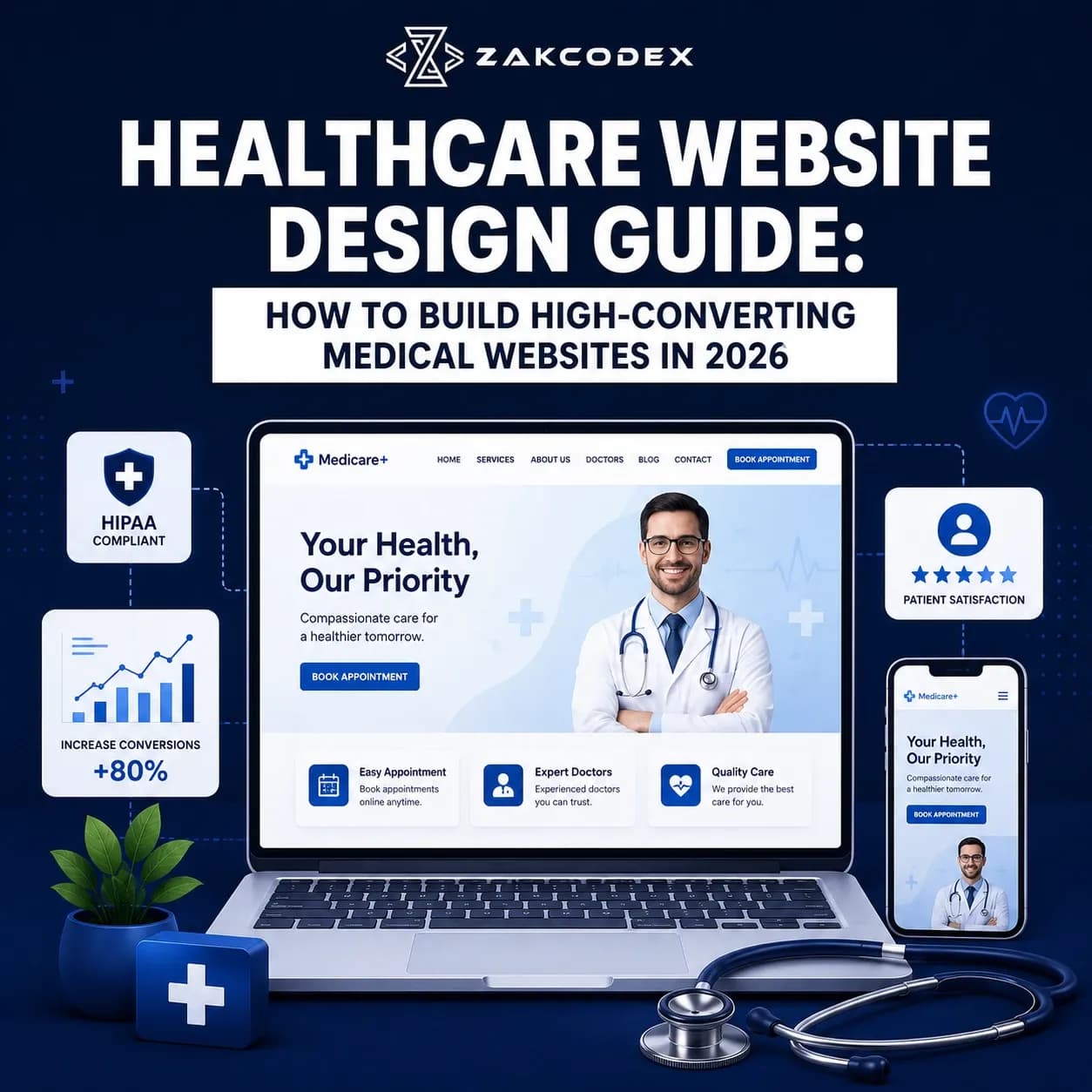
In the digital landscape of 2026, healthcare website design is the specialized software engineering and creative process of building secure, fully compliant, patient-centric digital interfaces that serve as the primary clinical gateway for medical practices, hospitals, and digital health platforms. Far from a simple aesthetic update, a successful medical storefront must establish immediate clinical credibility, reduce patient anxiety, ensure absolute data privacy, and deliver friction-free navigation paths. Investing in premium medical website design matters because it directly bridges the gap between digital consumer discovery and patient acquisition. A high-performing platform must achieve 100 percent mobile-first layout responsiveness, feature fast server paint times under 2 seconds, integrate automated scheduling grids, and strictly enforce compliance parameters like HIPAA and GDPR. Partnering with a specialized medical website design company ensures your clinic eliminates technical debt while building an authoritative, patient-first digital ecosystem that ranks across modern AI and traditional search tools.
Quick Answer Box: What Makes a High-Converting Healthcare Website in 2026?
• Patient Convenience: Real-time online appointment booking integrated directly into Electronic Medical Records (EMR).
• Absolute Compliance: Flawless end-to-end encryption providing a fully HIPAA compliant website and GDPR compliant healthcare website structure.
• Empathetic UX: Calming color palettes, distraction-free layouts, and strict accessibility settings following WCAG 2.2 standards.
• Search Visibility: Built-in structural markup optimized for traditional medical SEO, Answer Engines (AEO), and Generative Engine Optimisation (GEO).
As consumer healthcare journeys shift rapidly toward self-service scheduling platforms and AI-driven provider evaluations, a medical organization's digital architecture governs its entire operational growth. Selecting an unoptimized template setup or ignoring rigid data privacy frameworks introduces immense regulatory compliance risks, high cart abandonment rates, and severe brand damage. This publication-ready guide provides technical leaders, clinic administrators, and doctors with an objective strategic blueprint to execute a world-class healthcare website design roadmap.
What Is Healthcare Website Design?
Professional healthcare website design refers to the strategic engineering lifecycle required to construct a transactional, educational, and secure communication portal tailored explicitly for medical organizations. It requires a deep synthesis of advanced front-end web development frameworks, empathetic interface layouts, high-performance database architectures, and uncompromising security protocols. A professional implementation shifts the web asset away from a static company brochure, transforming it into a vital layer of clinical operations that handles patient data, facilitates virtual triage, and manages practitioner schedules smoothly.
Healthcare Website Design vs Medical Website Design
While the market occasionally uses these terms interchangeably, technical solutions architects draw a clear distinction between their operational scopes. Medical website design typically centers around individual practitioner portfolios, local family practices, and highly specialized clinics - focusing heavily on hyper-local discovery, direct practitioner credentials, and immediate booking actions. Conversely, a comprehensive healthcare website design company framework handles a much broader operational scale. This includes engineering massive, multi-facility hospital networks, public health organizations, multi-tenant telemedicine engines, and health-tech startups that demand extensive data segmentation, multi-tiered user authentication matrices, and complex software integrations across diverse enterprise clinical platforms.
Why Healthcare Providers Need a Professional Website
Modern patients browse the web with high levels of anxiety, urgent timelines, and strict expectations for transactional convenience. A modern clinical platform functions as the absolute foundation of your patient intake loop. Operating an outdated, slow, or disorganized web portal signals a lack of professional care and technological maturity, driving patients to click away and select regional competitors instead. A premium, custom-scaffolded deployment establishes immediate domain trust, streamlines administrative workloads by automating scheduling tasks, and maximizes the ROI of your patient generation campaigns.
| Strategic Dimension | Generic Business Storefront | Bespoke Healthcare Platform |
|---|---|---|
| Core Visual Objective | Bold commercial branding, high product sales, visual flair. | Calming color palettes, low cognitive load, high emotional trust. |
| Data Privacy Mandate | Standard secure socket layers (SSL), basic cookies tracking. | Strict end-to-end encryption, isolated patient data storage. |
| Primary Integration Focus | Marketing automation tools, retail carts, social grids. | EMR platforms, real-time clinical calendars, tele-care systems. |
| Accessibility Standards | Basic layout responsiveness, general text readability. | Strict WCAG 2.2 AA validation, screen-reader layers. |
Essential Features Every Healthcare Website Should Include
To successfully transition users from research to active booking states, a clinical platform must provide a powerful, unified suite of operational modules. Technical teams must prioritize building several essential features directly into their core deployment:
Online Appointment Booking
Modern patients expect to schedule care visits instantly without picking up a telephone. A professional online appointment booking matrix must connect directly to your back-office scheduling software using real-time API syncs to completely prevent double-bookings. The interface should offer clean filtering by clinical specialty, location, and accepted insurance plans, allowing users to select open slots and secure their confirmation in under 60 seconds.
Doctor and Specialist Profile Pages
A successful doctor website design or clinic website design requires highly structured provider profile pages. Patients select practitioners based on human connection and verified expertise. Profile nodes must showcase professional photography, detailed sub-specialty definitions, hospital affiliations, language capabilities, and direct verified patient review blocks, giving users the confidence to move forward with care decisions.
Patient Portals and Telemedicine Integration
To support continuous care management, modern medical website design and development involves deploying a highly secure patient portal integration layer. This provides users with a single, encrypted hub to check lab results, request prescription renewals, and message their care teams. Furthermore, embedding direct telemedicine video pathways allows practices to deliver remote care visits without forcing patients to install external applications.
Structured Medical Service Pages
Instead of grouping treatments onto a single generic page, a high-converting platform uses individual, dedicated nodes for each clinical condition and procedure. These service pages should use clear, patient-friendly language to explain complex diagnoses, provide step-by-step treatment roadmaps, and feature direct links to preparation checklists, systematically removing user friction before care begins.
Healthcare UX and Design Best Practices
The field of healthcare UX design focuses heavily on reducing cognitive overload for users who may be stressed or in physical pain. Visual designs should use calming color systems (soft blues, clean teals, and warm neutrals) that project authority and emotional safety, combined with extensive white space to improve text readability. Navigation menus must be kept simple - limited to 5 to 7 high-level items - ensuring that critical actions like location finder links, emergency advisories, and scheduling portals remain highly visible without deep scrolling.
Technical and Compliance Foundations
A beautiful clinical design delivers zero value if the underlying technical architecture compromises sensitive patient health records or fails basic accessibility audits. Modern medical web construction demands total compliance across several engineering pillars.
Responsive Mobile-First Design
With more than 70 percent of health-related searches originating from smartphones, building a flawless responsive healthcare website is a mandatory technical requirement. Front-end code grids must automatically adapt their layouts, size calls-to-action for easy thumb taps, and compress text layouts dynamically across all device sizes, ensuring a fast, clean user experience for patients checking details on the move.
Accessibility for Healthcare Websites (WCAG Compliance)
Ensuring absolute accessibility for healthcare websites means engineering your interfaces to be easily navigated by individuals with visual, auditory, or motor impairments. Aligning your code with globally recognized Web Content Accessibility Guidelines (WCAG 2.2 AA) requires maintaining high color contrast ratios, providing clear text descriptions (alt text) for all functional iconography, setting up full keyboard-only navigation paths, and writing clean structural aria-labels to ensure compatibility with screen-reading software.
Core Web Vitals and Website Speed
Slow page load speeds severely damage user conversions and push search engine positions down. Medical sites must optimize their core performance metrics by setting up advanced image compression scripts, implementing lazy-loading assets, and eliminating render-blocking JavaScript lines. Keeping page paint times well under the 2-second target window projects operational reliability, a core technical concept explored in our deep-dive review of core web vitals future technical seo optimization.
HIPAA vs GDPR Compliance Matrix
Operating a clinical digital platform requires strict adherence to geographic data privacy frameworks. If your application processes any patient health information within the United States, it must function as a fully HIPAA compliant website - requiring signed Business Associate Agreements (BAAs) with hosting partners, strict database activity logs, and auto-logout controls. If you serve patients within the UK or European markets, it must be engineered as a highly secure GDPR compliant healthcare website - mandating explicit cookie consent management, secure right-to-be-forgotten deletion workflows, and clear data minimization rules across all intake forms.
| Compliance Framework | Primary Geographic Focus | Core Technical Requirement | Data Handling Implication |
|---|---|---|---|
| HIPAA | United States Healthcare Market | End-to-end payload encryption, explicit database access audit trails, automated user session time-outs. | Applies strictly to Protected Health Information (PHI) stored across secure server ecosystems. |
| GDPR | United Kingdom & European Union | Explicit cookie opt-in trackers, automated right-to-be-forgotten scripts, transparent privacy notices. | Applies broadly to all personal identifiers, IP logs, and user contact entries gathered across the platform. |
Medical SEO Fundamentals & Local Search Domination
To attract new patients, your platform must be built with a comprehensive medical SEO framework embedded directly within its base code structures. Traditional search systems evaluate your content alignment using strict health-sector guidelines, requiring websites to provide exceptionally clear, medically accurate data. For localized providers, executing targeted local marketing pipelines - including precise geographic schema strings and Google Map synchronization - ensures your clinic appears at the top of organic results when nearby users search for regional care. Technical teams can explore these reporting and indexation loops in our strategic guide on what is seo reporting and why it matters.
Trust Signals and EEAT in Healthcare
Google evaluates healthcare content under strict "Your Money or Your Life" (YMYL) rules, requiring absolute alignment with EEAT metrics (Experience, Expertise, Authoritativeness, Trustworthiness). To prevent search position drops, all medical content must show clear author credentials. Ensure every page displays verified clinic licenses, displays trust badges from recognized medical boards, connects to external professional directories, and features a rigorous medical review process with links to the reviewing practitioner's bio, building trust with both patients and algorithms.
Specialised Web Frameworks by Practice Type
A professional medical website design agency tailors its approach to match the exact operational workflows of different clinical settings:
- Website Design for Medical Doctors: Focuses heavily on highlighting direct clinical specialties, publishing authoritative peer-reviewed research, and establishing strong personal credibility to drive expert care referrals, a specialized focus delivered through our website design for medical doctors channels.
- Medical Practice / Office Website Design: Prioritizes localized user journeys, providing clear clinic hours, dynamic location maps, accepted health insurance matrices, and simplified patient intake form downloads to reduce front-desk administrative strain.
- Medical Clinic Website Design: Tailored for multi-disciplinary facilities, providing clear triage pathways that route users smoothly to distinct service tracks like urgent care, physiotherapy, or radiology options.
- Dentist & Specialist Design: Heavy emphasis on patient education resources, visual before-and-after case files (where ethically compliant), transparent cost breakdowns, and clear explanations of advanced clinical treatments in plain language.
- Hospital Website Architecture: Enterprise-grade structures designed to support multi-site routing, emergency alert bars, distinct portals for career applicants, media departments, and deep system integrations for thousands of active clinical workers.
Website Redesign Considerations
Undergoing a complete clinical website redesign requires careful technical planning to avoid losing existing search rankings and breaking patient data paths. Your development team must map out thorough 301 redirect paths for all old URLs, audit database relationship structures, verify integration endpoints, and run extensive tests on automated forms before deploying the new system to production servers, ensuring a smooth transition without service drops.
AI Chatbots and Virtual Assistants in Healthcare
Integrating conversational AI modules allows clinics to deliver high-quality patient interactions 24/7. Modern virtual assistants handle early-stage patient routing, answer frequent administrative questions about clinic hours and accepted insurance, and guide users to the correct booking channels. These tools are configured with strict safety protocols, ensuring they handle scheduling tasks efficiently while automatically routing urgent medical situations to live clinical staff.
The Healthcare Website Development Process
Constructing a production-ready medical platform requires following a highly disciplined, phased software engineering process designed to systematically remove security bugs and protect timelines.
| Project Implementation Phase | Key Technical Milestones & Deliverables | Estimated Duration |
|---|---|---|
| 1. Architecture Discovery | Compliance scoping (HIPAA/GDPR), API audit of EMR platforms, keyword intent mapping. | 2 – 4 Weeks |
| 2. Interface UI/UX Design | Mobile-first wireframes, accessibility styling check (WCAG), interactive patient flows. | 3 – 5 Weeks |
| 3. Core Systems Engineering | Database construction using professional software development rules, clean coding, API booking hookup. | 8 – 14 Weeks |
| 4. Compliance & Security Audit | Penetration stress testing, data encryption verification, form vulnerability checks. | 2 – 4 Weeks |
| 5. Live Launch & Telemetry | DNS migration to secure cloud networks, sitemap indexing, post-launch site check. | 1 – 2 Weeks |
Medical Website Design Cost Factors
When calculating a realistic medical website design cost, business leaders must separate basic visual work from complex database engineering and compliance setups. Project budgets vary entirely based on your practice size, functional requirements, and target markets.
| Practice Scale Tier | Core Technical Specifications | UK Pricing Range (GBP) |
|---|---|---|
| Bespoke Solo Practitioner | Bespoke doctor website design layout, up to 12 pages, standard secure forms, foundational local search configuration. | £3,500 – £7,500 |
| Bespoke Private Clinic | Bespoke medical office website design, real-time EMR scheduling sync, multi-specialty pages, secure patient intake tools. | £7,500 – £20,000 |
| Enterprise Hospital / Health Network | Multi-facility routing layers, secure multi-tenant patient portals, telemedicine video pathways, strict SOC 2 enterprise compliance. | £25,000 – £65,000+ |
Buyer Framework: WordPress vs Custom Healthcare Website Development
Choosing your platform foundation requires balancing initial development velocity against long-term data security and structural control. Building on top of a standard Content Management System like WordPress is highly cost-effective for solo practitioners and local clinics that require simple informational updates and basic plugin extensions. However, open-source CMS ecosystems require continuous plugin maintenance and present a wider attack surface for security exploits if left unmanaged.
For high-volume private networks and health-tech organizations, investing in custom software development using secure, modern frameworks is the superior strategic choice. Custom engineering allows you to design specialized database relationships from scratch, write ultra-clean code that maximizes page loading speeds, and build tailored security guardrails, entirely removing the long-term structural risks found in generic website templates, an advanced design philosophy explored in our review of the importance of ui ux design for digital success.
Common Healthcare Website Mistakes to Avoid
The most severe mistake medical practices make is using cheap, generic business templates that treat clinical platforms like standard retail shops. These templates often contain heavy, unoptimized code that degrades page performance and lacks the strict security setups required to protect patient information. Another critical failure is using low-cost generic contact forms to collect detailed medical histories, which creates serious data compliance liabilities. Finally, avoid using overly complex medical jargon across your primary pages - overloading anxious users with dense technical terminology drives up bounce rates and hurts conversion efficiency.
Future Trends in Healthcare Web Design
The digital health landscape is moving rapidly toward hyper-personalized, intelligent care interfaces. Platforms are adopting smart dashboard views that dynamically adapt content layouts based on a returning patient's past appointments and health goals. We are seeing widespread implementation of voice-optimized search controls that allow users to search for treatments using natural speech, alongside deep technical optimizations designed to ensure clinical content is easily parsed and cited by next-generation generative search engines.
Final Recommendation
Executing an optimized healthcare website design strategy requires balancing patient empathy with rigid technical discipline and strict compliance controls. By prioritizing real-time scheduling integrations, clean mobile performance, and bulletproof encryption layers, you protect your organization from regulatory liabilities while building a powerful engine for business growth. Partnering with a dedicated healthcare website design company or engaging professional medical website design services ensures your digital properties are engineered to deliver clinical value, protect patient data, and scale cleanly as your healthcare organization expands.