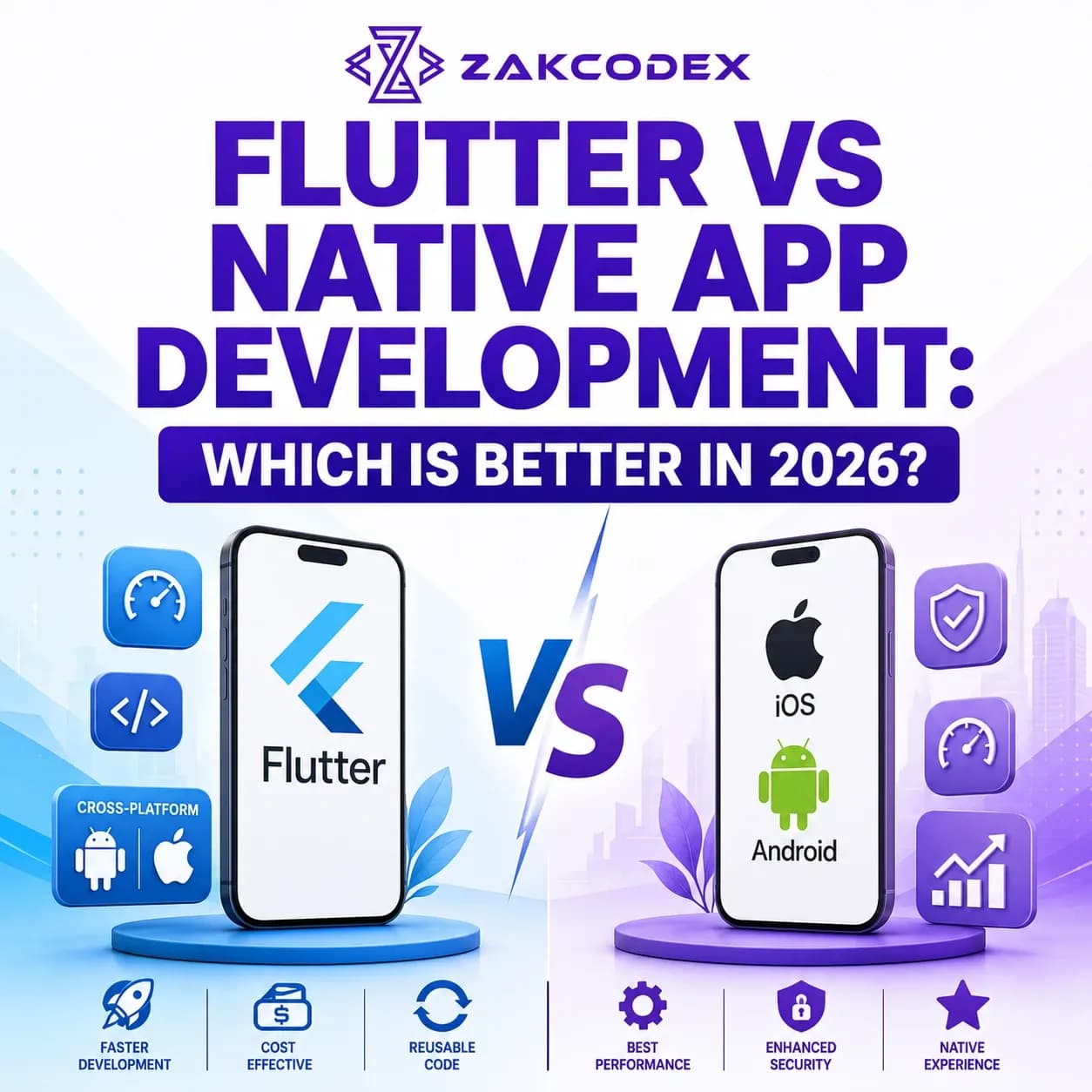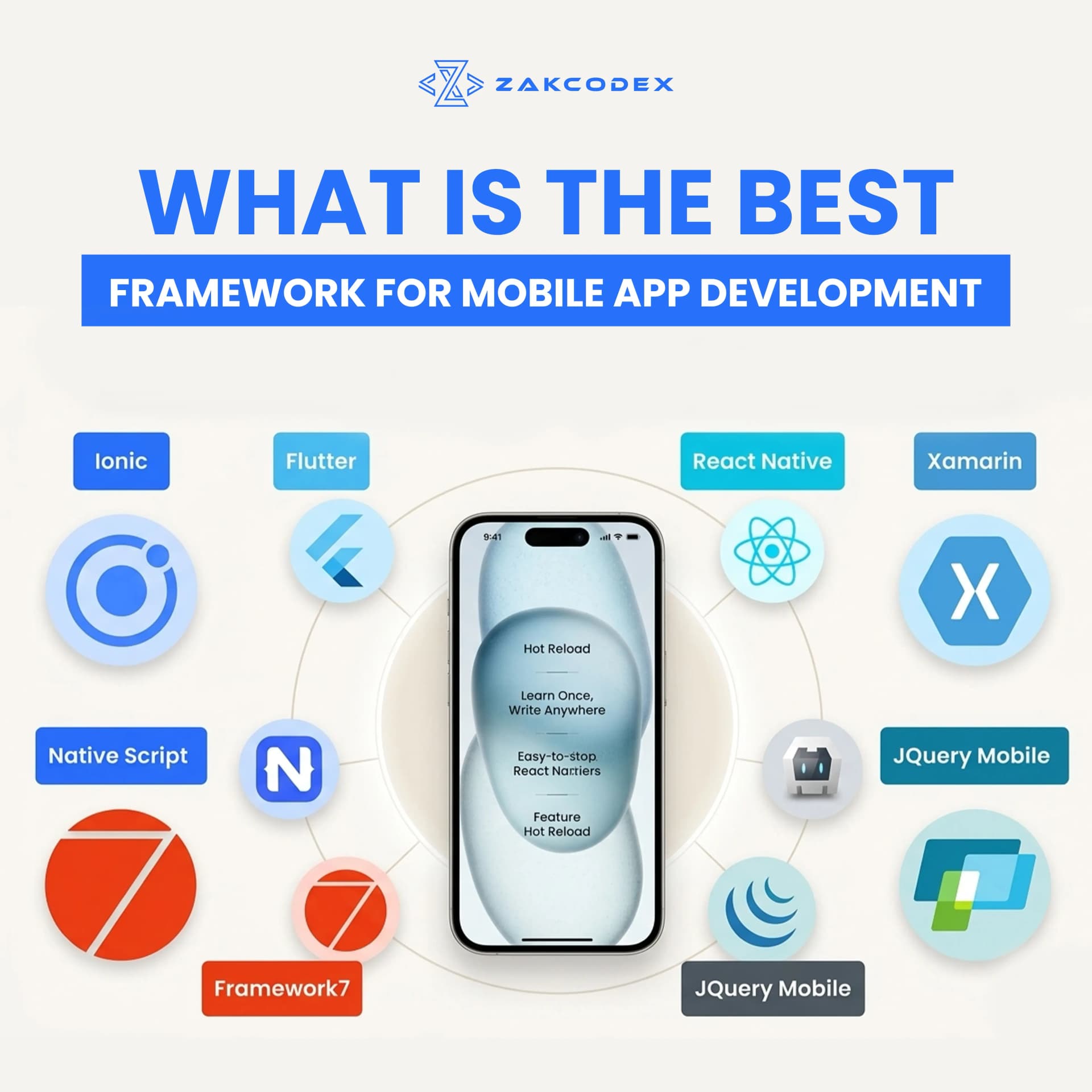
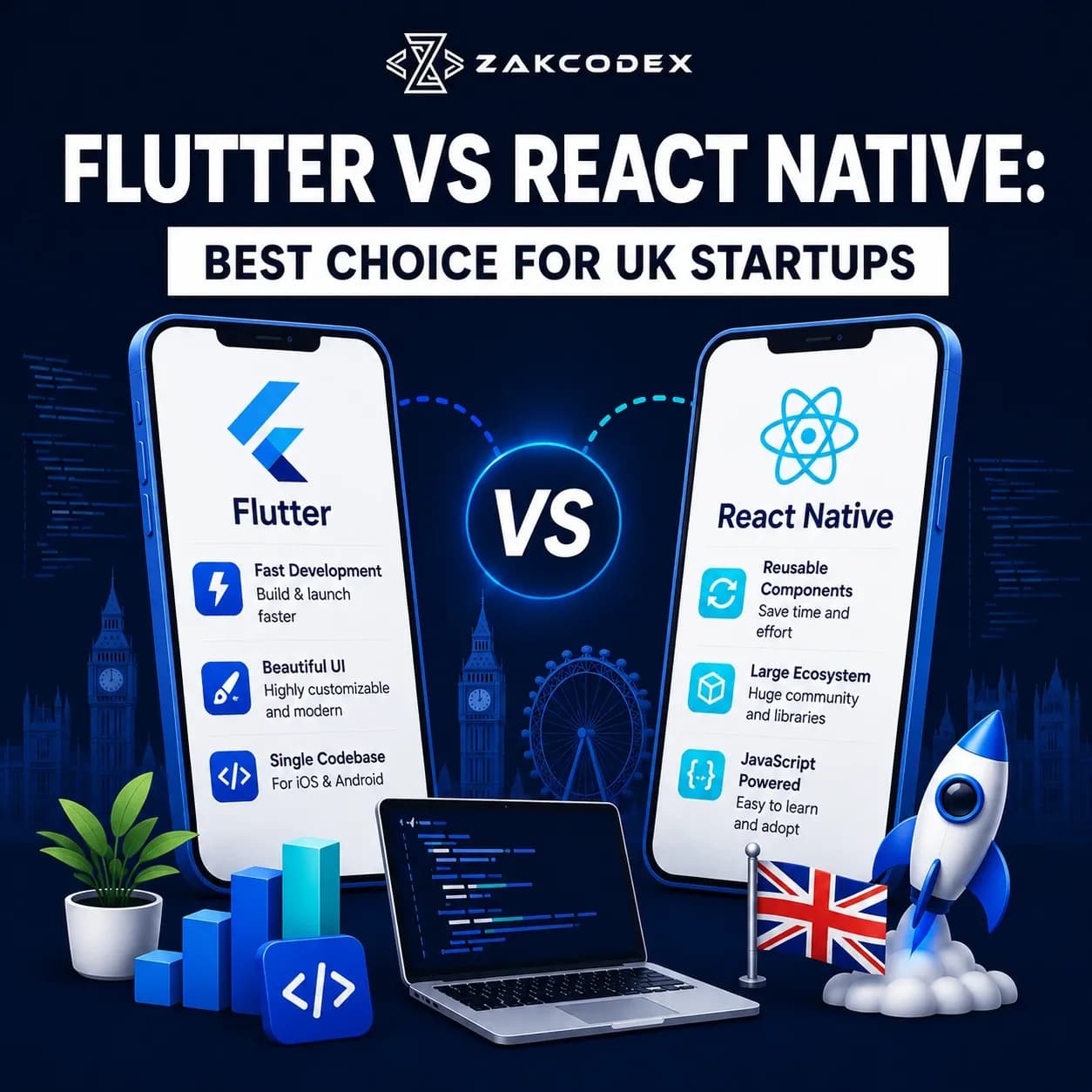
Choosing the right cross-platform framework is a high-stakes capital allocation decision for any tech co-founder. When you need to build a high-performing mobile app on a lean budget, the choice inevitably narrows down to two dominant technologies. In this guide, we evaluate flutter vs react native to determine which platform offers the highest return on investment, the fastest time-to-market, and the lowest maintenance overhead for your UK business.
For most UK startups launching from scratch without a legacy codebase, Flutter is the optimal choice due to its superior pixel-perfect UI rendering, rock-solid 120 FPS performance via the Impeller engine, and unified multi-platform reach (iOS, Android, web, and desktop). However, if your team already possesses deep expertise in JavaScript or React, or if you need to share up to 90% of your business logic with an existing web dashboard, React Native app development becomes the more resource-efficient option.
What is Flutter?
Flutter is Google's open-source UI toolkit designed for building natively compiled, multi-platform applications from a single codebase. Rather than acting as a wrapper or translating code into native platform components, Flutter ships with its own graphics rendering engine, painting every pixel directly onto the device's screen canvas.
Flutter relies on Dart, a strongly-typed, object-oriented language that supports both Just-In-Time (JIT) compilation for rapid developer cycles and Ahead-Of-Time (AOT) compilation for production-grade machine code performance. By compiling directly to native ARM code without an intermediary translation layer, Flutter eliminates runtime bottlenecks and ensures that your app runs identically across iOS, Android, web, and desktop environments.
What is React Native?
React Native is Meta's popular open-source framework that allows developers to build cross-platform mobile apps using JavaScript and React. Unlike Flutter's pixel-painting approach, React Native uses a declarative UI paradigm to orchestrate real, native platform components under the hood.
When you write a view component in React Native, the framework maps that component directly onto its native counterpart - such as a UIView on iOS or an Android.View on Android. This architectural decision ensures that your mobile application automatically inherits the native look, feel, and OS-specific behaviors that users expect, making it a highly popular tool for teams wanting immediate platform alignment.
Flutter vs React Native Overview
When comparing react native vs flutter, the core distinction lies in how they render interfaces and execute code. The following technical matrix provides a comprehensive flutter vs react native comparison across key modern architectural baselines:
| Feature Metric | Flutter | React Native |
|---|---|---|
| Primary Creator | Google (2017) | Meta (2015) |
| Programming Language | Dart | JavaScript / TypeScript |
| Rendering Engine | Impeller (Default) / Skia | Native Platform Components via Fabric |
| Compilation Profile | Ahead-of-Time (AOT) to Native Machine Code | Runtime Bytecode via Hermes V1 Engine |
| Average Cold Start Time | ~1.2 seconds | ~1.8 seconds |
| Baseline Memory Footprint | ~45 MB (iOS) | ~68 MB (iOS) |
| UI Consistency | Pixel-perfect across all platforms | Platform-authentic, system-dependent views |
Performance Comparison
When evaluating flutter vs react native performance, historical benchmarks often pointed to major discrepancies due to runtime translation bridges. The architectural landscape has shifted completely, making both platforms production-hardened powerhouses, yet notable engineering variances persist.
Graphics Rendering and Engine Performance
Flutter utilizes the Impeller rendering engine, which has permanently replaced Skia on mobile platforms. Impeller eliminates the notorious problem of "shader compilation jank" - the micro-stuttering that occurs the first time an app loads a complex animation - by pre-compiling all necessary shaders at build time rather than at runtime. By communicating directly with low-level graphic APIs like Apple's Metal and Android's Vulkan, Flutter achieves a stable, highly efficient 60 to 120 FPS on premium ProMotion displays. In complex data visualization dashboards or interactive canvas states, its average frame rasterization time drops significantly below the standard 16.7ms threshold.
React Native countered this limitation by rolling out its production-ready New Architecture. This system completely removes the legacy asynchronous bridge in favor of the JavaScript Interface (JSI), allowing direct, synchronous C++ interaction between the JavaScript thread and native host components. Backed by the Hermes V1 engine for pre-compiled optimized bytecode, cold startup times have dropped, making typical business CRUD (Create, Read, Update, Delete) application experiences indistinguishable from native code. However, under heavy rendering strains or complex, multi-layered UI transitions, React Native can experience occasional frame drops to 45–50 FPS due to runtime thread contention.
| Performance Metric | Flutter (Impeller) | React Native (New Architecture) |
|---|---|---|
| Animation Stability | Excellent (Solid 60–120 FPS) | Good (Stable 60 FPS, minor drops under strain) |
| CPU Idle Overhead | 2% – 3% | 4% – 6% |
| Memory Efficiency | ~100MB lower footprint on asset-heavy pages | Slightly higher due to JavaScript runtime layer |
| 1,000-Element List Scroll | ~2.1ms per frame (No UI stutter) | ~3.8ms per frame (Slight CPU spikes possible) |
Which framework performs better? For highly custom graphical interfaces, complex math workflows, or heavy visual animations, Flutter maintains a definitive, data-driven edge. For standard marketplace apps, B2B SaaS portals, or content feeds, both options offer native-grade performance.
UI Comparison
The choice between flutter vs react native for mobile app design revolves around your brand's philosophy: do you want an identical interface on every single device, or do you want your application to morph into the natural aesthetic of the host operating system?
The Widget-Centric Approach (Flutter)
Flutter treats everything as a widget. Because it bypasses native platform design suites and draws everything onto its own blank canvas, it completely guarantees visual consistency. An application built with Flutter will look exactly the same on an entry-level Android phone as it does on a top-tier iPhone.
- Material 3 & Cupertino: Flutter comes bundled with fully comprehensive UI component libraries that perfectly mimic Google and Apple design systems.
- Customization Freedom: You can break out of rigid design grids easily, allowing UI/UX designers to create brand-focused experiences without fighting platform restrictions.
- The Downside: Because it does not use native host views, major platform visual changes require a framework update from Google to stay aligned with new OS conventions.
The Native Component Approach (React Native)
React Native acts as an orchestrator. It passes your layout instructions down to native interface rendering mechanisms via the Fabric renderer.
- Platform Authenticity: Buttons, input fields, toggle controls, and context menus inherit the exact system styles of the user's specific OS version. If Apple introduces a new system font or design pattern, your app updates its underlying native styling out of the box.
- Design Parity Challenges: Because views render differently depending on the operating system, QA teams must rigorously audit layouts on both platforms to correct spacing, typography, and shadow variances.
Architecture Comparison
Understanding the internal structure of both cross-platform tools is vital for mitigating technical debt as your UK startup scales. Let's look at the core differences in flutter vs react native architecture:
Flutter Architecture: Direct GPU Rendering
[Dart Code] → [AOT Native Machine Code] → [Impeller Graphic Engine] → [Direct GPU Pipeline (Metal/Vulkan)]
Because Flutter bypasses native system components, the architecture contains no middleman translation layers. State management solutions like BLoC, Riverpod, or Provider work directly within Dart's execution framework, rendering your views with minimal overhead.
React Native Architecture: Synchronous JSI Framework
[JavaScript/TypeScript Code] → [Hermes Engine] → [JavaScript Interface (JSI)] → [Fabric Renderer & TurboModules] → [Native Views/APIs]
React Native’s New Architecture relies heavily on JSI, a C++ layer that allows JavaScript code to maintain direct references to host platform objects. TurboModules enable lazy-loading of native device modules (like Bluetooth, GPS, or Biometrics), loading them into memory only when strictly required, which saves device resources.
Development Speed and Cost
For resource-conscious founders, time-to-market is everything. When evaluating flutter vs react native development speed alongside mobile app development costs in the UK, your existing technical profile dictates efficiency.
Hiring and Talent Availability
JavaScript is the undisputed language of the web, with massive global adoption rates. If your UK startup already runs a React or Node.js web architecture, your internal web engineers can transition into mobile developers within 2 to 3 weeks using React Native. This greatly expands your local hiring pool and lowers hiring costs.
Flutter requires Dart, a language primarily used within the Flutter ecosystem. While Dart is intuitive for anyone with a background in C#, Java, or C++, finding senior specialized Dart talent in the UK can take longer, which can command higher upfront developer rates.
Iteration Speed and Tooling
Both frameworks feature exceptional development workflows that dramatically cut down engineering timelines compared to native development:
- Flutter Stateful Hot Reload: Allows developers to inject code changes directly into a running Dart Virtual Machine in under a second without losing the application's current state. This makes rapid prototyping during design feedback loops incredibly seamless.
- React Native Fast Refresh: Offers a modern, highly resilient hot-reloading experience that keeps the app running while applying small component modifications instantly.
Which framework is cheaper to develop? If you have an established web-facing team, React Native will yield significant initial savings by enabling extensive code reuse. If you are starting completely from scratch with a brand-new engineering team, Flutter’s out-of-the-box widget suite often allows you to ship a complete Minimum Viable Product (MVP) within 12 to 16 weeks, saving time compared to the configuration-heavy cycles of React Native.
Learning Curve and Community Support
Evaluating the flutter vs react native learning curve requires looking at your engineering team's current background. Let's break down the technical realities:
- Is Flutter easier to learn than React Native? If your developers are completely new to web patterns but understand strongly-typed object-oriented paradigms (like Java, Swift, or C#), Flutter’s widget composition model and structured documentation are widely considered best-in-class. Onboarding takes roughly 4 weeks.
- React Native Onboarding: For web developers already using modern hook architectures (
useState,useEffect), React Native feels entirely natural. The learning curve drops to a mere 2 weeks.
Regarding which framework has a larger community, the statistics highlight a healthy competitive split. According to recent global developer surveys, Flutter captures roughly 46% of the cross-platform development market share, while React Native commands about 35-38%. However, because React Native is built on top of JavaScript, its total ecosystem footprint remains massive, offering a vast repository of solutions on platforms like Stack Overflow and Reddit.
Ecosystem and Package Availability
The choice between react native vs flutter also hinges on package infrastructure maturity:
- React Native: Directly connects to the massive
npmregistry, which hosts over one million packages. While only a subset are optimized for mobile, you can easily tap into global JavaScript utilities, date managers, and calculation blocks. Tools like Expo SDK have also simplified push notifications, local storage, and build distribution pipelines. - Flutter: Uses the centralized
pub.devpackage repository, which features over 52,000 highly verified, structured packages. Because Google enforces strict documentation guidelines and quality scoring metrics onpub.dev, Flutter libraries are consistently maintained and less prone to sudden dependency updates.
Native Features, Scalability, and Security
Startups building deep tech, fintech, or large consumer platforms require enterprise-grade reliability. Here is how both toolkits handle advanced requirements:
Accessing Native Device APIs
If your mobile app requires deep, low-level hardware interactions - such as specialized Bluetooth IoT streaming, real-time background location filtering, or custom camera hardware access - React Native's mature TurboModules and direct C++ reference layer make writing custom native code simpler. Flutter uses Platform Channels, which rely on message serialization between Dart and native code. While highly effective, it introduces minor structural overhead when passing high-frequency data streams back and forth.
App Security Profiles
Security is a vital metric for modern digital compliance. Because Flutter compiles your application code directly down to raw, optimized ARM machine code, reverse-engineering its final production binary is incredibly difficult for malicious actors. React Native applications bundle JavaScript source code inside the package. While tools like Hermes compile this code into bytecode, it still requires thorough obfuscation strategies to achieve the same structural protection profile as Flutter.
Testing and Maintenance
Long-term maintenance costs can quietly strain a startup's runway. Writing clean code means choosing a platform with an ecosystem built around reliable automated validation tools.
- Flutter's Built-in Testing Framework: Google includes comprehensive, first-party testing capabilities for unit, widget, and integration testing right out of the box. You do not need to choose third-party tools; the built-in testing environment allows you to mock user interactions and verify pixel behaviors reliably.
- React Native's Testing Ecosystem: Relies on popular web testing libraries like Jest for unit tests and React Native Testing Library or Detox for end-to-end integration workflows. While incredibly powerful, managing updates across separate external open-source tools requires more proactive maintenance.
Market Share and Popularity
Both frameworks have earned the trust of major global brands, proving their stability at scale:
| Framework | Global Market Share | Enterprise Product Examples |
|---|---|---|
| Flutter | ~46% | Google Pay, BMW App, eBay Motors, Alibaba, Nubank (40M+ Users) |
| React Native | ~35% - 38% | Instagram, Discord, Shopify, Microsoft Teams, Tesla App, Coinbase |
While Flutter displays rapid growth momentum in international financial and enterprise applications, React Native maintains a rock-solid footprint among silicon-valley scale SaaS providers due to its robust web foundations.
Industry-Specific Startup Considerations
E-Commerce & M-Commerce Apps
For transactional retail platforms, React Native is highly efficient because it lets you share data models and state validation code directly with your web checkout systems. However, if your retail application features immersive, high-fidelity brand visual assets, custom product configuration tools, or complex parallax animations, Flutter’s custom canvas ensures a smooth shopping experience.
Healthcare & MedTech Apps
Medical platforms require strict data confidentiality and secure user flows. Flutter's robust binary compilation layout makes it an excellent foundation for meeting complex digital security standards. Additionally, its pixel-perfect rendering guarantees that medical diagnostic charts and health monitoring visuals display identically across all user devices.
AI & Machine Learning Applications
For smart mobile applications processing on-device AI inference or real-time model output visualizations, look at how the platforms handle concurrent computing. Flutter isolates - isolated worker threads that run concurrently on their own dedicated memory heaps - allow developers to process heavy calculations without locking the main UI thread. React Native's single-threaded JavaScript loop can sometimes introduce UI stuttering during heavy data processing unless complex native threading paths are written manually.
Chat App Development Comparison
Building real-time communications requires choosing a framework that can handle fast data inputs, swift local data storage, and highly dynamic UI layout recalculations. Let's look at a react native vs flutter chat app development comparison 2026 analysis:
Chat apps present two main engineering challenges: rendering hundreds of text messages during rapid scrolling, and maintaining responsive WebSocket or long-polling connections in the background.
- Flutter for Chat: Flutter's efficient memory utilization shines during list scrolling. Because its engine manages view state directly on the GPU, fast-scrolling through rich media chat feeds causes zero UI spikes or visible layout calculations. Dart's built-in Stream architecture also makes managing real-time chat updates incredibly clean out of the box.
- React Native for Chat: React Native relies on native view reuse for lists. While the Fabric renderer handles scrolling smoothly, historical text message threads with diverse rich media payloads can cause minor view recalculation overhead. However, its direct integration with popular real-time chat infrastructure packages (like Socket.io or Twilio) simplifies initial backend wiring.
Is Flutter or React Native better for chat app development? If you want absolute UI fluidity during heavy multimedia messaging flows, Flutter is an exceptionally strong candidate. If your goal is to quickly build a text-centric messaging MVP using an existing Node.js or React web infrastructure, React Native is highly effective.
Which Framework Should UK Startups Choose?
Selecting between these frameworks comes down to a clear analysis of your team's existing skill set, available project runway, and product experience goals.
Choose Flutter if:
- You want an absolute pixel-perfect, highly custom UI design that must look identical across all iOS and Android platforms.
- Your product relies heavily on continuous visual transitions, rich charts, or custom brand components.
- You want to target mobile, web, and desktop architectures from a single, highly structured codebase.
- You are building a brand-new engineering team and want to leverage clean, built-in tooling and documentation frameworks.
Explore how our team can help elevate your project with dedicated Flutter app development services.
Choose React Native if:
- Your current engineering team already has deep experience with JavaScript, TypeScript, or React web architectures.
- You want to maximize code reuse between a responsive React web service and your new mobile application.
- Your product requires deep integration with low-level native operating system APIs or specialized third-party hardware SDKs.
- You need access to the UK's largest available frontend web developer hiring pool to quickly scale your engineering resources.
Ready to build a flexible, platform-authentic app? Learn more about our custom mobile app development and mobile app design strategies tailored to fit your startup's growth roadmap.
For a detailed breakdown of how cross-platform apps match up against platform-specific development, explore our deep dive into native vs hybrid mobile app development.
Conclusion
Deciding between Flutter and React Native is a foundational step that shapes your startup's development velocity and engineering culture. Both options provide production-grade platforms capable of serving millions of active users. By evaluating your current team skills, performance requirements, and long-term scaling strategy, you can confidently select the framework that gets your mobile application into the hands of your UK users quickly and efficiently.